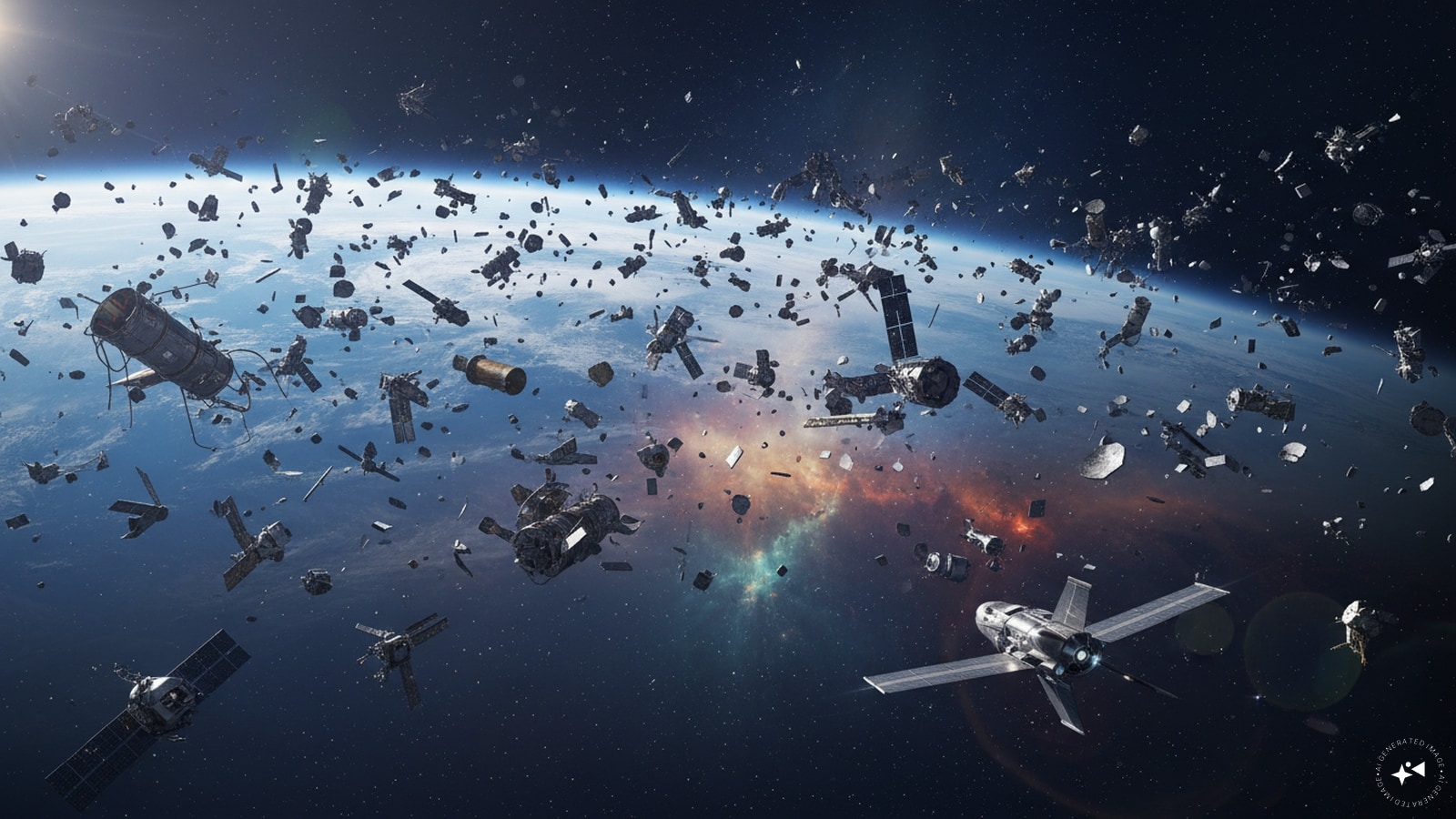
An abandoned SpaceX Falcon 9 upper stage is on a direct collision course with the Moon, scheduled to impact the lunar surface at roughly 2.58 kilometers per second. When this four-ton cylinder of spent metal strikes the dark side of our natural satellite, it will mark the first time in history that a piece of commercial space debris makes unintended, high-velocity contact with another celestial body.
Public fascination immediately latched onto the spectacle. A crashing rocket sounds like science fiction, a dramatic collision etched onto the cratered face of the Moon.
Yet the real story is far more mundane and much more alarming. This impact is not an isolated anomaly. It is the predictable mathematical outcome of an industry operating in a regulatory vacuum, where discarding multi-ton hardware in deep space remains an unchecked side effect of commercial dominance.
The Orbital Dead Zone
To understand how a piece of hardware launched in 2015 ended up crossing paths with the Moon seven years later, we have to look past low Earth orbit. Most people picture space junk as a dense cloud of micro-satellites and paint flecks burning up in the upper atmosphere. That is the low-altitude ecosystem.
Deep space is entirely different.
When a rocket delivers a payload to a high-energy orbit, such as a geostationary transfer orbit or a deep-space Lagrange point mission, the upper stage often retains too much velocity to return safely to Earth. It does not have enough propellant left for a de-orbit burn.
In the case of the 2015 DSCOVR mission—a joint venture between NASA, NOAA, and the United States Air Force to monitor solar weather—the Falcon 9 second stage placed the deep space climate observatory on its intended path. Once the payload separated, the booster was simply left behind. It possessed too much energy to fall back down, but not enough to escape the Earth-Moon gravitational system entirely.
It became a gravitational ghost.
For years, astronomers tracked its chaotic loops. It swung past the Earth, drifted out toward the Moon, looped back around, and slowly lost kinetic stability. Orbital mechanics in the Earth-Moon system are notoriously chaotic. Small gravitational nudges from the Sun compound over time, turning predictable paths into random walks through the solar system.
By late 2020, independent asteroid hunters ran the numbers and realized the trajectory was intersecting with lunar space. By early 2022, the math was definitive. The empty fuel tank was going to hit the Moon.
The Myth of the Void
The standard defense from aerospace executives and defense contractors is simple: space is big. Really big.
Statistically speaking, hitting the Moon is like throwing a dart across a continent and hitting a specific dime. Proponents of rapid commercialization argue that even if a few boosters wander out into cislunar space, the odds of them striking anything important are negligible.
That defense ignores the permanent footprint we are leaving on our celestial neighbor.
The Moon has no atmosphere to burn up incoming debris. Every piece of metal, every fleck of paint, and every drop of residual hydrazine fuel that reaches the lunar surface stays there forever. It becomes part of the regolith.
We are turning a pristine scientific and geological archive into an open-air junkyard.
Worse still, this collision will create a brand-new artificial crater several meters wide, throwing up tons of pulverized rock and dust. While geologists are quietly thrilled at the prospect of using lunar orbiters to analyze the subsurface material exposed by the impact blast, turning a celestial body into an accidental impact laboratory is a terrible precedent.
The Regulatory Black Hole
The root of the problem is not engineering incompetence. SpaceX builds remarkably efficient launch vehicles. The Falcon 9 second stage is designed to do its job, separate, and clear out of the primary payload path.
The failure lies in governance.
International space law is governed primarily by treaties drafted in the late 1960s and 1970s, an era when space was the exclusive playground of two superpowers launching a handful of government-funded missions per year. The Outer Space Treaty of 1967 states that nations retain jurisdiction and control over objects they launch into space, and that they are liable for damage caused by their space objects on Earth or in airspace.
Notice what is missing from that document.
There are no rules governing deep space debris. There are no fines for abandoning a four-ton fuel tank in a chaotic lunar orbit. The Federal Communications Commission and the Federal Aviation Administration regulate orbital debris mitigation for low Earth orbit satellites, requiring operators to de-orbit spacecraft within a specific timeframe after mission completion.
Cislunar space falls through the cracks. It is the Wild West, and commercial operators are rapidly scaling up operations without any legal incentive to clean up after themselves.
As commercial entities plan lunar outposts, resource extraction missions, and permanent infrastructure on the Moon, the traffic in cislunar space is about to multiply exponentially.
The Real Cost of Progress
If we continue to treat deep space as a cosmic garbage dump, the consequences will catch up to us much faster than we think.
Future lunar bases will require precise tracking of every object in orbit to prevent catastrophic impacts with crewed habitats or communication arrays. A stray upper stage hitting a commercial lunar lander at three kilometers per second would instantly vaporize both objects, creating a shrapnel cloud that would render low lunar orbit a lethal hazard zone.
We are currently building the highway system of the inner solar system while refusing to install guardrails or trash cans.
The upcoming impact of the Falcon 9 upper stage should not be viewed as a quirky space fact or an interesting night-sky observation for amateur astronomers. It is an unvarnished warning shot from the cosmos.
The debris we leave behind does not disappear. It just waits for gravity to finish the equation.