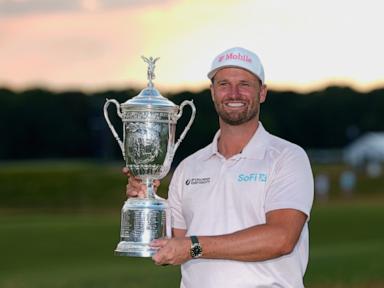
Wyndham Clark won the 126th U.S. Open at Shinnecock Hills by surviving a hostile New York crowd and his own compounding errors to secure a one-shot victory over Sam Burns. Entering Sunday with a massive six-stroke lead, Clark shot a grueling 3-over 73 to finish at 4 under par. He did not coast to victory. Instead, he stared down the barrel of what would have been the most historic collapse in tournament history, ultimately preserving his second major title in four years through sheer psychological endurance.
The story of the 2026 U.S. Open is less about a golfer executing a flawless game plan and more about an athlete absorbing immense psychological punishment. Shinnecock Hills is notoriously brutal, but the gallery on Father's Day was entirely unmerciful.
The Hostile Symphony of Long Island
Major championship leaders usually enjoy a degree of reverence. Wyndham Clark received none.
The crowd openly weaponized their support for Scottie Scheffler, who entered the final pairing chasing a career Grand Slam on his 30th birthday. When Clark flared a drive on the fourth hole, the gallery cheered. When his ball trickled into a greenside bunker on the par-3 seventh, the grandstands erupted in applause. One spectator was forcibly removed after screaming "Don't choke, Wyndham" directly into Clark's backswing on the fourth tee box.
This was sports tribalism at its rawest, fueled by lingering public distaste for Clark’s past emotional outbursts, including an incident at Oakmont where he damaged locker room property after a missed cut.
Navigating that level of active antagonism changes the physiological state of a competitor. Adrenaline spikes. Peripheral vision narrows. Golf requires precise fine motor skills, which are the first things to disintegrate under intense social duress. Clark’s six-shot cushion disintegrated in just five holes, his front-nine 38 opening the door for Sam Burns and Tom Kim.
Anatomy of a Near Collapse
When a leader begins leaking oil early in a final round, the pressure compounds exponentially. The chart below illustrates how the margin of error vanished before the field even reached the turn.
| Competitor | Starting Score | Front Nine Score | Position at Turn |
|---|---|---|---|
| Wyndham Clark | -7 | 38 (+3) | -4 (Leader) |
| Sam Burns | -1 | 33 (-2) | -3 (1 back) |
| Tom Kim | -1 | 34 (-1) | -2 (2 back) |
| Scottie Scheffler | -1 | 36 (E) | -1 (3 back) |
The turning point was not a heroic birdie, but a sequence of defensive par saves. After missing an eight-foot par putt on the 13th, Clark’s lead shrunk back down to a single stroke.
The Defiant Stand on the 16th
The tournament was won in the thick, unforgiving fescue of the par-5 16th hole. Clark struck his worst tee shot of the afternoon, hooking his ball deep into a lie that on-course reporters deemed nearly unplayable.
A lesser mental approach would have yielded a catastrophic double-bogey. Clark chunked his recovery shot cleanly back into the fairway, stuck an 8-iron to the back of the putting surface, and drained a staggering 30-foot birdie putt.
It was a cold, clinical conversion that stunned the gallery into silence.
While Sam Burns put massive pressure on the leader by firing a closing 67, he ultimately failed to convert a crucial 17-foot birdie opportunity on the final green. That left Clark standing over a daunting 52-foot par putt on the 72nd hole. He rolled the first putt to tap-in range, sealing the championship with a final round that tied the highest by a U.S. Open winner since Graeme McDowell in 2010.
Winning when you have your best stuff is easy. Winning when your swing feels alien, the course is baked out, and thousands of fans are actively rooting for your failure requires a grim, unyielding resilience. Clark’s triumph at Shinnecock Hills did not look pretty, but major championship trophies do not feature a space for style points.


