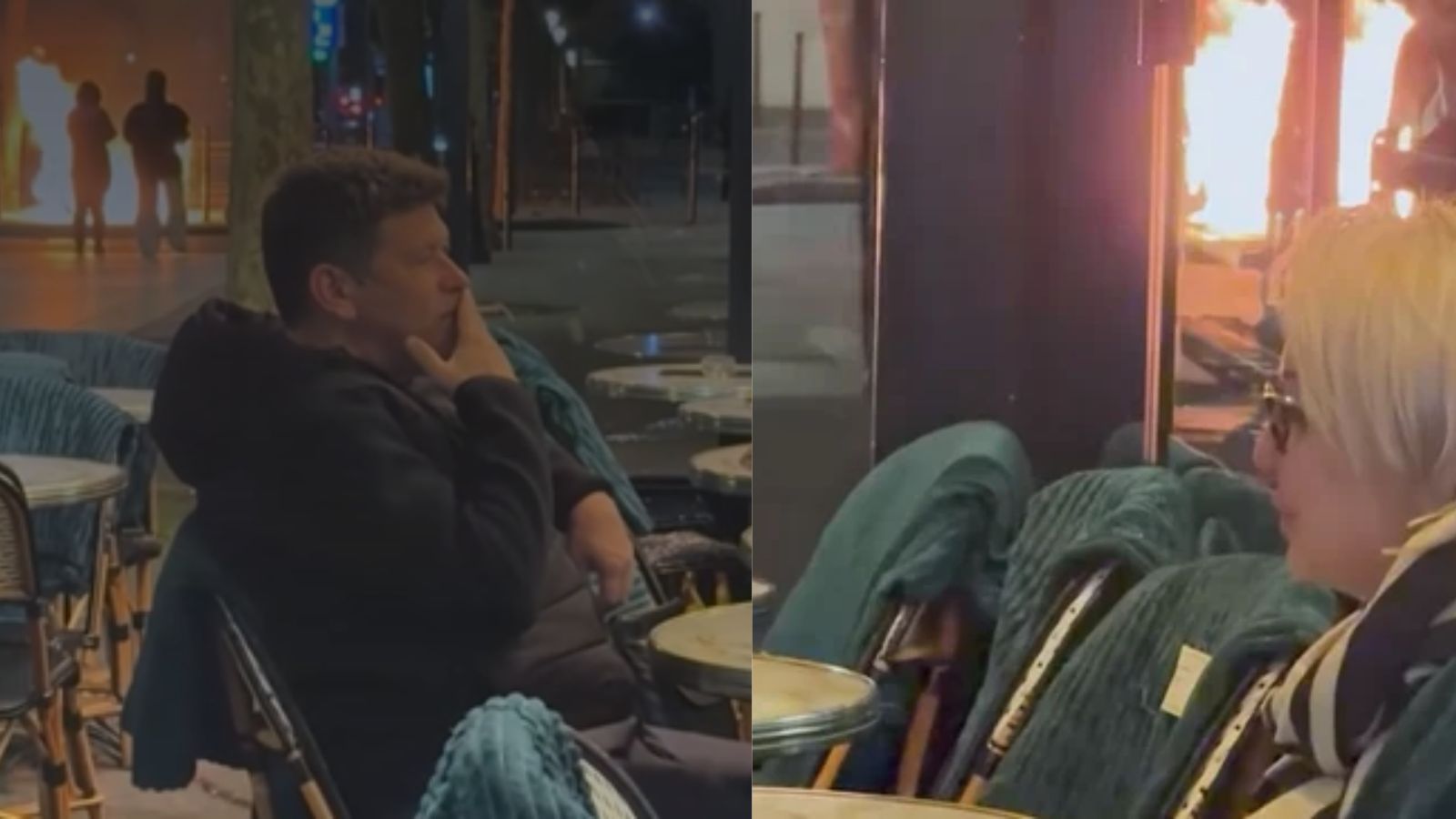
Two people sit at a sidewalk table in Paris. Drinks in hand. A fire blazes a few yards away. Sirens wail. Smoke curls into the air. Millions of people watch the clip, hit replay, and decide they are looking at peak French coolness, supreme stoicism, or uncanny composure.
They aren't. They are looking at an optical illusion wrapped in an algorithm.
The lazy consensus on viral clips like "Paris couple calmly sip drinks as fire burns behind them amid riots" is predictable. Commenters treat the scene like a character study. Either the couple is made of iron, or Paris itself has become so numb to unrest that citizens treat street fires like background weather. Both interpretations are cheap theater. They turn a split-second visual frame into a sweeping moral verdict on human courage and urban life.
I have spent years analyzing how crises play out on the ground and how they get flattened on screens. I have watched brands, media outlets, and analysts burn serious credibility mistaking a frozen camera angle for ground truth. When a clip goes viral, everyone rushes to play psychologist on strangers whose full minute before and after the frame is completely missing.
Let's strip away the memes and look at what actually happens when a sidewalk table sits next to civil unrest.
The Frame Is Not the Whole Room
A ten-second video clip is a keyhole, not a window. A camera lens flattens depth. A fire that looks ten feet behind a glass of wine might be thirty or forty feet down a block, separated by parked vans, street furniture, crowd movement, or a shift in wind direction. Perspective compresses distance. Anyone who has worked around live scenes or incident response knows how badly two-dimensional footage lies about proximity and heat.
Calmness in a viral video rarely proves fearless mastery. Often, it proves proximity lag, sensory overload, or simple spatial awareness.
Consider three very real reasons someone stays seated while chaos erupts nearby:
- Delayed threat perception: Smoke and noise travel fast, yet a person facing away from a flare-up or focused on a conversation may take several seconds to register that a situation has shifted from routine noise to immediate danger.
- Directional shelter: Buildings, corners, and street geometry create pockets where heat and debris feel distant even when camera framing makes the danger look right over someone's shoulder.
- Habitual urban filtering: In dense cities with frequent protests, strikes, and street demonstrations, residents develop a learned baseline for distinguishing theatrical noise, localized clashes, and genuine threat vectors.
None of those explanations makes for a snappy caption. "Person calculates wind direction and waits two seconds before deciding whether to stand up" does not get retweeted forty thousand times. "Unbothered king/queen sipping wine while Paris burns" does.
We confuse stillness with invulnerability. Sometimes stillness is just waiting to see which way the crowd moves.
Why People Ask the Wrong Questions About Viral Riot Clips
Whenever a clip like this circulates, the surrounding search queries follow a predictable script. People want to know if the video is real, whether the couple was acting cool for attention, or what it says about safety in Paris.
Every one of those questions misses the real story.
"Were they just trying to look unbothered for social media?"
Maybe. Performative nonchalance exists in the social media era. People film reactions, hold poses, and curate an image of detachment. Yet assuming every calm face in a crowd is clout-chasing is just the flip side of assuming every calm face is heroic. Without context, assuming vanity is no more rigorous than assuming grit. Most people in public spaces are not starring in a movie; they are reacting to incomplete sensory cues in real time.
"Does this mean Paris is completely desensitized to riots?"
No. Desensitization is a lazy catchphrase that explains too much and proves too little. Cities with long traditions of labor protests, student marches, and political demonstrations have well-worn rhythms of disruption. Locals often know which intersections tend to flare up, how quickly police units clear an avenue, and which side streets stay quiet. Knowing the local rhythm is situational literacy, not emotional deadness.
"Is it safe to sit outside when unrest breaks out nearby?"
No—not as a rule. Even if a specific spot looks quiet for a moment, street unrest is volatile. Crowds surge. Tear gas drifts. Glass breaks. Vehicles move unpredictably. Treating a viral clip as proof that sitting near a fire is harmless is a fast way to get caught off guard when conditions change in ten seconds.
The Psychology Behind Viral Contrast
Why does a calm drink beside a burning barricade hook millions of viewers so fast? Contrast.
Human attention is wired to snap toward contradiction. Fire means danger, urgency, and motion. A glass of wine or coffee means leisure, routine, and stillness. Put them inside the same frame and the brain experiences instant cognitive friction. We try to resolve that friction by inventing a story: How can anyone sit there?
Social media platforms reward that friction. Algorithms do not measure accuracy, context, or nuance. They measure watch time, re-watches, shares, and argument in the replies. A clip that invites half the comment section to applaud "stoicism" and the other half to mock "cluelessness" is engagement gold.
Sociologists and media scholars—from Erving Goffman on how people manage impressions in public settings to media theorists studying how television and digital feeds compress complex events into spectacle—have long pointed out how easily observers misread staged or partial public behavior. Goffman's work on front-stage and back-stage conduct reminds us that a single snapshot of outward composure tells us very little about internal state or situational awareness. When platforms strip away before-and-after context, viewers supply their own melodrama.
Imagine a scenario where a couple sits outside a bistro, a flare or trash fire ignites twenty yards away during a march, someone raises a phone from across the street, and five seconds later the couple checks the crowd and heads inside. The viral clip ends right before they stand up. Millions of people spend the next three days debating their souls based on five missing seconds.
That isn't journalism. It's Rorschach testing with fire.
What Insiders Get Wrong Too
My contrarian pushback has a blind spot if I overcorrect. I have seen analysts get so cynical about viral clips that they dismiss real warning signs on the ground.
Just because social media exaggerates danger in one frame does not mean the street is safe. Just because a bystander looks calm does not mean they are in control. Assuming everyone in a viral video is either a fearless stoic or a calculated poser is another neat box—and neat boxes break in messy real-world environments.
There is also a real cost to taking a contrarian stance on viral spectacles. Readers who want easy outrage or easy applause don't always want depth. Nuance slows people down. It forces them to hold two thoughts at once: the camera angle exaggerates the visual drama, and street unrest still carries real risk. That middle space is harder to sell than a one-line verdict.
Still, accuracy beats applause every time.
A Better Way to Read Viral Crisis Footage
If you care about what is actually happening rather than what strangers in the comments want to believe, change how you watch clips like the Paris cafe scene.
- Look for distance cues, not just facial expressions. Check shadows, crowd spacing, smoke drift, and whether people in the background are running, walking casually, or standing still. Faces lie; spatial relationships tell you more.
- Ask what happened ten seconds before and ten seconds after. Viral edits are curated for maximum tension. Treat the first and last two seconds of any shock clip with skepticism.
- Separate spectacle from risk assessment. A video can be entertaining or surreal to watch while still showing poor situational judgment if someone lingers near volatile street activity.
- Resist turning one frame into a national stereotype. One table on one street in Paris does not explain forty million lives, an entire city, or human nature as a whole.
Next time a video puts a calm drink next to a burning street and crowns someone the patron saint of unbothered cool, don't fall for the framing. Watch the distance, question the edit, and leave your table before the smoke reaches your chair.


