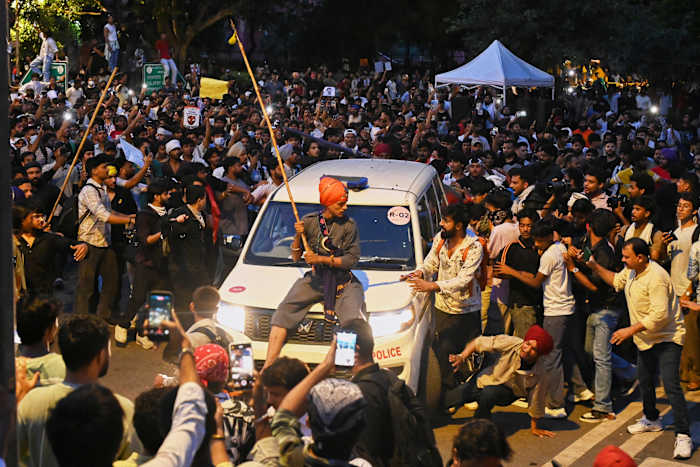
The Illusion of the Capital Siege
Mainstream coverage of street protests in national capitals relies on a tired, predictable formula. Photographers capture police in riot gear, reporters stand before barricades, and editorial boards run frantic op-eds about the erosion of democratic norms or the collapse of public order.
It is a comfortable narrative. It is also entirely wrong.
When demonstrators flood the streets of a capital city to set up long-term sit-ins, the conventional media frame treats the event as a spontaneous, grass-roots eruption of raw public anger meets brutal state oppression. That framing ignores basic political mechanics. Capital sit-ins in major democracies are rarely organic explosions of popular will. They are highly organized, capital-intensive logistical campaigns designed to force media amplification rather than direct government concession.
I have spent two decades analyzing mass mobilization and political bargaining in emerging markets. I have sat in the backrooms where these strategies are mapped out on whiteboards long before the first tent is pitched. The truth that legacy newsrooms refuse to report is simple: the modern capital protest is an optics war, and both the movement leaders and state security forces know the rules of the game far better than the journalists covering them.
The Economics of a Sustained Sit-In
Media outlets routinely describe long-term protest camps as decentralized gatherings of disenfranchised citizens. Look closely at the supply chains required to maintain a multi-week capital blockade.
A sit-in involving thousands of people requires:
- Tons of daily food and clean water delivered through established urban transit corridors.
- Mobile sanitation units and waste management to prevent public health collapses that invite immediate shutdown.
- Legal defense networks and bail funds operating on 24-hour shifts with deep capital reserves.
- Power generation, communication infrastructure, and stage equipment capable of broadcasting daily press briefings.
None of this happens by accident. The romanticized idea of an unorganized, leaderless crowd holding down a government center against state power is a myth.
[Spontaneous Public Anger] ──> Dissipates in 48-72 Hours
[Financed Logistical Network] ──> Occupies Capital for Weeks
When protest movements transition from single-day marches to prolonged capital occupations, they shift from public assembly to siege warfare. The primary objective is no longer to persuade the government; it is to create a perpetual pressure cooker that forces the ruling administration into a political lose-lose choice: tolerate an illegal occupation and look weak, or clear it by force and look autocratic.
Why State Suppression Playbooks Are Intentionally Misread
The standard reporting on police enforcement against capital sit-ins always focuses on the immediate confrontation—the tear gas, the water cannons, the mass arrests. Headlines scream about crackdowns and authoritarian overreach.
This reaction plays directly into the organizers' hand. In modern asymmetric politics, state force is not something protest leaders fear; it is the exact currency they trade in.
The Asymmetric Incentive Structure
| Actor | Primary Goal | Desired Outcome of Escalation |
|---|---|---|
| Protest Organizers | Force international media attention and delegitimize the regime | High-visibility police reaction to create viral footage |
| State Security | Clear public spaces while minimizing political damage | Quiet, incremental fatigue and targeted leader arrests |
| Mainstream Media | Maximize engagement and narrative conflict | Framing the event as a binary moral struggle |
When security forces deploy to clear a capital sit-in, the movement's operational team is not attempting to hold physical ground. They know rubber bullets and riot shields win physical battles every time. Their goal is to maximize the political cost of the clearance.
If the state uses restraint, the occupation expands, paralyzing the capital and signaling government impotence to rival political factions. If the state uses force, the movement captures the moral high ground, triggering international pressure, economic boycotts, and internal political defections.
By portraying police crackdowns purely through the lens of human rights violations without analyzing the tactical traps set by organizers, commentators miss the actual chess game being played. The police are not acting out of unchecked rage; they are executing a calculated risk assessment, usually reacting to a movement that has backed the executive branch into a corner.
The Fallacy of the Mass Movement Narrative
The most pervasive misconception in capital protest reporting is the assumption that the size of a capital sit-in reflects its broad popular support across the entire country.
Capital cities are unique ecosystems. They house the highest concentration of political activists, media operations, non-governmental organizations, and university students. A movement can assemble 50,000 highly motivated demonstrators in the center of a capital while representing a position that is deeply unpopular among the millions of citizens living outside the metropolitan core.
Consider how political leverage actually functions in these scenarios:
- Geographic Concentration: Capital occupations concentrate political pressure at the exact geographic point where international journalists live and work.
- Disproportionate Disruption: A relatively small group of dedicated activists can paralyze an entire national economy by choking key transit arteries surrounding government buildings.
- Media Bias toward Friction: Calm regions of the country supporting the status quo receive zero airtime, while a three-block occupied zone in the capital receives 24/7 live coverage.
This creates a dangerous distortion in democratic politics. When governments yield to capital sit-ins simply to restore physical order, they often end up overriding the democratic choices of the silent majority who expressed their preferences at the ballot box rather than on the pavement.
The Trade-off: Democracy vs. Street Mobility
Sustained capital occupations are not an unmixed good for democratic health. There is a real cost to normalizing street vetoes over legislative processes.
When political factions realize that blocking key intersections in the capital yields faster policy concessions than winning parliamentary elections, the entire democratic framework degrades. Electoral politics gets replaced by a contest of mob logistics: whichever group can raise the capital to keep 20,000 people fed in a public park for a month gets to dictate national policy.
This model is inherently exclusionary. It privileges well-funded political machinery, urban elites, and organized interest groups capable of mobilizing personnel over rural, working-class, or politically unorganized populations who cannot afford to take a month off work to sleep in a tent.
Stripping Away the Romanticism
Stop reading capital protests as morality plays about good versus evil. They are hard-nosed political negotiations conducted through physical occupation and public relations warfare.
The organizers are not martyrs; they are strategists. The state security forces are not comic-book villains; they are bureaucrats managing state stability and legal authority. The public square is not a sacred altar of freedom; it is a tactical battleground where optics matter far more than truth.
Until we start analyzing these movements with the cold, calculating realism they deserve, we will keep falling for the same recycled stories every time a few thousand tents pop up on the streets of a capital city.
Stop analyzing the drama on the street. Follow the logistics, calculate the political trade-offs, and look at who benefits when the cameras stop rolling.