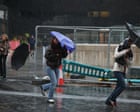
Severe meteorological events like Storm Boelo expose systemic vulnerabilities across UK transport networks, logistics chains, and public safety infrastructure. The operational breakdown triggered by major wind and precipitation storms is rarely the result of a single catastrophic structural point of failure. Instead, infrastructure degradation follows a predictable model of cascading failures where localized environmental stress triggers wide-scale system paralysis.
The Tri-Particle Disruption Model
The operational impact of extreme wind and rain weather systems operates across three distinct operational layers: primary physical obstructions, secondary network throttling, and tertiary administrative cancellation.
1. Primary Physical Obstructions
High velocity wind gusts exceeding 60 mph introduce structural strain on overhead line equipment (OLE) across railway electrification corridors and create severe aerodynamic instability for high-sided road transport vectors. When trees or debris breach rail tracks or highway lanes, capacity drops instantly to zero on the affected segment. Unlike static road closures, rail obstructions create localized blockages that reverberate across entire regional routing networks due to fixed-guideway constraints.
2. Secondary Network Throttling
In anticipation of or response to structural hazards, transit authorities enforce safety-driven operational limits. Speed restrictions (such as imposing 50 mph limits on rail networks designed for 125 mph traffic) reduce network throughput by more than 60%. This throughput drop creates severe time-space congestion: trains consume block sections for longer durations, causing backpressure that delays following units and starves depot management operations of rolling stock.
3. Tertiary Administrative Cancellation
When cumulative delay propagation exceeds actionable recoverability thresholds, operators transition from delayed execution to service cancellation. This shift is driven by strictly regulated crew duty limits, physical displacement of rolling stock, and safety parameters surrounding public gatherings and outdoor event infrastructure.
Structural Vulnerabilities in Fixed-Guideway Transit
The operational resilience of national rail systems depends on two main factors: structural exposure and dynamic rerouting capacity. Overhead line equipment represents an inherent single point of failure. High winds create physical displacement of contact wires, leading to pantograph entanglement and subsequent power loss across entire power supply sections.
[High Wind / Tree Strike]
        │
        ▼
[OLE Entanglement / Power Loss]
        │
        ▼
[Speed Restrictions & Blockage]
        │
        ▼
[Rolling Stock / Crew Misalignment]
        │
        ▼
[Systemic Schedule Collapse]
When an overhead line failure occurs on a primary trunk route, three immediate operational friction points emerge:
- Rolling Stock Misalignment: Trains are trapped in degraded sections, preventing them from completing scheduled return journeys and leaving destination terminals without outbound units.
- Crew Duty Expirations: Train crew members reach their legally mandated maximum shift lengths while waiting for route clearance, rendering units motionless even after physical track clearances are complete.
- Depot Access Starvation: Maintenance facilities lose access to incoming units scheduled for mandatory safety inspections, compounding operational deficits into subsequent operational days.
Economic and Risk Asymmetry in Event Cancellations
The decision to cancel outdoor public gatherings, sporting events, and cultural venues during severe wind and rain events is governed by risk asymmetry. The financial consequences of hosting an event during a severe weather warning involve a complex risk profile:
$$Total\ Expected\ Loss = Direct\ Hazard\ Risk + Liability\ Exposure - Unrecoverable\ Sunk\ Costs$$
Organizers evaluate three operational thresholds when determining whether to proceed or cancel:
- Structural Integrity Threshold: Temporary infrastructure—including staging, marquee structures, perimeter fencing, and scaffolding—possesses strict wind speed tolerance limits. Exceeding design speed tolerances creates immediate structural failure risks to attendees.
- Emergency Service Clearance: Local authorities require verified response access corridors for emergency vehicles. Severe road congestion or flooding renders these access times non-compliant with municipal safety permits.
- Transit Supply Chain Collapse: Even if a venue remains physically intact and safe, the cancellation or severe disruption of public transport removes the access mechanism for attendees and staffing operational baselines, making the event economically and operationally non-viable.
Operational Playbook for Systemic Resilience
Managing high-impact weather events requires moving away from reactive service suspension toward structured operational mitigation.
Transit authorities and logistics operators must implement staged capacity reduction schedules 12 to 24 hours prior to forecasted peak wind gusts. Rather than maintaining normal operations until physical damage forces a halt, operators must pre-emptively reduce timetable density to 50% capacity. This strategy preserves track block margins, reduces the likelihood of trains being stranded between stations, and ensures crew units complete their assigned rotations within regulated working hours.
Logistics networks must establish designated inland holding terminals outside primary coastal high-wind zones to store heavy goods vehicles prior to major bridge and highway closures. Pre-positioning maintenance vehicles and rail clearing crews near high-risk forestry corridors speeds up physical debris removal, shortening the recovery window once wind speeds drop below critical threshold levels.


