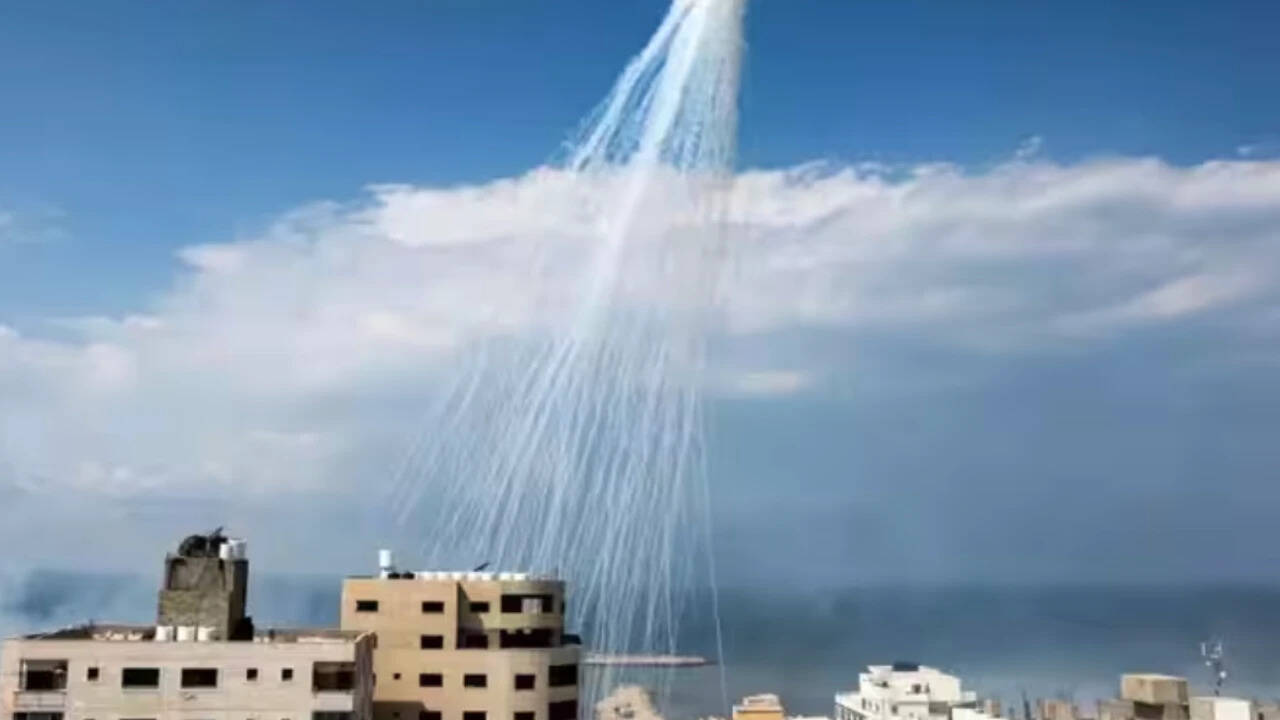
The operational friction between sovereign municipal safety mandates and foreign military base logistics reached a focal point during the chemical incident at Osan Air Base in Pyeongtaek, South Korea. When municipal authorities issued emergency evacuation orders following a reported white phosphorus containment failure originating from munitions, the event exposed the cascading systemic vulnerabilities inherent in high-density urban military operations. Deconstructing this event requires an examination of chemical reactivity profiles, command-and-control discrepancies between allied forces, and the structural metrics governing perimeter security.
The Chemical Vector and Thermodynamic Risk Profile
White phosphorus ($P_4$) is an allotrope of phosphorus widely utilized in military applications for target marking, incendiary effects, and obscurant smoke generation. Its utility stems directly from its thermodynamic properties. The substance is pyrophoric, meaning it undergoes spontaneous exothermic oxidation upon direct contact with atmospheric oxygen at ambient temperatures, producing dense phosphorus pentoxide ($P_4O_{10}$) smoke: Meanwhile, you can explore related events here: Why Every Election in Azad Kashmir is Just High Stakes Theater Nobody Wants to Stop.
$$P_4 + 5O_2 \rightarrow P_4O_{10}$$
This reaction proceeds rapidly, generating temperatures exceeding 800 degrees Celsius. In the context of the Osan incident, municipal reporting indicated that the material leaked from the warhead components of ordnance. To see the complete picture, check out the detailed article by The Guardian.
The hazard matrix of $P_4$ is defined by two primary vectors:
- Thermal and Chemical Burn Kinetics: Liquid or solid particles adhere to organic surfaces, continuing to combust in the presence of oxygen until the fuel source is exhausted or oxygen is excluded via water immersion or airtight sealing. This causes deep dermal necrosis extending to subcutaneous tissue and bone.
- Inhalation Toxicity: The dense aerosolized smoke produced during combustion irritates the upper respiratory tract, pulmonary parenchyma, and mucous membranes. High-concentration exposure leads to pulmonary edema, systemic phosphorus poisoning, and multi-organ failure.
The operational risk is not merely the presence of the chemical, but its kinetic instability during handling, transport, or storage degradation inside maintenance facilities.
The Information Asymmetry and Command Friction Matrix
A structural divergence characterized the response between the municipal government of Pyeongtaek and the United States 51st Fighter Wing command. This divergence highlights a recurring communication bottleneck in Status of Forces Agreement (SOFA) jurisdictions.
When local fire and police authorities received initial reports of a chemical breach at approximately 4:54 p.m., municipal leadership faced an immediate decision threshold under uncertainty. The safety calculus demanded a conservative posture, prompting the issuance of an emergency text alert advising civilians within immediate proximity to evacuate and prevent skin exposure.
Conversely, the military installation's public affairs framework deployed an alternative nomenclature. The 51st Fighter Wing categorized the event as a "ground mishap" necessitating a standard 1,000-foot safety cordon, omitting explicit references to white phosphorus in initial public communications.
This creates a dual-track reporting reality:
- The Municipal Priority: Public life safety, political accountability to civilian constituents, and rapid perimeter isolation via local police deployment.
- The Military Priority: Operational security, minimization of internal panic, and phased hazard assessment governed by internal command protocols.
Resolution of the crisis occurred only after military liaisons clarified to municipal authorities that the leaked material had undergone partial pre-dilution, reducing its immediate volatility. This data transfer permitted the retraction of the evacuation order within roughly one hour of issuance. However, the time lag between the initial breach, the public alert, and the down-scaling of risk highlights a structural friction point in cross-border military-civilian hazard response.
Perimeter Defense Mechanics and Urban Density Vulnerability
Osan Air Base is situated directly adjacent to densely populated sectors of Pyeongtaek, creating an urban-military interface where industrial or munitions accidents instantly intersect civilian infrastructure.
The emergency response required the deployment of municipal fire units and police vehicles to establish physical exclusion zones ranging from 300 to 500 meters from the base perimeter. The physical mechanics of containing a volatile chemical leak in an urbanized zone depend on strict environmental variables:
- Wind Vector Analysis: Atmospheric dispersion of $P_4$ combustion products is dictated by wind speed and thermal inversions. Low-altitude stability can trap aerosols near ground level, expanding the necessary evacuation footprint.
- Hydrological Containment: Because $P_4$ is insoluble in water and sinks, yet reignites upon drying, water application via standard fire suppression must be carefully managed to prevent secondary ignition once moisture evaporates. Decontamination protocols require specialized neutralizing agents or complete oxygen exclusion.
The rapid stabilization of the Pyeongtaek incident avoided a prolonged crisis, but it exposed the fragility of safety margins when hazardous ordnance is managed within municipal footprints. Future risk mitigation relies on real-time telemetry sharing between base safety officers and municipal disaster control centers, bypassing the delays inherent in traditional diplomatic and public affairs clearinghouses.