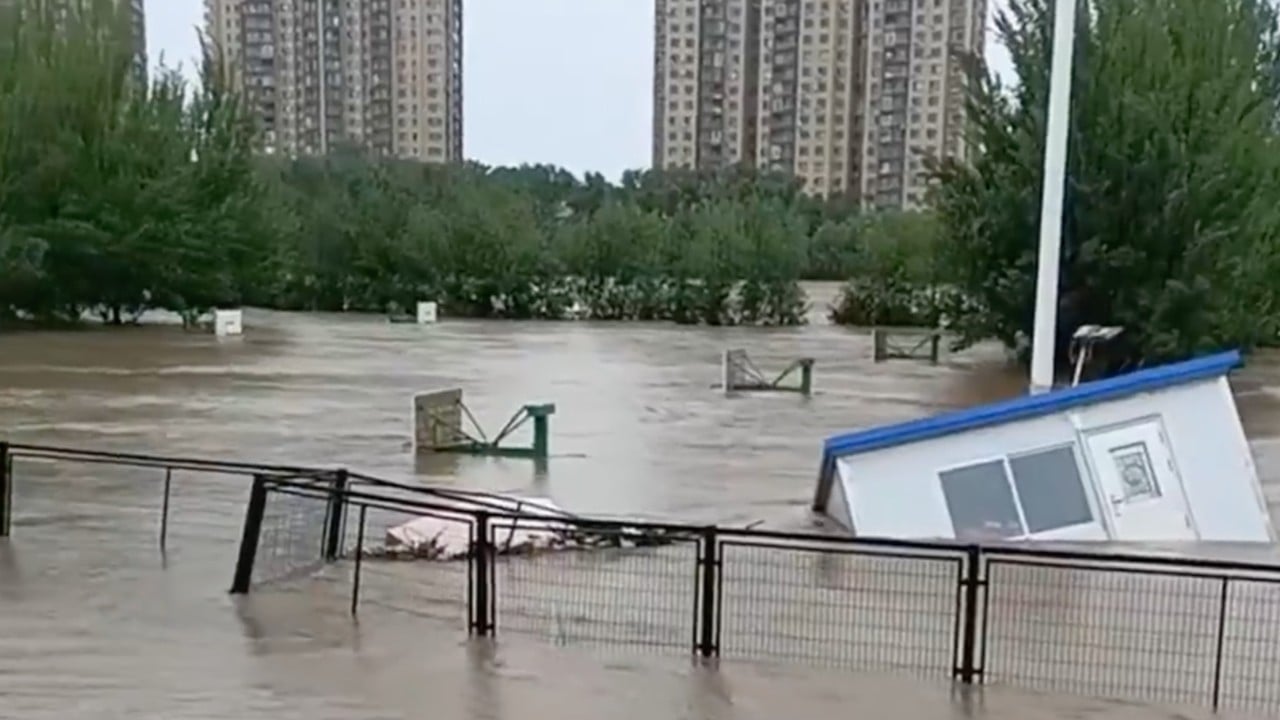
Typhoon Bavi cleared out of northeastern China and left behind the predictable deluge of alarmist headlines. Standard media outlets dusted off their usual script: the climate is broken, the weather is getting unprecedentedly violent, and cities are entirely helpless victims of nature.
This lazy consensus is wrong. It masks a much harsher reality.
The narrative that cities are defenseless against changing meteorological patterns ignores decades of hydraulic engineering data. The issue following typhoons like Bavi is not merely an increase in rainfall volume. The actual crisis lies in the systemic failure of rapid urbanization models that treated natural floodplains as blank real estate canvases. We do not have a weather problem as much as we have an engineering architecture problem.
Mainstream reporting focuses on the sky. We need to look at the concrete.
The Sponge City Illusion
In 2014, China launched its ambitious "Sponge City" initiative. The concept sounded brilliant on paper: transform urban areas into giant sponges using permeable pavements, rain gardens, and green roofs to absorb and reuse rainwater. The state poured billions into pilot cities like Wuhan, Zhengzhou, and Harbin to prove that modern engineering could outsmart seasonal monsoons.
The media bought the marketing hook, line, and sinker. Every time a storm approaches, articles point to these initiatives as the ultimate shield, later feigning shock when downtown districts still end up submerged under four feet of water.
Here is the technical reality they ignore: sponge city infrastructure is rated for ordinary, low-intensity urban runoff. It was never engineered to withstand the concentrated hydraulic head of a category 1 or 2 typhoon. When a system drops several inches of rain in a matter of hours, the topsoil saturates instantly. Permeable concrete becomes completely useless once the local water table rises to meet the surface.
I have analyzed municipal drainage frameworks across East Asia. The hard truth is that green infrastructure cannot compensate for a lack of massive, gray-infrastructure underground retention tunnels. Tokyo understood this decades ago with its G-Cans project—a massive, subterranean cathedral of concrete silos and turbines capable of pumping 200 tons of water per second into the Edo River.
Many rapidly developed cities chose cheap surface modifications over deep, expensive subterranean excavation. They built parks instead of mega-tunnels, then act surprised when the parks turn into lakes and the subways still flood.
The Flawed Premise of Unprecedented Weather
Whenever a storm hits, the media rushes to answer the standard consumer question: "Is this the worst weather on record?"
This is the wrong question to ask. By framing every major storm as an anomalous, once-in-a-century black swan event, municipal planners absolve themselves of accountability.
Let us look at the historical data. The plains of Northern and Eastern China have suffered catastrophic, cyclical flooding for three millennia. The Yellow, Yangtze, and Huai river basins are, by definition, dynamic flood plains. The geographic reality of the region dictates that heavy summer rains will happen.
What has changed is not the fundamental physics of the Western Pacific typhoon track; it is the radical alteration of the topography.
- Wetland Destruction: Over the past forty years, over 60% of the natural coastal and riverine wetlands in major economic zones were paved over to build manufacturing hubs and residential high-rises.
- River Channelization: Rivers were forced into straight, concrete-lined channels. This destroys the natural friction of a winding riverbed, accelerating water velocity downstream and intensifying flash floods.
- Subsidence: Heavy groundwater extraction in major metropolises has caused the land itself to sink, sometimes by several centimeters a year, lowering the baseline defense against sea surges and swollen rivers.
When you build a mega-city on a drained marsh, pave over every square inch of dirt, and constrain the local rivers into concrete gutters, you do not need an "unprecedented" storm to cause a disaster. A completely ordinary, run-of-the-mill seasonal low-pressure system will do the trick perfectly. Stop blaming the clouds for the decisions made by zoning boards.
The Economic Mirage of Disaster Recovery
Mainstream business reporting routinely highlights the massive post-flood rebuilding efforts as a net-positive injection into local GDP. This is a classic manifestation of the broken window fallacy, popularized by classical economist Frédéric Bastiat.
Replacing destroyed subway cars, repaving ruined highways, and restoring flooded electrical grids does not create new wealth. It merely diverts capital from productive innovation and technological upgrades toward maintaining a broken status quo.
I have watched public entities throw hundreds of millions of dollars into rebuilding infrastructure in the exact same flood-prone zones, using the exact same design specifications that failed them weeks prior. It is an economic treadmill.
The standard approach to disaster management is entirely reactive. Money flows only after the disaster occurs, because pointing to a newly rebuilt bridge looks better on a political resume than quietly investing in a deep-bore drainage system that stays hidden fifty meters underground.
Re-engineering the Urban Matrix
If the current strategy is broken, how do we fix it? It requires abandoning the comforting myth that we can seamlessly blend nature into dense urban environments without making structural sacrifices.
First, municipal governments must enforce strict "No-Build" zones on historical alluvial plains, regardless of how valuable that real estate might be for commercial development. If a district has flooded three times in the last century, it should be transitioned into a dedicated, seasonal spillway—not a technology park.
Second, we must pivot capital allocation away from cosmetic surface greening and toward high-capacity mechanical drainage. This means investing in deep-shaft storage systems, heavy-duty industrial pumping stations, and automated tidal barriers. These systems are expensive, disruptive to build, and invisible to the average citizen, but they are the only defense mechanism that actually functions when a typhoon hits.
Finally, supply chains must be decoupled from vulnerable coastal nodes. Relying on highly concentrated manufacturing clusters situated in low-lying delta regions is a systemic vulnerability for global commerce. True resilience means geographic diversification, even if it means sacrificing the immediate cost efficiencies of coastal shipping hubs.
The coverage surrounding storms like Bavi will continue to treat urban flooding as an unavoidable act of God. It is not. It is a predictable consequence of aggressive, short-sighted engineering. Until we stop treating water management as a public relations challenge and start treating it as a raw physics problem, the water will keep winning.
Stop looking at the sky for answers. Fix the concrete.