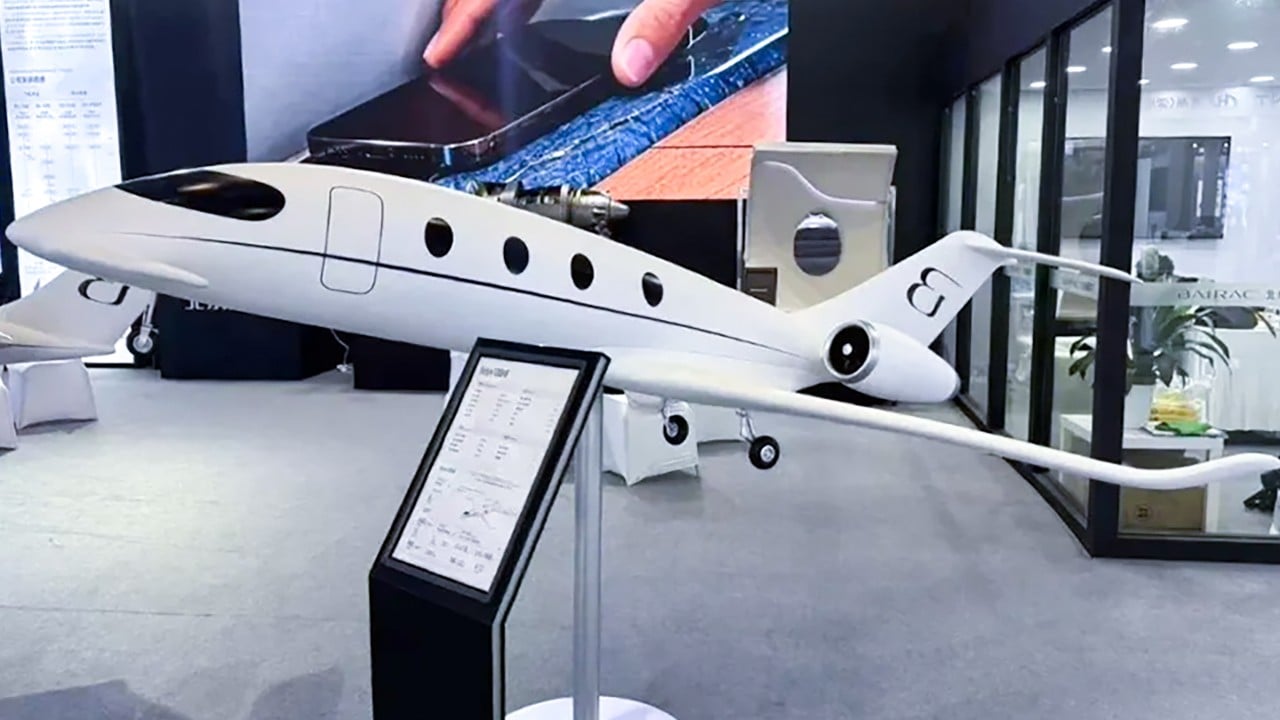
A new wave of Chinese aerospace start-ups is attempting to build the country’s first home-grown, new-energy business jet, aiming to bypass decades of Western dominance in jet propulsion by jumping straight to electric, hybrid-electric, and hydrogen-fueled flight. While state media and venture pitch decks frame these announcements as the aviation equivalent of China’s electric vehicle takeover, the underlying engineering tells a much harder story. Batteries remain far too heavy for executive travel speeds, hydrogen storage devours cabin space, and aviation certification is a slow, unforgiving gauntlet that cannot be rushed with software updates or factory subsidies.
If you have spent enough years watching aerospace start-ups rise and quietly liquidate, you learn to separate the press release from the propulsion math. Every few months, a glossy rendering appears out of Shanghai, Shenzhen, or Chengdu, promising an ultra-quiet, zero-emission executive aircraft capable of whisking twelve passengers across regional corridors at near-transonic speeds. The ambition is real. The capital flowing into China’s low-altitude economy and green aviation sectors is massive. Yet an aircraft is not a sedan with wings, and the unforgiving laws of aerodynamics do not bend for national industrial policy.
The Automotive Playbook Hits a Wall at 40,000 Feet
To understand why these Chinese start-ups are suddenly targeting the business jet sector, you have to look at what happened on the ground over the last decade. China missed the boat on dominating internal combustion engines, so Beijing strategically skipped ahead, pouring state backing and supply chain mastery into lithium-ion batteries and electric drivetrains. Today, Chinese automakers dictate the global pace of electric vehicles.
Now, policymakers and venture capitalists are trying to run the exact same play in the sky. Western aerospace giants like Gulfstream, Bombardier, and Dassault have spent half a century perfecting the high-bypass turbofan business jet, building moats around metallurgy, turbine blade cooling, and global maintenance networks that no newcomer can easily breach. Even COMAC, China’s state-backed commercial aircraft champion, still relies heavily on Western joint ventures for the engines and avionics inside its C919 airliner.
For a hungry Chinese start-up, competing head-to-head with Rolls-Royce or Pratt & Whitney on traditional jet engines is a suicide mission. Developing a new-energy business jet looks like the ultimate flanking maneuver. If you replace kerosene-burning turbines with electric motors, hydrogen fuel cells, or hybrid architectures, you theoretically erase the Western advantage in precision metallurgy. You get to use the battery supply chains, power electronics, and high-torque electric motors already thriving in the Yangtze River Delta.
There is just one problem. A car carries its weight on four rubber tires against solid asphalt. An airplane has to pay an energy tax every single second just to stay suspended in thin air.
The Brutal Math of Energy Density
Aviation lives and dies by a single metric called gravimetric energy density, which measures how much usable energy you can pack into a single kilogram of fuel or battery mass. Jet A-1 aviation kerosene packs roughly 12,000 watt-hours per kilogram. Even the most advanced, commercialized lithium-ion battery packs rolling off Chinese assembly lines today struggle to break 300 watt-hours per kilogram at the pack level.
That is a forty-fold disadvantage before the wheels even leave the tarmac.
When an executive jet burns kerosene, it gets lighter as it flies. A Gulfstream or a Challenger takes off heavy with fuel, climbs efficiently, and lands light, burning progressively less energy per mile as the trip goes on. A battery-powered aircraft takes off heavy and lands at the exact same weight. You have to haul dead lithium across the sky for the entire journey.
Consider a hypothetical example to see how quickly this falls apart. Suppose a start-up wants to build a light business jet capable of carrying eight passengers 1,500 nautical miles—roughly the distance from Beijing to Hong Kong, or Shanghai to Tokyo—at a cruising speed of 450 knots. On standard jet fuel, the fuel load might weigh around 2,500 kilograms. To store the exact same amount of propulsive energy in current-generation batteries, even accounting for the superior efficiency of electric motors over thermal turbines, the battery pack alone would weigh well over 30,000 kilograms. That is heavier than the entire maximum takeoff weight of a mid-size business jet, leaving zero room for wings, fuselage, pilots, or passengers.
This is why every credible aerospace engineer treats pure-electric long-range jets as physical impossibilities with current chemistry. You can build a battery-powered two-seat trainer for forty-minute hops. You can build a four-seat electric air taxi for urban commutes. You cannot build a pure-electric business jet that flies fast and far.
Hybrid Architectures and the Hydrogen Gamble
Because pure batteries hit a brick wall, most Chinese new-energy aviation start-ups quietly pivot to two alternative pathways when pressed by technical reviewers: hybrid-electric propulsion and liquid hydrogen. Both solve some problems while creating entirely new nightmares.
In a hybrid-electric setup, a smaller conventional turbine engine acts as an onboard generator, burning sustainable aviation fuel or standard kerosene to charge a buffer battery pack, which in turn feeds distributed electric fans along the wings. On paper, this looks clever. You can size the turbine for steady cruising rather than peak takeoff power, saving fuel, while using electric motors to blow air over the wings for shorter takeoffs.
In practice, hybrid systems force an aircraft to carry two completely different propulsion systems at the exact same time. You have the weight and maintenance headaches of a gas turbine, plus the heavy copper wiring, thermal management loops, inverters, and batteries of an electric drivetrain. When you add up the mass penalty of carrying both systems, the fuel savings often evaporate.
Hydrogen offers a much better energy-to-weight ratio than batteries—roughly three times higher than jet fuel by mass. Several Chinese aerospace ventures, backed by municipal innovation funds in cities like Hefei and Shenyang, are aggressively testing hydrogen fuel cells and direct hydrogen combustion. Yet hydrogen brings a severe volumetric penalty. Even when chilled to cryogenic temperatures of minus 253 degrees Celsius as a liquid, hydrogen takes up four times more space than kerosene for the same energy output.
A business jet is defined by cabin comfort and sleek aerodynamics. Executives pay tens of millions of dollars to stand up straight, stretch their legs, and arrive quickly. If you stuff massive, heavily insulated cylindrical cryogenic tanks into a business jet fuselage, you either gut the passenger cabin or bloat the airframe into a fat, drag-heavy tube that ruins high-speed cruising efficiency.
The Domestic Supply Chain Mirage
Venture backers in China frequently argue that domestic manufacturing dominance will accelerate timelines in ways Western competitors cannot match. It is true that China controls the lion's share of global lithium processing, rare-earth permanent magnets for high-power electric motors, and carbon-fiber composite production. A start-up in Shenzhen can prototype a custom stator or an inverter housing in three weeks, a process that might take six months through legacy aerospace tiers in Europe or North America.
Speed in prototyping, however, is not the same thing as aerospace-grade reliability.
An automotive inverter that fails on a highway causes a driver to pull over onto the shoulder and call a tow truck. An inverter that experiences a thermal runaway or high-altitude arcing at 35,000 feet causes a hull loss. High-voltage electrical architectures behave differently in the thin, freezing air of the upper atmosphere. Air loses its insulating properties as pressure drops, meaning electrical components rated for 800 or 1,000 volts on the ground can suddenly arc across circuit boards at cruising altitude, incinerating critical flight systems.
Solving high-altitude dielectric breakdown, shielding avionics from intense electromagnetic interference generated by megawatt-class power cables, and preventing lithium battery fires in an unpressurized or pressurized hold require years of destructive testing. You cannot shortcut thermal runaway containment.
The Certification Gauntlet
Even if a Chinese start-up solves the weight, volume, and high-voltage thermal engineering puzzles, it faces a regulatory mountain that has humbled giants. Aircraft do not go to market when the founders feel ready; they go to market when aviation authorities grant a Type Certificate.
Inside China, that authority rests with the Civil Aviation Administration of China (CAAC). Over the past decade, the CAAC has become increasingly sophisticated, aligning its airworthiness standards closely with the US Federal Aviation Administration (FAA) and the European Union Aviation Safety Agency (EASA). While Beijing has fast-tracked certain frameworks for unmanned drones and low-altitude eVTOL aircraft—most notably granting certification to EHang’s autonomous passenger drone—a pressurized, high-speed business jet operating in commercial airspace alongside airliners is an entirely different beast.
There are currently no finalized, globally harmonized airworthiness standards for megawatt-class hydrogen or hybrid-electric transport-category jets. Writing the rules while simultaneously testing the hardware takes years. For the CAAC, approving an unproven propulsion system for passenger transport carries immense political and safety risk. One high-profile crash would set China's entire domestic aviation sector back a decade.
Furthermore, a business jet that can only legally fly inside mainland China has a severely capped commercial market. True business aviation is inherently international. Wealthy buyers and corporate flight departments buy jets to fly from Shanghai to Singapore, Beijing to London, or Shenzhen to Geneva. Without reciprocal validation from the FAA and EASA, a Chinese new-energy business jet remains trapped inside domestic airspace, unable to land at major international hubs with paying passengers aboard. Given current geopolitical friction and trade scrutiny surrounding Chinese green tech, Western aviation regulators are unlikely to rubber-stamp novel Chinese propulsion certifications anytime soon.
Who Actually Buys These Aircraft
Assume, for a moment, that a Chinese start-up beats the odds. Suppose by the early 2030s, they certify a sleek, eight-seat hybrid-electric or hydrogen-powered business jet capable of 1,000-nautical-mile regional hops. Who writes the check?
The traditional business jet buyer is notoriously conservative. Corporations, charter operators, and ultra-high-net-worth individuals care deeply about dispatch reliability, resale value, and global service coverage. If an aircraft breaks down in a secondary airport, the owner wants a technician with a replacement part on site within twelve hours. Legacy manufacturers like Textron, Embraer, and Gulfstream maintain massive global parts warehouses and mobile repair teams to guarantee that uptime. A cash-strapped start-up cannot replicate that physical footprint overnight.
Infrastructure poses an even sharper bottleneck. Business jets thrive because they can fly into thousands of smaller regional airports that commercial airlines ignore. Those regional airfields have kerosene trucks. Almost none of them have megawatt-scale fast-charging grids capable of pumping massive electrical loads into an aircraft during a forty-five-minute turnaround, and even fewer have cryogenic liquid hydrogen refueling bunkers.
Without refueling infrastructure at destination airports, a new-energy business jet becomes a tether-bound novelty, restricted to flying back and forth between two or three specially equipped hubs. That destroys the core value proposition of private aviation, which is point-to-point freedom on demand.
Where the Real Breakthroughs Will Happen
Dismissing the grander claims of zero-emission transcontinental business jets does not mean the engineering effort is wasted. History shows that ambitious aerospace moonshots rarely deliver what their initial press releases promise, yet they routinely spin off technologies that transform adjacent sectors.
The real winners of China’s push into new-energy business aviation will likely not be the companies building full-size executive jets. They will be the component makers and regional utility aircraft developers operating lower and slower.
At lower altitudes and slower speeds—say, turboprop regional commuters carrying nine to nineteen passengers across 300-mile routes—the physics of hybrid-electric and hydrogen fuel cells suddenly become workable. Propeller efficiency is much higher than jet propulsion at moderate speeds, reducing the raw power required to stay aloft. In China’s mountainous western provinces, where building high-speed rail lines through rugged terrain costs billions per mile, small hybrid-electric regional aircraft could genuinely connect isolated cities to major transit hubs.
Meanwhile, the high-power-density electric motors, silicon-carbide inverters, and lightweight composite cooling systems developed for these aviation start-ups will filter straight back into China’s automotive, marine, and industrial robotics sectors. Even if the sleek executive jet never carries a single billionaire across the South China Sea, the intellectual property generated in the attempt will strengthen China's broader industrial base.
Watching start-ups promise clean, quiet executive jets is seductive because it mirrors a technological transition we have already seen happen on our streets. Yet the sky exacts a far heavier price for every kilogram carried and every knot of speed demanded. Until battery chemistry undergoes a generational leap or cryogenic hydrogen infrastructure becomes as common as concrete runways, the home-grown new-energy business jet will remain far easier to render on a computer screen than to lift off a tarmac.