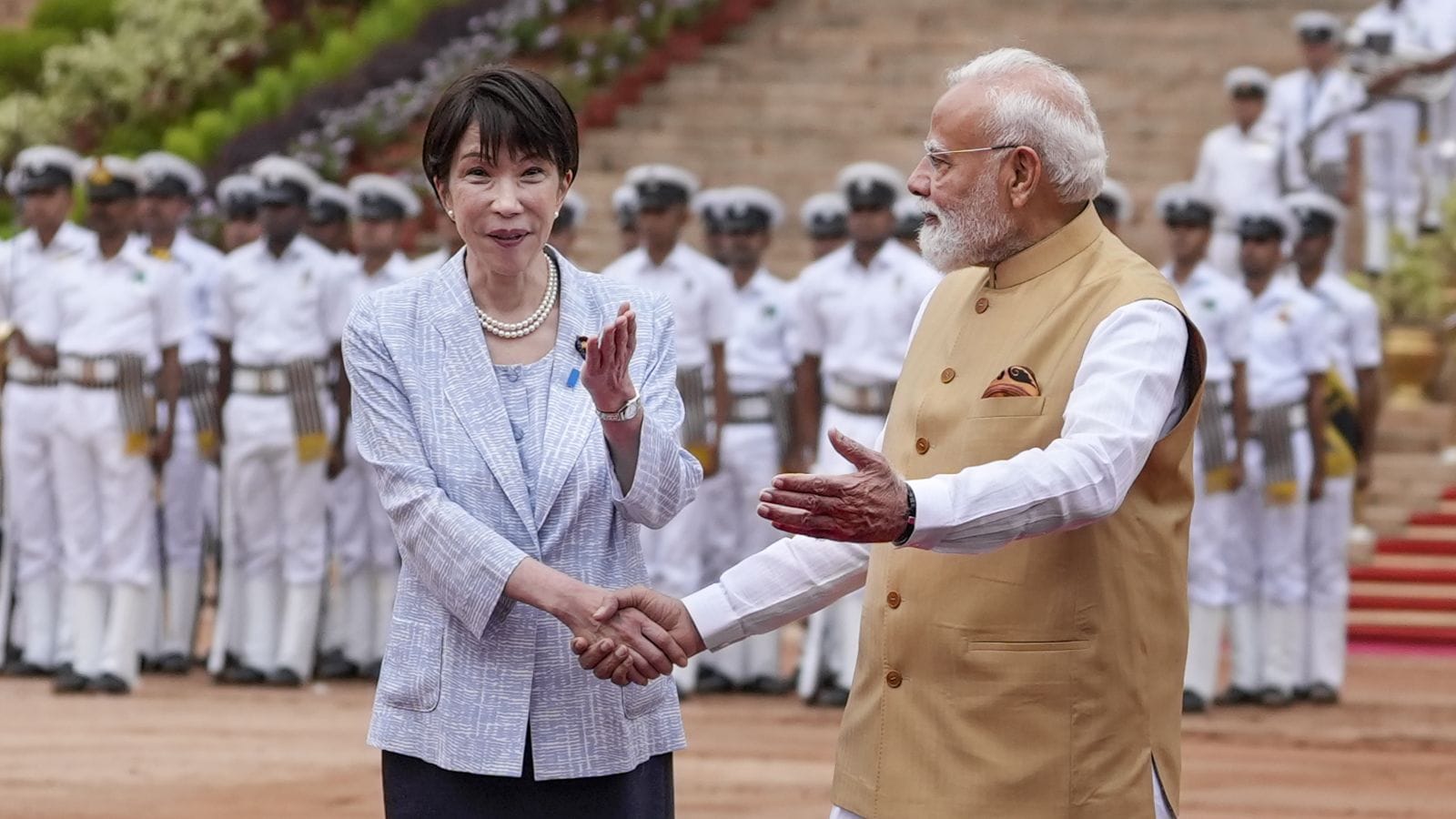
Beijing is getting anxious about Asian alliances, and it shows. When Indian Prime Minister Narendra Modi welcomed Japanese Prime Minister Sanae Takaichi to New Delhi for the 16th India-Japan Annual Summit, the response from China was as swift as it was predictable. Chinese Foreign Ministry spokesperson Guo Jiakun issued a sharp warning against building exclusive small groupings and stoking regional division.
But let's look past the diplomatic jargon. China's predictable outcry about exclusive cliques reveals a deeper reality. Beijing isn't just worried about military encirclement anymore. It's terrified of an economic decoupling that chips away at its dominance over global supply chains.
The three-day summit between Modi and Takaichi wasn't just a routine diplomatic meet-and-greet. It resulted in a massive 10 trillion yen investment roadmap over the next decade, key defence pacts, and a targeted strategy to secure critical minerals. For China, which controls roughly 70 percent of global rare earth mining and 90 percent of its processing, this partnership strikes right at its geopolitical leverage.
The Takaichi Factor and the New Delhi Dynamic
You can't understand Beijing's irritation without understanding who Sanae Takaichi is. A known protégé of the late Abe Shinzo, Takaichi brings a notably hawkish stance to Tokyo's foreign policy. Relations between Beijing and Tokyo have already hit a rough patch following her direct assertions that Japan would respond if China launched a military assault on Taiwan.
When she landed in India, Beijing's radar went into overdrive. Modi explicitly welcomed Takaichi, calling her his younger sister and reinforcing a deeply personal brother-sister bond that mirrors the close ties he once shared with Abe.
That personal chemistry translates directly into aggressive economic policy. The leaders signed a significant economic partnership framework alongside a defence pact to co-develop military hardware, starting with the Naval Radio Antenna Unicorn project.
The joint statement also didn't mince words, expressing serious concern over the security environment in both the East and South China Seas. They explicitly opposed unilateral attempts to change the status quo by force. For a Chinese leadership used to treating these waters as its backyard, that language was a direct challenge.
Weaponized Economies and the Critical Minerals Battle
The real battleground right now isn't naval coordinates; it's the technology supply chain. During the summit, Takaichi openly warned about the weaponization of the economy and non-market policies—a clear nod toward China's recent trade maneuvers.
Just days before the summit, China's Commerce Ministry placed 20 Japanese entities on an export blacklist, claiming they helped boost Tokyo's military capacity. Tokyo called the move unacceptable. This followed previous Chinese restrictions on rare earth exports to Japan, the US, and India.
Instead of backing down, India and Japan are moving to bypass Chinese leverage entirely. The core of the Modi-Takaichi roadmap centers on economic security. They are building a resilient supply chain network across semiconductors, quantum technology, and critical minerals.
- The Silicon Strategy: Merging Japan's precision hardware engineering with India's massive software talent pool to build independent AI and chip ecosystems.
- Energy Buffers: Japan is offering technical and financial backup to expand India's strategic petroleum reserves, helping protect New Delhi from sudden energy shocks.
- Manufacturing Shift: Spurring corporate Japan to actively shift manufacturing capital out of China and directly into Indian industrial corridors.
A prime example of this shifting capital happened right during the visit, as the two leaders jointly inaugurated Maruti Suzuki's expansive new manufacturing facility in Kharkhoda, Haryana. This isn't abstract diplomacy. It's real-world infrastructure built to run without Beijing's input.
Why Beijing's Exclusive Clique Narrative Fails
China wants the world to believe that India and Japan are forming a dangerous, closed-off military bloc. Guo Jiakun asserted that international partnerships should not target any third party or harm their interests.
But look at what actually happened in New Delhi. The agreements signed focus heavily on commercial expansion, green energy, and public health. The two nations launched an India-Japan bio-gas initiative to construct 1,000 bio-gas and organic fertilizer plants across India. They signed agreements on pharmaceuticals, biotechnology, and medical devices aimed at lowering the cost of global healthcare.
This isn't a secretive military alliance. It's defensive economic diversification. For years, global companies tolerated the risks of centralization because China was the cheapest factory floor on earth. Now, the risk of sudden export bans or political blacklisting makes that centralization a liability. India and Japan are simply building an alternative.
Practical Next Steps for Regional Businesses
The geopolitical friction between Beijing, New Delhi, and Tokyo means supply chain managers cannot afford a wait-and-see approach. If your operations rely on critical minerals, electronics manufacturing, or sub-assembly parts from East Asia, change is coming fast.
First, audit your component origins immediately. Figure out exactly how much of your secondary and tertiary supply chain relies on the 20 blacklisted Japanese firms or Chinese rare earth processors.
Second, look closely at the incentives pouring into India's manufacturing sector. With Japan pledging 10 trillion yen in investments and aiming to double the number of Japanese companies operating in India, the financial runway for setting up operations in Indian industrial zones is becoming highly subsidized. Diversifying production lines to places like Haryana or Gujarat isn't just a political statement anymore; it's becoming a fiscal necessity to shield your business from the next round of export restrictions.


