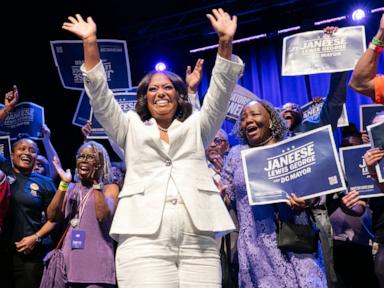
Janeese Lewis George secured a historic victory in the Democratic mayoral primary in Washington, D.C., effectively guaranteeing her position as the next leader of the nation's capital. Her top opponent, Kenyan McDuffie, conceded after Lewis George captured 52.9% of the vote in the city's first-ever ranked-choice election. This win signals a fundamental realignment for a city long governed by business-friendly centrism. It is a direct reaction to a brutal economic contraction forced by federal job cuts and an internal affordability crisis that has alienated working-class residents.
The vote count took days to finalize, drawing heavy criticism from local organizers. Yet the outcome was clear enough before the final tallies dropped. Lewis George swept seven of the city's eight wards, failing only in the wealthiest and whitest precincts of Ward 3. Her victory reveals a deeply fractured electorate where young, working-class, and non-white voters banded together to reject the establishment status quo left behind by outgoing Mayor Muriel Bowser.
The Economic Ghost Town Driving the Radical Shift
The capital faces an existential fiscal crisis. Mass layoffs from the federal government, driven by aggressive slashing from the Trump administration and its efficiency initiatives, have hollowed out the local economy. For decades, the federal workforce acted as a stabilizing cushion for the District, insulating it from the worst macroeconomic shocks felt by the rest of the country. That cushion is gone. Tens of thousands of jobs vanished over the last year alone, causing empty commercial offices to litter the downtown core and driving local unemployment to some of the highest levels seen nationwide.
Working-class families bore the brunt of this sudden collapse. When the federal payroll shrunk, the service industries, local restaurants, and municipal contractors that relied on commuter foot traffic felt the immediate impact. Lewis George built her campaign directly on this pain, presenting a platform that promises massive public intervention where the market has failed. She championed universal childcare subsidies, an aggressive expansion of social housing models, and free transit options for residents.
Centrists argued these proposals were financially impossible for a city facing a shrinking tax base. They pointed to the ballooning municipal budget, which expanded from $13 billion to $22 billion over the past decade, arguing that further social expenditures would trigger capital flight. Lewis George rejected this orthodoxy entirely. Her strategy hinges on aggressively taxing residents earning above $250,000, gambling that the city's wealthiest can absorb the burden of funding a reconstructed safety net.
The Collapse of the Centrist Coalition
The establishment failed to read the room. Kenyan McDuffie ran a traditional campaign focused heavily on commercial development, public safety, and fiscal restraint, aligning himself with the legacy of Mayor Muriel Bowser. Bowser opted not to seek reelection after three terms, leaving behind a legacy marked by intense gentrification and growing friction with the progressive wing of the city council. McDuffie attempted to position himself as the pragmatic adult in the room, claiming he possessed the administrative experience required to manage a city under federal duress.
That pitch fell flat across almost every demographic. A detailed analysis of the precinct data shows that McDuffie only found success among older, wealthier voters who have managed to insulate themselves from the housing crisis. In precincts where the median income exceeded $150,000, his margins were competitive, but he was utterly crushed in younger neighborhoods and working-class strongholds. Lewis George won voters under thirty-five by immense margins, demonstrating that the demographic future of the city has completely broken away from the old guard.
Affordability proved to be the ultimate wedge issue. Over the last decade, skyrocketing rents and aggressive luxury redevelopments forced thousands of native Washingtonians out of their historic neighborhoods. Lewis George understood this dynamic on a personal level, frequently recounting how her own family was displaced from her childhood home due to a sudden rent hike. This narrative resonated deeply with a population that felt invisible to a city hall focused on corporate tax incentives and downtown developer profits.
The Union Machine and the Ethics Fight
This victory was not an accident of shifting sentiment. It was engineered by an aggressive, highly organized ground game led by local labor unions and the Metro D.C. chapter of the Democratic Socialists of America. While McDuffie relied on traditional donors and political action committees, Lewis George mobilized an army of door-knockers who saturated working-class apartment complexes and targeted underrepresented precincts. This institutional backing allowed her to become the first candidate to maximize matching funds under the city's public financing system.
The alliance with organized labor did not come without significant political costs. Days before the primary concluded, the Office of Campaign Finance issued a finding that Lewis George’s campaign had engaged in improper coordination with labor unions and an independent expenditure committee. The establishment attempted to use this finding as a late-stage weapon to derail her momentum, framing her as an untrustworthy actor who violated the spirit of campaign finance reform.
She pushed back aggressively against the charges. Lewis George dismissed the regulatory findings as a politically motivated hit job designed by establishment insiders desperate to protect their grip on power. Voters ultimately agreed, viewing the scandal as a minor procedural dispute rather than a disqualifying ethical breach. The controversy actually served to solidify her image as an outsider fighting against a desperate political machine willing to use every institutional lever to survive.
The Looming Federal Standoff
The real test for the presumptive mayor will not come from local council opponents. It will come from the White House. Days before the primary concluded, President Donald Trump inserted himself directly into the local race, threatening to strip the District of its home rule and launch a full federal takeover of the city administration if a democratic socialist took office. The administration has already demonstrated its willingness to override local authority, deploying National Guard forces and executing aggressive immigration sweeps within city limits over the past year.
The legal mechanics of a complete federal takeover remain highly contested. The federal government possesses extraordinary constitutional authority over the District of Columbia, meaning a hostile administration could easily choke off local operations. The federal government underwrites roughly twenty-five percent of the city's annual operating budget, giving the White House an immense financial lever to punish a non-compliant local administration.
Lewis George has promised total resistance to federal overreach. She vowed to end all local police cooperation with federal immigration authorities and stated she would openly defy executive attempts to dictate municipal policy. This sets the stage for a constitutional crisis that could paralyze the city's daily operations. If the federal government freezes funding or attempts to dismantle local boards, the city could find itself unable to pay municipal workers or maintain basic infrastructure.
The incoming mayor is gambling that the political cost of a federal intervention will be too high for the White House to bear. Taking over the daily administration of a major American city is a logistical nightmare that requires managing public schools, sanitation, and local emergency services. By electing Lewis George, Washington voters chose a leader who is explicitly willing to risk that confrontation rather than continue the policy of appeasement that defined the final years of the Bowser administration. The city has chosen a path of open defiance, and the consequences of that choice will shape the capital for decades to come.


