The mud in northeastern Poland does not care about geopolitics. It is a thick, gray paste that sucks at the boots of soldiers and clogs the treads of diesel-chugging tanks. In November, when the mist rolls in from the Baltic, visibility drops to zero, and the pine forests feel ancient, heavy, and quiet.
But lately, that quiet is broken by a strange, high-pitched whir. It is the sound of electricity meeting the wilderness.
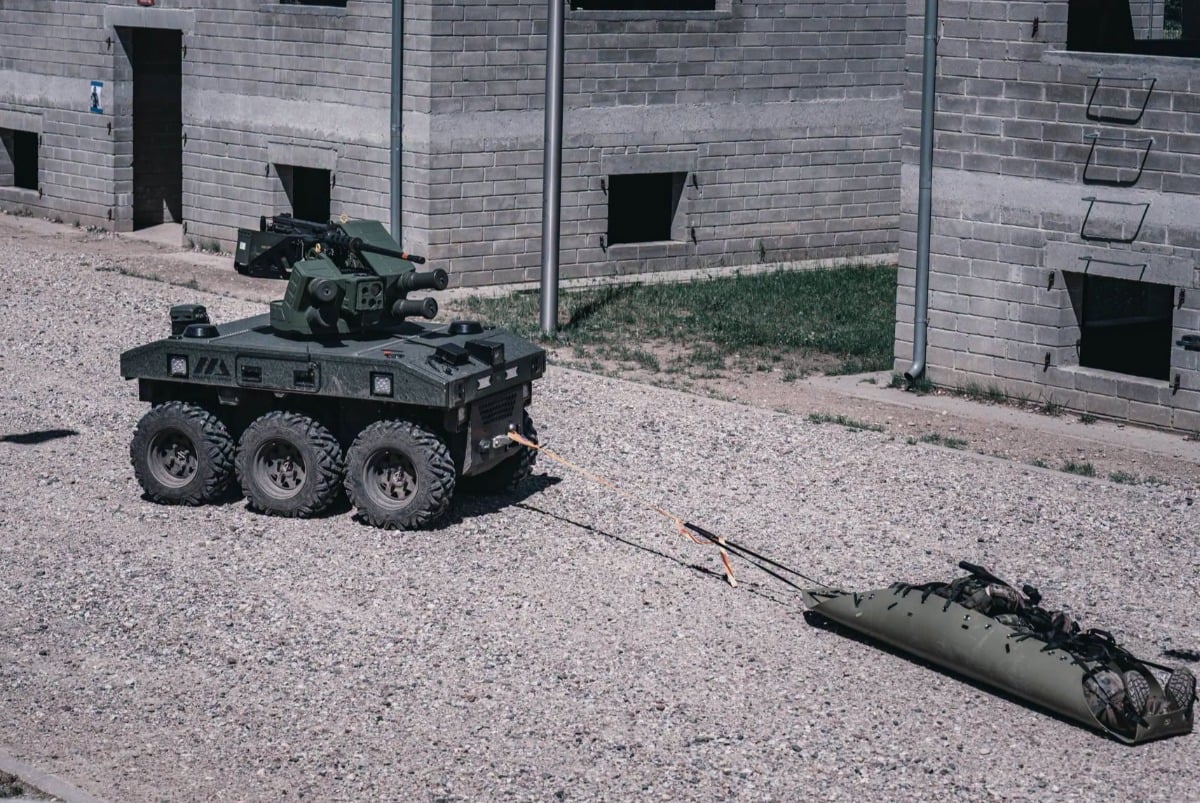
If you look through the trees, you might spot them. Four-wheeled, metallic beasts, low to the ground, painted in matte drab green. They do not pant. They do not get tired. They carry machine guns and anti-tank missiles across terrain that would break a human ankle in minutes.
These are Poland’s combat robots, and they are learning how to fight for a strip of land that keeps NATO strategists awake at night.
Sixty-Five Miles of Panic
To understand why a nation is putting its faith in remote-controlled steel, you have to look at a map. Find the border where Poland meets Lithuania. It is a narrow bottleneck, just sixty-five miles wide. To the northwest lies Kaliningrad, a heavily armed Russian enclave. To the southeast lies Belarus, a staunch Russian ally.
This is the Suwałki Gap.
If a conflict ever breaks out, this tiny corridor is the bullseye. If an adversary chokes off this gap, the Baltic states—Estonia, Latvia, and Lithuania—are physically cut off from the rest of Europe. No trucks. No reinforcement tanks. Nothing.
For decades, the plan to defend this land relied on blood and iron. Human soldiers would have to dig into the freezing earth, waiting for an onslaught of armor. But the nature of war shifted while we weren't looking. Today, the sky over Ukraine screams with the buzz of FPV drones. Artillery can pinpoint a single huddle of soldiers from miles away just by tracking their thermal signatures or cell phone signals.
Being a flesh-and-blood soldier in an open field has never been more terrifying.
That is the problem driving Poland’s defense engineers. How do you hold a choke point when staying in one place is a death sentence?
The Birth of the Perun
Enter the Perun. Named after the ancient Slavic god of thunder, this four-wheeled Unmanned Ground Vehicle (UGV) is the centerpiece of Poland’s new defensive strategy.
It is not an autonomous killer from a sci-fi movie. It does not think. Instead, it acts as a force multiplier, operated by a soldier sitting half a mile away inside an armored vehicle or a hidden bunker, looking at a screen.
Consider a hypothetical scenario on a foggy morning in the Gap. A reconnaissance team spots an advancing column of enemy armored vehicles. In the old days, a human anti-tank team would have to crawl through the brush, aim a heavy missile launcher, fire, and immediately run for their lives before the return fire obliterated their position.
Now, they send the Perun.
The machine weighs roughly a ton. It creeps through the brush silently, its electric motors emitting barely any heat. To an enemy’s thermal cameras, it looks like a boulder or a stray patch of warm earth. It positions itself. The operator, safe behind layers of concrete, locks onto the target.
A flash. A roar. The missile is gone.
By the time the enemy forces fire back at the launch site, they are blowing up a frame of steel and rubber. The human operators are already setting up their next trap somewhere else.
The math is brutal, but simple. Steel is cheap. Metal can be replaced in a factory. A twenty-year-old soldier cannot.
The Invisible Stakes
It is easy to get caught up in the technical specifications—the range of the optical sensors, the caliber of the remote weapon station, the battery life in sub-zero temperatures. But the real story here isn't about engineering. It’s about human psychology.
Imagine being a nineteen-year-old conscript or a young officer stationed near Suwałki. You know the geography. You know that if the whistles blow, you are the speed bump meant to slow down an army until the rest of the alliance can mobilize. Every letter you write home, every night spent shivering in a trench, carries that weight.
The introduction of combat robots changes the emotional calculus of the front line.
When soldiers train alongside these machines, something shifts. They stop seeing themselves as targets. They start seeing themselves as pack masters. The robot takes the vanguard. It enters the dangerous intersection first. It draws the sniper’s fire. It tests the minefield.
During recent exercises in the dense Polish forests, units integrated these UGVs into standard infantry platoons. The results were telling. The physical strain on the human soldiers dropped significantly when the machines carried the heavy ammunition and supplies. But more importantly, the tactical confidence of the unit skyrocketed. They could take ground faster because they weren't sending human scouts into the blind spots.
The Friction of Reality
Yet, anyone who has ever worked with technology knows it possesses a unique ability to fail at the worst possible moment.
The forest is a hostile environment for electronics. Water seeps into seals. Thick mud wraps around axles, creating massive mechanical drag. Dense pine needles can muffle radio signals, threatening the vital link between the operator and the machine. If an enemy deploys heavy electronic warfare jamming, a million-dollar combat robot can instantly turn into a very expensive, motionless lawn ornament.
Polish commanders are open about these vulnerabilities. They aren't treating these robots as a magic wand that solves the riddle of modern warfare. They know the limitations.
That is why the training happening right now in the Suwałki region is so grueling. They aren't testing the robots on flat asphalt or inside clean hangars. They are driving them through deep swamps, forcing operators to guide them through electronic jamming environments, and seeing what happens when a tree branch jams the camera lens.
They are learning that the machine is only as good as the human adaptability behind it. If the link goes down, the soldier still needs to know how to pick up a rifle and fight the old-fashioned way.
A New Line in the Mud
The era of massed armies clashing in grand, predictable maneuvers is fading into history. The future belongs to the small, the dispersed, and the automated.
As autumn turns to winter in the northeast, the mud will freeze into iron ruts. The wind off the border will sharpen. Human sentries will stamp their feet against the cold, their breath blooming in white plumes under the gray sky.
Beside them, the silent green machines will sit waiting, their optical lenses staring unblinkingly into the tree line, ready to take the hit that was meant for someone's child.