The water does not taste like the sea. It tastes like hardware. It tastes like chlorine, engineered clarity, and the relentless hum of commercial filtration systems designed to keep invisible decay at bay.
To stand at the glass of a major metropolitan aquarium is to bear witness to an extraordinary human paradox. We build these cathedrals of blue light because we are desperate to touch the wild, to look an apex predator in the eye and feel the sovereign pulse of something larger than ourselves. Yet the moment we bring that wildness inside our walls, we domesticate its tragedy.
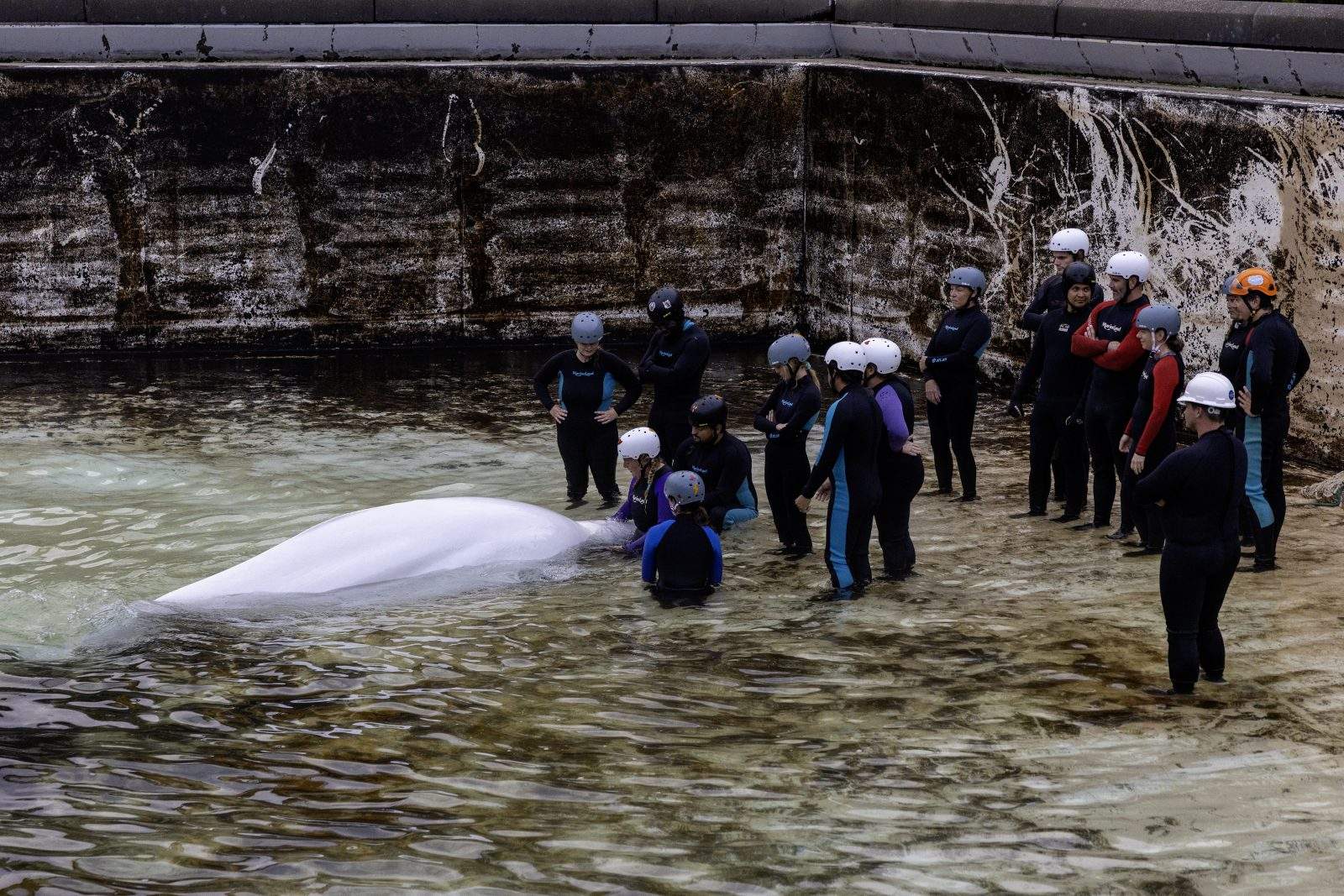
Another life has ended behind the glass. Chicago’s Shedd Aquarium lost another Marineland whale, a quiet punctuation mark in a long, unbroken sentence of loss that stretches across decades. The headlines will come and go. The official statements will speak of advanced age, specialized veterinary care, and the deep sadness felt by the training staff who fed fish from frozen buckets every morning at dawn. But the headlines miss the texture of the life. They miss the silence that follows the splash.
The Geometry of Concrete
Imagine a creature whose evolutionary lineage spans millions of years, an animal designed to map an infinite, three-dimensional acoustic universe through echolocation. Now, place that creature in a circular white enclosure where every sound it emits bounces back as a chaotic, disorienting echo of synthetic boundaries.
Cetaceans do not merely swim. They travel. In the open ocean, pods cover vast aquatic territories, guided by complex dialects, cultural traditions passed down through generations, and the shifting temperature of ocean currents. They dive deep into twilight zones where the pressure alters and the world goes black.
Inside an aquarium, the deep ocean is reduced to a chlorinated stage.
When researchers study the psychological toll of captivity, they do not just look at physical illness. They look at the architecture of boredom and sensory deprivation. Without the infinite horizon, behavior changes. Repetitive motions take root. The spark in the eye dims. We call it adaptation, but anyone who has stood before a glass wall long enough after closing time knows what it really is: endurance.
The Cost of Proximity
Why do we keep them?
It is the central question of our relationship with the non-human world. We tell ourselves stories about education. We argue that children who gaze upon a living whale or dolphin will grow up to be fierce defenders of the oceans. We believe that proximity breeds empathy.
(Note: When psychologists evaluate public engagement at marine parks, they find that while initial awe is high, the educational retention is often fleeting, overshadowed by the spectacle of entertainment.)
There is a profound dissonance in learning to love an animal by watching it confined. We trade the reality of their freedom for the convenience of our curiosity. We want the magic of the ocean delivered to our downtown waterfronts, packaged with gift shops and snack bars, wrapped in the comforting illusion that we are participating in conservation.
Yet, every time a whale breathes its last breath in a tank, the illusion shudders. We are forced to look past the training smiles and the synchronized leaps to confront the raw arithmetic of containment. No matter how pristine the water, no matter how attentive the veterinarians, a concrete pool remains a prison.
The Anatomy of Grief
Grief in the non-human world is a subject science is only beginning to map, though we have watched mothers carry their dead calves for days across open bays. We know these animals possess emotional lives as complex and fragile as our own. They form deep, lifelong bonds. They mourn.
When a companion dies in a facility, the remaining animals notice. Their vocalizations shift. Their routines alter. They search corners of the enclosure that suddenly feel emptier.
We rarely talk about the grief of the handlers, either. Many enter these fields driven by a genuine, fierce love for marine life. They spend years learning individual preferences, personalities, and quirks. They form an intimate, tactile bond with creatures that weigh thousands of pounds. To watch them stand on the platform during a veterinary necropsy is to see a strange intersection of professional duty and private heartbreak. They are mourning something they swore to protect, even as the system they serve continues the cycle.
Looking Beyond the Tank
The conversation around marine mammals in captivity has shifted from the fringes to the mainstream. Public sentiment has turned. Legislative walls are closing in around the practice of capturing and breeding cetaceans for public display. Facilities are grappling with an existential crisis: how to transition an aging infrastructure designed for spectacle into something else entirely.
Some point toward sea sanctuaries—coastal bays netted off from the open ocean, where former captives can feel the pull of real tides, hear the natural sounds of the sea, and live out their remaining years with dignity. It is not a complete restoration of the wild, but it is a vast, merciful mercy compared to the sterile geometry of concrete.
The death of another whale at Shedd is not just a news item. It is a mirror. It forces us to ask what price we are willing to extract from other sentient beings for the sake of our own wonder.
The tanks remain. The water is filtered. The tourists will line up tomorrow morning, buying tickets, pressing their palms against the glass, looking for a connection that can never truly be made across that divide.
Outside, Lake Michigan stretches away to the horizon, grey and cold and indifferent to our architecture. Beneath its surface, life moves with a wild, untamed grace that no concrete wall can ever hold. We would do well to remember what it looks like from a distance.