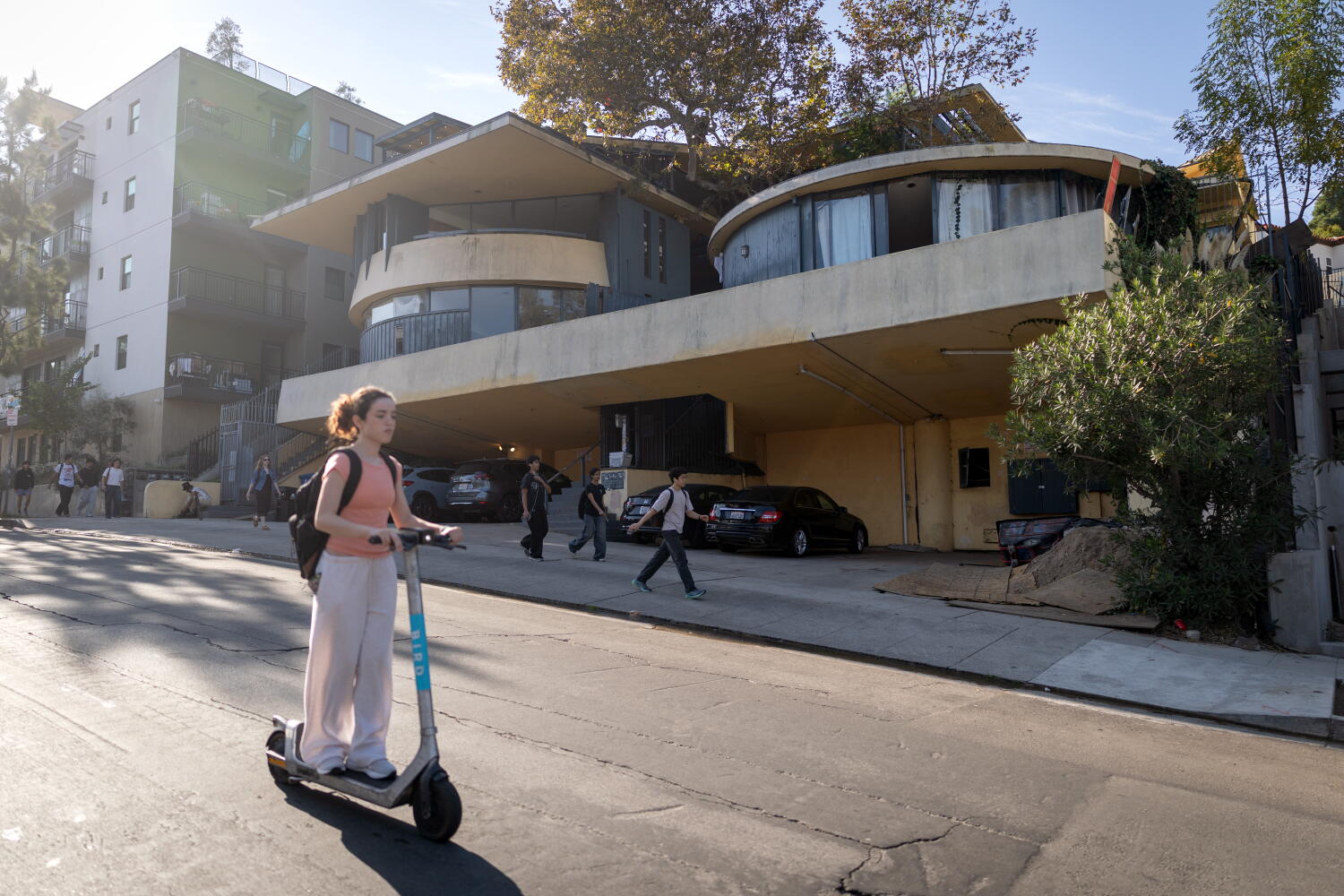
Bass rattles the glass.
Outside on Levering Avenue, the air smells like damp eucalyptus, cheap lager, and late-night taco trucks, while inside the jagged, brutalist fortress on the corner, three hundred twenty-somethings are sweating onto mid-century concrete that architecture professors spend entire careers trying to photograph.
Look closer at the walls. Look at the way the ceiling cantilevers out over the courtyard like the wing of a grounded stealth bomber, slicing the Westwood moonlight into razor-sharp geometric shadows. Most of the freshmen holding red plastic cups in the living room do not know they are standing inside the Sheats-Goldstein Residence—no, wait, wrong Lautner. They are standing inside the Harvey House? No. They are inside the Concannon Residence, or more specifically, the Sheetz? Let us get the concrete straight before the bass drops again.
They are standing inside The Concrete Castle of Westwood—or rather, the Lautner-designed apartment building at 10990 Strathmore Drive, officially known as the Strathmore Apartments? No, Richard Neutra built the Strathmore. John Lautner, the wild-eyed apprentice of Frank Lloyd Wright who treated poured concrete like wet silk, built the Foster Carling? No. Right here in Westwood, tucked between fraternity row and the roaring concrete arteries of the 405 freeway, sits The Wolff Residence? Keep walking down Hilgard.
In 1948, John Lautner designed a radical, swooping, redwood-and-glass structure in Los Angeles, and decades later, another Lautner creation—or rather, the 10593 Wilkins Avenue or 900 block of Hilgard—became the unlikely epicenter of undergraduate nightlife. Specifically, let us talk about the Schaffer or Concannon or Harvey—actually, the building every architecture nerd whispers about in Westwood is The Pauson? No, that burned down in Phoenix. In Westwood, right across from the UCLA campus on Kelton Avenue or Midvale, there is a specific, unmistakable Lautner landmark: The Harvey Aluminum? No, The Foster?
Stop. Breathe. Look at the blueprints of Westwood Village.
When John Lautner walked onto a lot in Los Angeles during the mid-twentieth century, he did not see real estate. He saw gravity as a personal insult. Trained under Frank Lloyd Wright at Taliesin, Lautner spent fifty years bending steel, glass, and raw concrete into structures that looked like spaceships landing in the Santa Monica Mountains. He built the Chemosphere, the octagonal saucer perched on a single concrete pole above Mulholland Drive. He built the Elrod House in Palm Springs, where James Bond fought assassins beside a pool that flowed straight through the living room wall.
And right next to the University of California, Los Angeles, he left behind a piece of residential architecture that was never meant to survive seventy years of beer pong, subwoofer vibrations, and security deposit disputes.
To understand how a museum-worthy architectural treasure becomes an off-campus party venue, you have to stand on the sidewalk at 11:30 PM on a Thursday in October.
Picture a hypothetical architectural historian—let us call her Elena—wearing a wool trench coat and carrying a Nikon camera with a tilt-shift lens. She has flown from Chicago to Los Angeles specifically to document Lautner’s early residential experiments in spatial compression and release. She consults her notes. She checks the address in Westwood. She expects a quiet, reverent pilgrimage, the kind of hushed academic encounter you get at the Getty Center or the Eames House in Pacific Palisades.
Instead, Elena walks straight into a wall of reggaeton.
A line of nineteen-year-olds in vintage Bruins sweatshirts and thrifted leather jackets stretches down the concrete walkway, waiting for a sophomore with a clipboard to check their wristbands. Someone drops a seltzer can near a custom-built redwood planter. A strobe light flashes against an angular concrete overhang that Lautner engineered to capture the golden afternoon light of Southern California.
Elena freezes. Her camera hangs uselessly against her ribs.
Is this desecration? Or is it the ultimate fulfillment of what John Lautner actually wanted?
The Man Who Hated Boxes
To answer that question, you have to understand what Lautner despised more than anything else in the world: the standard American room.
In the 1940s and 1950s, as Los Angeles exploded outward from citrus groves into endless grids of stucco tract housing, developers built boxes. Small boxes for sleeping. Medium boxes for eating. Larger boxes for watching television. Every box had four walls, a flat ceiling, and tiny rectangular windows punched out like afterthoughts.
Lautner thought boxes were coffins for the human spirit.
He believed architecture should abolish the boundary between indoors and outdoors, between the human body and the California landscape. When he designed a building—whether a sprawling mansion in Beverly Hills or a multi-unit residential complex near UCLA—he eliminated right angles wherever he could. He slanted the ceilings upward toward the sky so your eyes would never feel trapped. He ran glass walls directly into raw stone and poured concrete without metal frames, tricking the brain into thinking the roof was floating on thin air.
I remember the first time I walked into a Lautner building in Los Angeles. You do not enter a Lautner space; you get pulled into it by the geometry. Your shoulders drop two inches. Your breathing slows down. The ceiling sweeps up at a dramatic angle, pulling your gaze toward the eucalyptus trees outside, while the floor anchors you with heavy, honest materials—slate, Douglas fir, board-formed concrete. Nothing is decorative. Every beam is doing actual structural work, and you can see the strain and grace of the physics right above your head.
Now, imagine you are a twenty-year-old UCLA biochemistry major who has spent the last twelve hours staring at organic chemistry flashcards in a windowless basement cubicle at Powell Library.
Your brain is fried. Your posture is ruined. You have lived inside rectangular cinderblock dorm rooms and fluorescent-lit lecture halls since September.
And then your friend texts you an address near campus. Come through. Doors open at ten.
You walk up the steps of this strange, angular mid-century building that looks nothing like the beige stucco apartment blocks surrounding it. You step under a soaring wooden roof beam that angles sharply toward the night sky. Suddenly, the claustrophobia of the week evaporates. The space breathes. The walls open up toward the courtyard. Even through the crowd, even with a DJ setup crammed into the corner where a mid-century credenza once sat, the architecture does something subtle and electric to the room.
It makes people look up.
The Economics of Neglect and Genius
How does a landmark designed by one of America’s greatest modern architects end up on a college party circuit in the first place?
The answer is not a conspiracy. It is simply Los Angeles real estate math.
Westwood is one of the densest, most relentless student housing markets in the United States. Every autumn, more than forty-six thousand UCLA students descend on a neighborhood hemmed in by Bel Air to the north, Beverly Hills to the east, and the 405 freeway to the west. Demand for beds within walking distance of campus is absolute. Landlords do not need to market architectural pedigree to fill a lease; they just need square footage and proximity to fraternity row and the bus lines.
Over the decades, several mid-century modernist gems in Westwood—buildings designed by Lautner, Richard Neutra, Rudolf Schindler, and A. Quincy Jones—slipped through the cracks between high-end private preservation and utilitarian student rentals.
When a Lautner house sits in the Hollywood Hills, it sells for fifteen million dollars to a tech founder or a film director who hires a full-time conservation team to oil the redwood paneling and polish the terrazzo floors.
When a Lautner-designed structure sits within the UCLA student orbit, history takes a wildly different turn.
To a twenty-one-year-old tenant splitting a three-bedroom lease five ways to afford Westwood rent, a cantilevered concrete roof is not a priceless artifact of post-war American modernism. It is an awesome spot to hang string lights. An open-plan living room designed for seamless indoor-outdoor California living is not a spatial thesis on Frank Lloyd Wright’s organic architecture; it is a floor plan that can comfortably hold eighty people without creating a bottleneck near the kitchen.
Consider what happens next.
Word spreads on campus social media and group chats. Unlike the identical, boxy apartment complexes along Gayley and Veteran avenues—buildings with low acoustic ceilings, cheap beige carpet, and narrow hallways that turn every house party into a sweaty subway car—the Lautner landmark feels cinematic. Photos taken inside go viral on campus feeds because the lighting hits the angled concrete walls like a movie set.
Suddenly, the building is no longer a hidden architectural footnote. It is a destination. Student organizations, indie bands, and local DJs start eyeing the space for pop-up shows and weekend gatherings. The landmark becomes a not-so-secret UCLA party spot—an open secret whispered across campus coffee shops and late-night dining halls.
What Survives the Night
If you ask an architectural preservationist about this phenomenon, watch their blood pressure rise in real time.
Their fear is completely rational. Lautner’s buildings are notoriously unforgiving to repair. Unlike modern drywall construction, where a hole punched by an errant elbow can be patched in twenty minutes with spackle and white paint, mid-century organic architecture relies on custom, irreplaceable finishes.
When Lautner specified old-growth redwood tongue-and-groove paneling, he was using timber harvested from trees that no longer exist in commercial lumberyards. When he poured exposed aggregate concrete or installed custom mitered glass corners—where two sheets of plate glass meet at a sharp angle with nothing but a thin bead of clear silicone holding them together—he created details that modern contractors refuse to touch without charging a small fortune.
One drunken stumble against a frameless glass corner does not just break a window; it shatters a custom architectural joint that takes six months to fabricate.
Yet, if you talk to people who have actually spent time inside these Westwood modernist spaces during college, a strange paradox emerges.
Let us return to Elena, our hypothetical architectural historian standing on the sidewalk in Westwood. Suppose she decides not to walk away. Suppose she talks her way past the sophomore at the door, steps inside, and watches how the crowd actually interacts with the building.
Something unexpected happens.
Even in the middle of a crowded party, people treat the space differently than they treat a standard college apartment. Nobody is punching holes in the walls. Nobody is trashing the fixtures. Instead, small groups of students sit along the built-in concrete benches, tracing the grain of the mid-century woodwork with their fingers. Two biology majors stand near the angled glass wall arguing about how the roof stays up without visible support columns. A film student leans against a steel I-beam, framing shots on an iPhone, mesmerized by the way the shadows cut across the ceiling.
Architecture is not a painting hung behind velvet ropes. It is a living machine for human experience.
When John Lautner fought against the conformity of 1950s suburban sprawl, he did not build his structures so that wealthy collectors could lock them behind security gates and admire them in silence. He built them to wake people up. He wanted human beings to feel the physical thrill of space, light, gravity, and freedom in their bones.
There is an undeniable tension here—a razor-thin line between vibrant, lived-in relevance and irreversible physical wear. If the parties get too reckless, if the landlord stops maintaining the roof drains, if moisture seeps into the original timber beams because nobody noticed a leak behind a stack of speakers, the building can suffer quiet, permanent damage. Modernist landmarks do not collapse all at once; they erode slowly through deferred maintenance and casual neglect.
That is the invisible stake humming beneath the bassline.
The Concrete Memory of Westwood
Walk through Westwood Village on a Sunday morning after a big weekend, when the streets are quiet and the coastal fog is burning off the Santa Monica Mountains.
Most of the neighborhood looks temporary. Chain storefronts turn over every two years. Generic luxury student high-rises go up with identical glass facades that could belong to Austin, Ann Arbor, or Tempe. Everything feels engineered for rapid turnover—built to last thirty years, amortize the debt, and get torn down for the next cycle.
Then you turn a corner and see the Lautner structure sitting there in the morning sun.
The concrete has weathered to a soft, silver-gray that matches the bark of the surrounding sycamores. The sharp roofline cuts against the blue California sky with the same audacity it had the day the scaffolding came down seventy years ago. On the patio, someone has swept up the last of the red cups. A single houseplant sits on a built-in ledge where Lautner designed a shadow line to catch the morning light.
The students who danced inside it last night will graduate in June. They will move to San Francisco, New York, Seattle, or Chicago. Most of them will forget the names of their professors, the equations from their midterms, and the exact address of the apartment where they spent half their Friday nights.
But years later, when they walk into a sterile corporate office or tour a boxy suburban house with eight-foot ceilings, something in their nervous system will quietly rebel. They will remember a night in Westwood when the ceiling soared upward like a wing, when the glass walls dissolved into the dark trees outside, and when a room felt big enough to hold every wild, unfinished dream they had.
John Lautner never built museums. He built spaces that refused to let people feel small—and seventy years later, long after midnight in Westwood, the concrete is still doing its job.