The sea does not care about your identity card.
It does not check your middle name, nor does it cross-reference your digital footprint against a database maintained by civil servants working under fluorescent lights in Kowloon. The sea simply rises, crashes against the basalt columns of Sai Kung, and recedes, indifferent to human bureaucracy.
For generations, Hong Kong maintained a quiet, unspoken agreement with its geography. You could step off a crowded double-decker bus, smell the sharp tang of diesel mixed with salt spray, and within forty minutes, vanish into an amphitheater of jagged stone and turquoise water. The trails belonged to everyone and, by extension, to no one. You walked until your legs burned, sat on a sun-warmed boulder, and watched the South China Sea stretch out toward the horizon.
That untamed liberty is about to change.
Consider what happens next: a concrete gate, invisible yet absolute, drops across the path to Po Pin Chau.
The Agriculture, Fisheries and Conservation Department recently announced a trial real-name reservation system for the wildly popular coastal trail leading to those majestic, cathedral-like rock columns. Starting soon, on selected weekends and public holidays, the numbers will be capped at two thousand visitors a day. If your name is not on the digital ledger, your boots do not hit the dirt.
To understand why this is happening, you have to stand where the rangers stand on a Sunday afternoon when the weather holds.
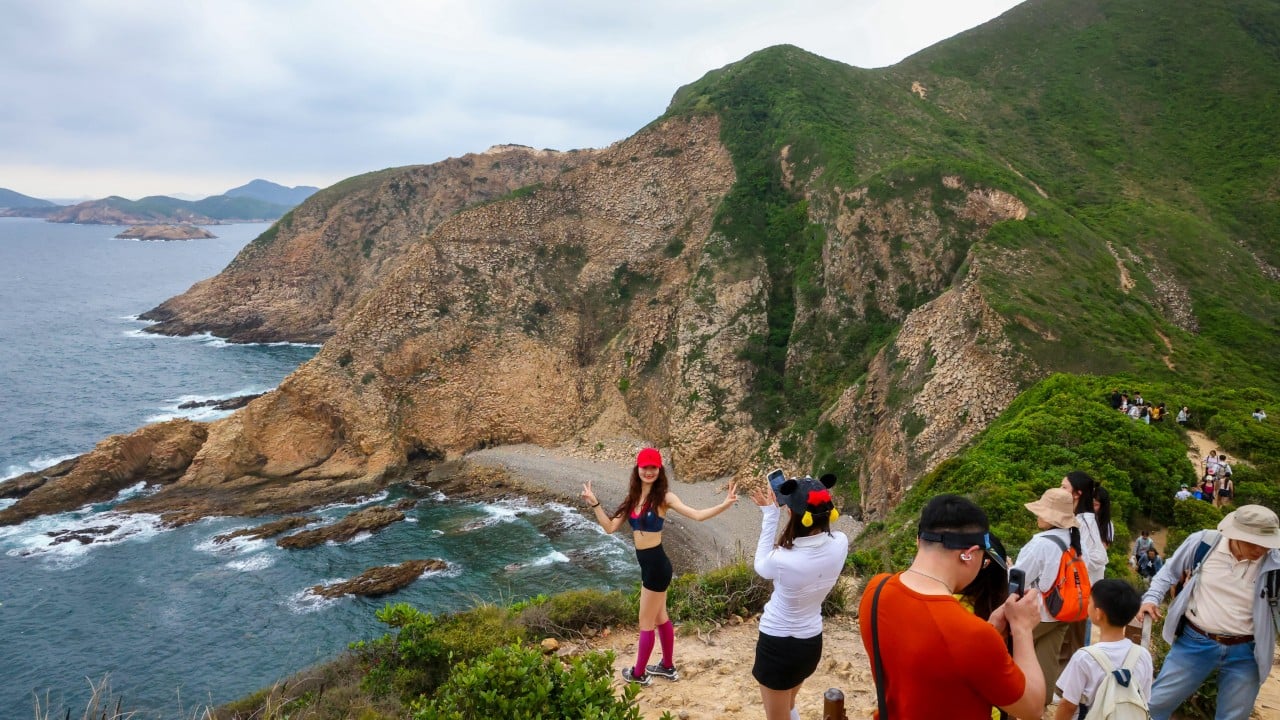
Imagine a human river. It spills down the narrow paths of the High Island Geo Trail, a colorful, pulsing mass of synthetic hiking gear, selfie sticks, and breathless chatter. The sheer volume of foot traffic has turned ancient earth into hard-packed dust, worn down the edges of fragile ecosystems, and transformed what was once a desolate sanctuary into an outdoor bottleneck. On social media, Po Pin Chau became a trophy. In reality, it began to buckle under its own viral weight.
Crowds breed friction. Safety hazards multiply when thousands of unseasoned walkers crowd cliff edges chasing the ultimate photograph. Emergency services have faced mounting headaches rescuing stranded hikers who underestimated both the distance and the heat.
So, the government drew a line. Or rather, a booking window.
The mechanics of the new system are straightforward on paper. Visitors must log on ahead of time, submit their personal details, and secure one of the daily slots for the High Island Geo Trail and Po Pin Chau section. For now, the bookings are free, and there are no financial penalties if a hiker ghosts their reservation. The government calls it a trial, a cautious step to gauge capacity and manage crowds before things spiral past the point of ecological return.
Yet, a chill runs through the hiking community.
There is a distinct melancholy that accompanies the introduction of reservations to the wild. We have grown accustomed to booking tables for dim sum, booking tickets for cinemas, and booking seats on high-speed trains. We live our lives inside an architecture of calendars and permissions. But trading the spontaneity of a Sunday morning hike for a pre-approved digital permit feels like something essential has been lost.
It transforms a pilgrimage into an appointment.
Think of the teenager staring at a locked booking portal on a Friday night, watching the last available slot vanish into digital ether. Think of the spontaneous urge to escape the towering concrete cages of the city, thwarted not by weather or landslides, but by a missing QR code. When nature requires a reservation, it ceases to be an escape. It becomes another amenity.
Yet, to romanticize the chaos of the old days is to ignore the destruction happening beneath our boots. Unchecked foot traffic leaves scars that nature cannot heal quickly. Litter accumulates in crevices where waves cannot reach. Trails widen illegally as hikers skirt around mud puddles, trampling rare native flora. When a place becomes universally desired, it invites its own ruin.
The real-name booking system is an admission of failure. It is a confession that we do not know how to share our wild spaces without breaking them.
When the trial begins, two thousand people will walk the path to Po Pin Chau on a given weekend. They will take their photographs, breathe the ocean air, and hike back out. Behind them, the stone columns will stand as they have for millennia, indifferent to the digital permits tucked away in pockets. But the invisible boundary line will remain, changing forever the way a densely packed metropolis interacts with its edge.
The wild is no longer waiting for you. You have to book your place in line.


