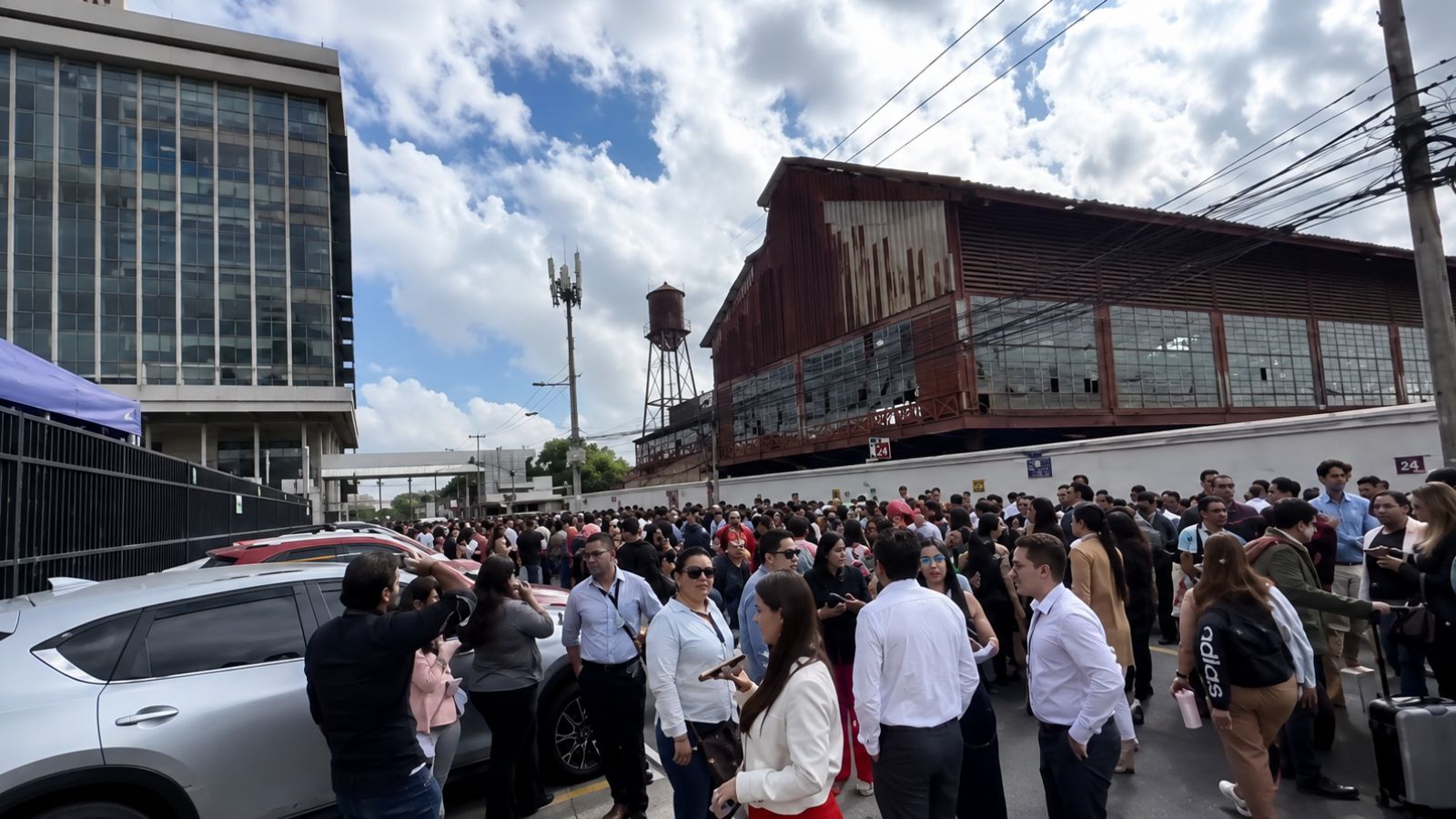
The coffee in the mug does not ripple. It jumps.
It is a Tuesday morning in San Marcos, a Guatemalan highlands department where the air usually smells of woodsmoke and damp earth. For a fraction of a second, the world goes perfectly silent, the kind of quiet that feels heavy, like the pause before a lightning strike. Then comes the sound. It is not a crack or a boom. It is a low, guttural growl that rises from the soles of your feet, traveling up through your shins until your teeth vibrate.
When the earth shifts beneath three nations simultaneously, geography ceases to be an abstract map concept and becomes an immediate, violent reality.
A 7.4 magnitude earthquake does not care about customs checkpoints or national sovereignty. The epicenter coordinates place the rupture off the Pacific coast of Mexico, near the Chiapas border, but the energy released respects no human boundaries. Within seconds, the shockwaves rip through the volcanic spine of Central America, tearing across Guatemala and sending tremors deep into the valleys of El Salvador.
To read the official dispatches is to encounter a ledger of structural data: hypocenter depths, tectonic plate boundaries, and peak ground acceleration. But those numbers are just the autopsy report of a living moment. The true story of a major seismic event is written in the sudden, terrifying fragility of ordinary things.
The Geography of Panic
Consider the difference between a three-second tremor and a minute of sustained violent motion.
In Tapachula, Mexico, the shaking begins as a rhythmic sway that quickly degrades into a violent jerk. Roof tiles slip from their beams, clattering onto the pavement like breaking dishes. The human brain, hardwired to view the ground as the ultimate symbol of permanence, experiences a profound, systemic shock when that assumption fails.
For someone standing in a kitchen in Ciudad de México, hundreds of miles away, the experience is a slow, nauseating oscillation as the ancient lakebed beneath the capital amplifies the long-period waves. The hanging lamps swing in wide, lazy arcs. The warning sirens wail, a synthetic scream that triggers an instant rush of adrenaline in a population that carries the collective scar of past disasters.
But as you move closer to the border zone, the nature of the crisis changes. This is a region defined by its rugged beauty and its architectural vulnerability.
In the mountainous terrain of western Guatemala, the infrastructure tells a story of survival, economics, and hope. Many families build their homes over decades, adding a room of concrete block or adobe whenever money allows. When a 7.4 magnitude event strikes, these structures face the ultimate engineering test without the benefit of formal blueprints.
The weight of an adobe wall is immense. When the ground moves laterally, that weight becomes a destructive pendulum. Dust fills the air instantly, a thick, choking cloud pulverized from mortar and brick, turning the morning sun into a pale, ghostly disc.
The Secondary Threat
The initial shaking is only the first movement in a complex, multi-layered emergency. As the ground subsides, a new clock begins to tick.
Offshore, the sudden displacement of the seabed pushes a massive volume of water upward, initiating a series of long-wavelength waves. In the coastal fishing villages of El Salvador and Guatemala, the immediate fear shifts from falling masonry to the horizon. The Pacific Ocean, usually a source of livelihood, becomes a question mark.
Tsunami watches are issued, sending a wave of evacuation orders through low-lying communities. Families who have just fled their trembling homes must now pack into the backs of pickup trucks or flee on foot toward higher ground, looking back over their shoulders at a sea that looks deceptively calm.
Meanwhile, in the highlands, the danger is vertical. The steep, verdant hillsides that define the landscape are held together by a delicate matrix of roots and soil. The violent shaking breaks these bonds.
Without warning, entire sections of mountainside untether themselves, transforming into fast-moving rivers of mud, rock, and debris. These landslides cut through winding mountain highways, isolating remote villages precisely when they need emergency assistance the most. The roads become impassable, transformed into gray scars across the green landscape, leaving rescue workers to navigate the terrain on foot, carrying medical supplies on their backs.
The Architecture of Resilience
What happens after the dust settles reveals the true anatomy of a region.
In the hours following the main shock, the immediate priority is rescue, followed closely by assessment. Power grids blink out, plunging vast swathes of three countries into a sudden digital silence. Communication becomes a precious commodity; cellular networks clog as millions of people attempt to send a single, vital text message: Are you okay?
When the infrastructure fails, the human network takes over. Neighbors work side by side, clearing debris with bare hands and shared shovels long before the first official emergency vehicles can navigate the blocked roads. There is a quiet, fierce efficiency to this collective response, born out of necessity and a long history of weathering the unpredictable temper of the Ring of Fire.
The international response moves with a different kind of momentum. Governments coordinate across borders, sharing satellite data to map the worst-hit areas and dispatching specialized search-and-rescue teams. The common threat of tectonic activity has, over generations, forged a shared expertise among the emergency services of Mexico and Central America. They speak the same language of structural triage, canine search patterns, and seismic monitoring.
Yet, the recovery from a 7.4 magnitude earthquake is measured in years, not days.
Long after the international camera crews depart and the headlines shift to other crises, the people of the border region remain. They face the quiet, exhausting task of rebuilding. Every cracked wall must be repaired or torn down; every compromised foundation must be reassessed. The psychological aftershocks linger even longer than the physical ones, manifested in the way a room goes quiet whenever a heavy truck rumbles past on the street outside, everyone freezing for a split second to see if the ground will jump again.
A woman sits on a plastic chair in a courtyard in San Marcos, watching the dust settle over the remnants of her kitchen wall. Her hands are gray with mortar dust. She does not look at the sky or the ruined masonry; she looks at the ground, which has finally stopped moving, resting once more in its ancient, deceptive stillness.