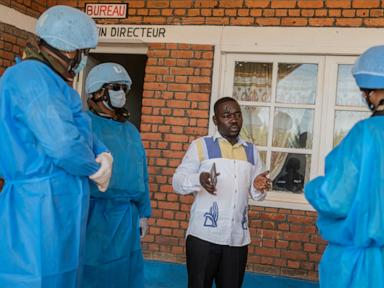
You can't fight a deadly virus on an empty stomach. Yet, in the gold-mining hub of Mongbwalu, health workers are doing exactly that. Medical staff at the center of the Democratic Republic of Congo's latest Ebola crisis are working exhausting shifts with almost no rest, minimal equipment, and unpaid salaries.
This isn't just a local labor dispute. It's a gaping hole in global health security.
When the Ministry of Health officially confirmed the outbreak on May 15, the virus already had a massive head start. International agencies are scrambling to move supplies into the region, but local doctors and nurses are paying the price for years of systemic neglect. If you want to know why containment efforts fail, you have to look at how we treat the people standing between the virus and the rest of the world.
The Reality in Mongbwalu
Mongbwalu is a chaotic mining town. It draws tens of thousands of laborers who crowd into tight mining camps and work face-to-face in muddy gold deposits, deep pits, and narrow caves. This environment is practically built for community transmission. Ebola spreads through direct contact with bodily fluids like blood, sweat, or vomit. In crowded, low-income camps with poor sanitation, a single case can spark a wildfire.
Congolese health authorities have already confirmed 452 cases, including 82 deaths. Just days ago, officials logged 71 new cases in a single 24-hour period. That spike confirms active community transmission. Worse, testing delays mean the virus likely circulated silently for up to three months before anyone realized what was happening. Local hospitals lacked the proper kits to identify this specific strain, allowing the disease to entrench itself deep within the population.
The medical response relies entirely on human sacrifice. Alice Bamuhinga, a nurse at the Mongbwalu hospital, described a brutal routine during the initial weeks of the response. Staff didn't have time to go home. They didn't have time to eat. Nurses were eating just once a day, consuming what Bamuhinga described as a late-evening breakfast.
No Vaccines for the Bundibugyo Strain
To understand the pressure on these workers, you need to understand the virus itself. This outbreak involves the rare Bundibugyo strain of Ebola.
Unlike the more common Zaire strain, which has highly effective vaccines like Ervebo, the Bundibugyo type has no approved vaccine or targeted therapeutic treatment. Medical teams can't rely on a vaccination campaign to halt transmission or protect themselves. They are limited to supportive care: managing symptoms, maintaining hydration, and treating secondary infections.
This makes personal protective equipment (PPE) life-critical. Yet, when the outbreak hit, frontline workers faced immediate shortages of basic gear. Masks, gloves, and heavy boots were scarce. Health workers are forced to manage highly infectious patients while knowing that a single torn glove could mean a death sentence. Several first responders and medical staff have already died during this response.
Fighting Rumors and Historical Neglect
Physical exhaustion is only half the battle. Medical teams also face deep-seated community skepticism. Because initial symptoms of Ebola mirror malaria or typhoid, families often delay seeking professional care.
Consider the tragedy of Asero Jeanne, a 52-year-old local resident. She lost two of her five children within two weeks. When her daughter first fell ill, neighbors explicitly warned the family to stay away from the clinic, claiming that anyone who entered the hospital would die immediately. The daughter died after weeks of moving between home and various facilities. Her son died shortly after. Jeanne eventually contracted the virus herself but survived after receiving care from the very doctors her neighbors feared.
This distrust doesn't happen in a vacuum. It stems from decades of state abandonment. Heather Kerr, the country director for the International Rescue Committee in Congo, points out that the regional healthcare architecture has faced severe erosion from lack of investment over many years. When a government fails to provide basic healthcare during peace times, citizens naturally question its motives during an emergency.
Local doctor Lokudu has publically called for immediate government intervention, noting that while distant officials report statistics, workers on the ground are sacrificing their comfort, safety, and rest without receiving regular salaries. The Congolese government has remained silent on the wage delays.
Fixing the Response Breakdown
We keep repeating the same mistakes in global health crises. We wait for an outbreak to explode, send international delegations, and ignore the local workforce running the actual triage lines. To stop this outbreak from spilling across borders, international donors and local authorities must pivot immediately.
- Fund Direct Payroll, Not Just Logistics: International aid packages frequently fund vehicle fleets, research, and high-level management while local nurses go months without a paycheck. Emergency funds must directly underwrite hazard pay and back-salaries for local clinic staff.
- Establish Decentralized Supply Hubs: Waiting for emergency flights from Kinshasa or Europe to deliver basic PPE during an active outbreak is a failure. Regional medical stores must maintain permanent stockpiles of gloves, masks, and fluids independent of active crises.
- Embed Trusted Local Leaders in Triage: Distrust won't be solved by clinical lectures. Survivors like Asero Jeanne and local community leaders need to be actively integrated into outreach efforts to counter deadly rumors regarding hospital isolation units.
The situation in Mongbwalu shows that global health security is only as strong as the most neglected clinic. Expecting underpaid, underfed medical staff to contain a lethal virus without tools is not a strategy. It's a gamble with global consequences.