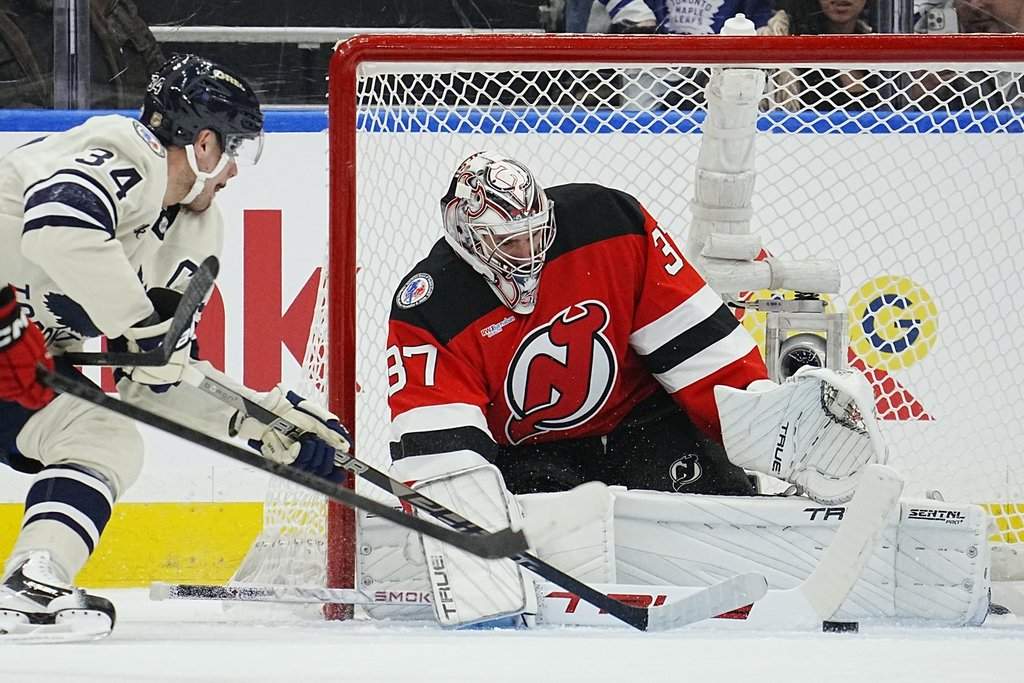
Connor Hellebuyck will not start between the pipes for the New Jersey Devils on Tuesday night when the team faces the Winnipeg Jets at Canada Life Centre. The coaching staff made the call ahead of the morning skate, opting to hold the veteran goaltender out of what was widely billed as an emotional homecoming against the franchise where he spent the bulk of his professional career.
On the surface, a routine lineup scratch during a long regular-season road trip barely registers as news. Coaches manage workloads constantly. Backups get starts in hostile buildings to spark sluggish rosters or keep starters fresh for divisional matchups later in the week. Yet when a franchise goaltender is acquired to anchor a championship window and subsequently sits out the most emotionally charged game on the calendar, standard hockey platitudes fall apart. To understand why Hellebuyck is watching Tuesday's puck drop from the bench, you have to look past the morning press conference and examine the intersection of sports science, psychological pressure, and the unforgiving math of modern NHL roster construction.
The Anatomy of a Scheduled Scratch
NHL coaching staffs rarely make goaltending decisions on a whim. Every start is mapped out weeks in advance by a committee that includes the head coach, the goaltending coach, the director of sports science, and the general manager. When a player like Hellebuyck sits out a high-profile game, the decision usually stems from one of three operational realities: biomechanical maintenance, tactical shielding, or emotional risk management.
Modern goaltending is an assault on the human lower body. The reverse-VH technique, relentless post-to-post pushes, and explosive butterfly recoveries place immense shear force on the hips, knees, and groin. Over an 82-game schedule, even the most durable workhorses accumulate micro-trauma that never makes the official injury report. Teams track these workloads through biometric sensors and tracking data, measuring not just shots faced, but high-danger lateral movements and practice volume. If the sports science department flags a dip in recovery metrics or a slight asymmetry in push-off velocity, the medical staff intervenes before a minor strain becomes a six-week absence.
Beyond the physical toll, there is the cold reality of the schedule. Road trips through Western Canada are notoriously grueling due to travel distances, time zone shifts, and compressed game windows. Burning a number-one goaltender in a non-conference game against a familiar opponent can compromise his sharpness for a four-point divisional clash forty-eight hours later. In the standings, a win against a Metropolitan Division rival carries twice the weight of a victory in Manitoba. Front offices do not pay elite goaltenders to win narrative battles in November or March; they pay them to secure playoff seeding and survive four rounds in the spring.
The Homecoming Trap
Anyone who has covered professional hockey for more than a decade knows the trap of the "revenge game." Fans and media build these matchups into operatic clashes of pride and validation. For the player at the center of the storm, the reality is far more exhausting.
Returning to a former city involves an immediate disruption to every routine a goaltender relies on to stay grounded. Instead of a quiet afternoon nap and a predictable pre-game meal, the player spends forty-eight hours fielding ticket requests from former billet families, answering repetitive questions from local beat writers, and navigating the strange sensation of walking into the visitor's dressing room in an arena where he once knew every bounce off the end boards.
For a position built entirely on mental stillness and muscle memory, that kind of external noise is poison. Goaltenders thrive on boredom. They want every game day to feel identical to the last. When a matchup becomes an event, players often over-try. They grip the stick too tightly, over-commit to first shots, or abandon their structural depth to make a highlight-reel save in front of a crowd that used to cheer their name.
Furthermore, the opposing coaching staff holds a massive informational advantage. Nobody knows a goaltender's technical blind spots better than the coaches and shooters who practiced against him for years. They know whether he drops his glove hand slightly when tracking traffic from the point. They know how aggressively he challenges shooters on odd-man rushes, and they know the exact angle above his shoulder where pucks tend to slip through when he drops early into the butterfly. Putting a starter into a game where the opposition possesses a complete blueprint of his tendencies—while he simultaneously deals with the emotional weight of a tribute video—is a gamble most pragmatic coaches prefer to avoid.
What This Means for New Jersey's Crease
Holding Hellebuyck out in Winnipeg sends a clear message about how the Devils intend to manage their netminding assets this season. For years, New Jersey struggled to find stability in the crease, cycling through injured veterans and overwhelmed prospects while watching high-powered offensive seasons go to waste. Acquiring an established, Vezina-caliber starter was supposed to end the carousel.
However, acquiring an elite goaltender is only half the equation. Protecting that investment requires resisting the urge to ride him into the ground during the regular season. History is littered with teams that leaned too heavily on a star netminder from October through April, only to watch him run out of gas by the second round of the playoffs. By willingly absorbing the local media scrutiny of sitting Hellebuyck in Winnipeg, the Devils' coaching staff is prioritizing long-term durability over short-term optics.
The decision also serves as a critical stress test for the backup goaltender. A true contender cannot afford to treat every non-starter appearance as a scheduled loss. Throwing the backup into a loud, hostile environment like Canada Life Centre forces the skaters in front of him to tighten up their defensive structure. Teams notoriously play looser when they believe their superstar goalie will erase their turnover mistakes. When the backup gets the nod in a tough building, defensemen tend to block more shots, clear rebounds faster, and manage the puck more responsibly through the neutral zone.
The Shift in NHL Goaltending Economics
To fully appreciate why a decision like this happens, look at how the valuation of goaltenders has shifted across the league. A decade ago, a healthy starter making top-of-market money played sixty-five to seventy games without question, and sitting him in his old barn would have been viewed as a sign of internal friction or lack of competitive fire.
Today, the math has changed entirely. Salary cap constraints mean teams spend a massive percentage of their available space on top-end forwards and defensemen, leaving thinner margins for error in net. At the same time, league-wide shooting talent and offensive pace have reached levels that make sustained workload historically punishing. A goalie facing thirty-five shots a night in the modern NHL is dealing with far more east-west puck movement, screens, and deflections than his counterparts faced fifteen years ago.
As a result, the sixty-five-game workhorse is effectively extinct. Elite starters now hover around fifty-two to fifty-eight appearances, and every single off-night is strategically deployed to maximize rest intervals. If a coaching staff sees an opportunity to give their starter a four-day block without game action by skipping a Tuesday night game in the middle of a road trip, they will take it every single time, regardless of the storyline attached to the opponent.
Reading Between the Lines
When a team announces a lineup change without citing an injury, skepticism is natural. Fans immediately wonder if there is an undisclosed ailment, a trade brewing, or a quiet disciplinary issue. While teams routinely guard injury details closely—especially regarding lower-body soreness that opponents might target—the broader context of the schedule usually provides the simplest explanation.
If Hellebuyck were dealing with a structural injury, the team would be forced to recall an emergency backup from the AHL to preserve roster flexibility and avoid dressing a compromised player. When a starter simply takes a seat on the bench in full gear as the backup for the night, it confirms he is physically cleared to play if an emergency strikes, but deemed better served by taking the night off from starting duties.
Still, the optics remain jarring for fans who bought tickets months in advance expecting to see a marquee reunion. Professional sports operates as an entertainment product, yet the competitive incentives of the franchises rarely align with the desires of the ticket-buying public. Coaches are not paid to deliver satisfying narrative arcs to television networks or hometown crowds. They are judged entirely on their win-loss record in May and June.
If New Jersey skates out of Winnipeg with two points on Tuesday night, the decision to sit Hellebuyck will be praised as a masterstroke of roster management and psychological foresight. If the Jets run up the score early against the backup, the second-guessing will begin before the second intermission. Either way, the Devils have made their priorities unmistakable: they did not bring Connor Hellebuyck to New Jersey to win sentimental battles in his past, and they are willing to let a loud building in Manitoba go unsatisfied if it keeps their starter sharp for the games that actually define their season.