The brick radiates long after the sun goes down. If you have ever lived through a July heatwave in a second-floor walkup, you know the specific violence of that warmth. It does not just sit in the room; it presses against your chest. It turns the mattress damp. It makes the air conditioner rattle like a dying engine while the electric meter spins until the glass seems to hum.
For Clara, who has lived on the third floor of a Philadelphia rowhouse for thirty-one years, summer used to mean a migration. Not to the shore, but to the linoleum kitchen floor. Around two in the afternoon, when the tar roof overhead turned into a literal skillet, the heat trapped her inside the walls. She would press her bare feet against the kitchen tiles, sip lukewarm tap water from a plastic tumbler, and wait for the sun to drop behind the horizon. She did not open the windows. Opening the windows only let in soup. In other updates, we also covered: Why Building Taller Smokestacks Was Engineering Genius Not A Coverup.
We talk about climate change as if it were a distant weather report, a matter of melting ice sheets and graphs projected onto distant screens. But the truth is local. It is asphalt. It is brick. It is the dark, heavy roofing materials we inherited from an industrial century that viewed the sun as something to capture rather than something to deflect.
Dark roofs absorb up to ninety percent of the sunlight hitting them. They bake the buildings below, forcing overworked air conditioning units to draw staggering amounts of power, which in turn pumps more heat into the alleys, creating a feedback loop of misery known to scientists as the urban heat island effect. It is a quiet crisis. It does not make dramatic television unless the power grid fails entirely. Instead, it kills quietly, one elderly resident at a time, inside sweltering apartments where the thermostat reads ninety-eight degrees and climbing. NPR has also covered this critical topic in extensive detail.
Then came the white paint.
To understand what happened next, we have to look past the bureaucratic language of municipal grants and energy targets. In city after city, programs are quietly rewriting the physical surface of our neighborhoods. In Philadelphia, a targeted initiative rolled out across three hundred and forty senior households, transforming standard, heat-absorbing dark roofs into brilliant, blindingly reflective white surfaces.
Let us be precise about the physics, because the simplicity of the solution masks its power. Traditional cool roofs use specialized white coatings that bounce sunlight right back up into the atmosphere instead of letting it soak into the structure. Think of it like wearing a white linen shirt on the beach instead of a black wool overcoat.
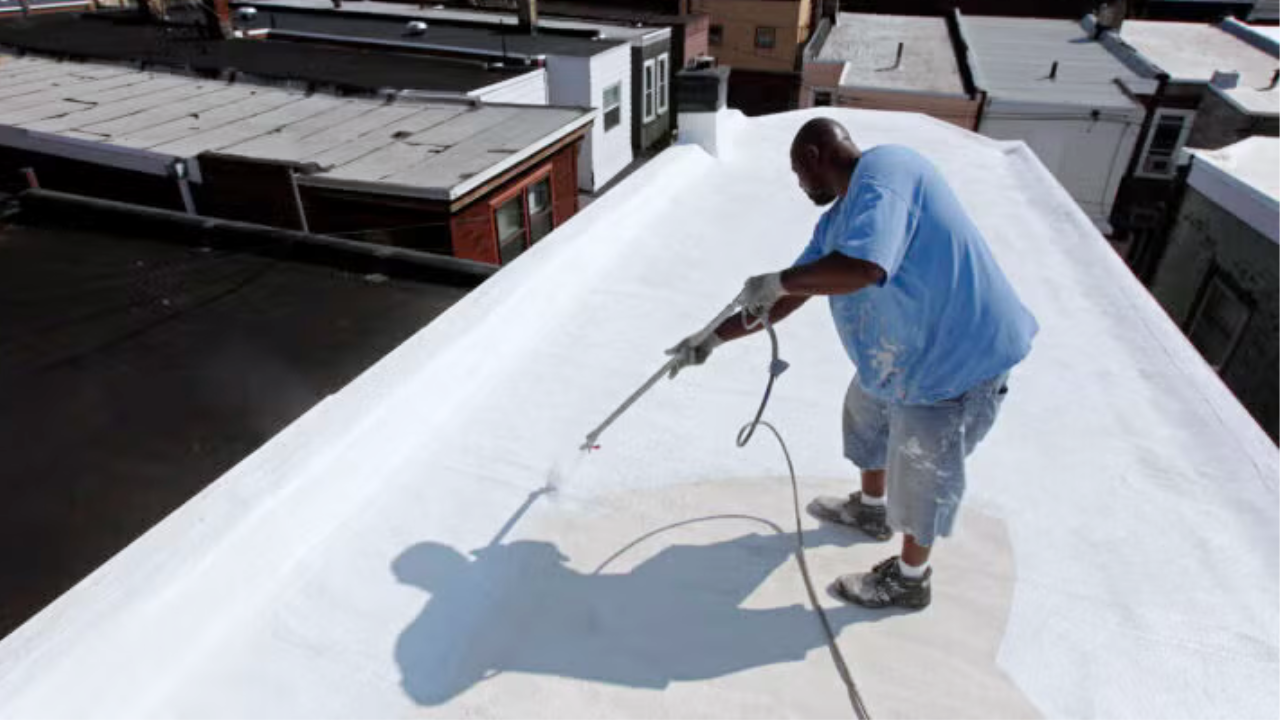
When the crews finished painting Clara’s roof, the change was not subtle. Walking up the stairs felt different by the second week of August. The air no longer tasted of baked dust.
The numbers tell a stark, undeniable story. Independent monitoring of these retrofitted senior homes revealed an average indoor temperature drop of five degrees Fahrenheit. Five degrees does not sound like much on paper. On a hundred-degree day in an apartment with no cross-breeze, five degrees is the difference between surviving and suffocating. It is the difference between needing an ambulance for heat exhaustion and sleeping soundly through the night.
And then there is the energy. By keeping the thermal load off the building, these homes saved an average of five hundred and sixty kilowatt-hours of electricity over the cooling season. Multiply that across hundreds of households, and you see a sudden, dramatic drop in strain on the local grid. Fewer brownouts. Lower utility bills for people living on fixed incomes, where a single fifty-dollar spike in an electric bill can mean choosing between medication and cooling.
This is not high-tech wizardry. There are no microchips or rare-earth metals required. It is acrylic elastomeric coating, rollers, and a crew of workers spending a morning on a hot roof.
Yet we consistently overlook the obvious in favor of the complex. We spend billions chasing hyper-engineered cooling systems while the cheapest, most effective climate mitigation strategy sits directly above our heads, entirely ignored. For decades, urban planning favored dark aesthetics and traditional building codes that treated energy efficiency as an afterthought. We built cities that act as giant radiators, and then we wondered why our summers became unbearable.
Clara does not care much about urban heat island mitigation metrics or kilowatt-hour savings. She cares that she can sit in her armchair at three in the afternoon without a wet towel draped over her neck. She cares that her monthly electric bill did not trigger a panic attack when it slipped through her mail slot.
The revolution, it turns out, does not arrive with a loud announcement or a silicon valley keynote. Sometimes, it arrives in a five-gallon bucket of elastomeric white paint, hoisted up a ladder by a worker wiping sweat from his forehead, ready to paint the town cool, one roof at a time.