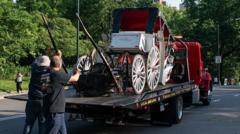
The sound is what stays with you long after the sirens fade. It is not the roar of an engine or the screech of modern brakes. It is the rhythmic, hollow rhythm of iron shoes striking asphalt—a sound stolen directly from another century, echoing incongruously against glass skyscrapers and concrete avenues.
We walk past them every day in New York. Tourists look up from their phones, smiling at the sight of giant, gentle beasts pulling wooden wheels through the exhaust fumes of Central Park South. It looks like a postcard. It feels like a harmless step backward in time, a romantic escape from the relentless speed of modern life. But underneath the velvet seats and the polished brass lies a stark, structural friction that we usually choose to ignore.
Then, the rhythm breaks.
A car horn blares too close. A piece of plastic trash tumbles across the lane like a ghost. A sudden brake light flashes. In a split second, the fragile illusion of control shatters, leaving behind the devastating reality of what happens when two entirely different eras collide on the same strip of urban pavement.
A teenager is dead.
The bare facts of the police report will tell you the time, the intersection, and the medical determination of mortality. They will classify it as an incident, a tragic statistical anomaly in a city of millions. But a life is not a statistic. A teenage life is a sprawling web of unfinished sentences, half-decorated bedrooms, unfulfilled promises, and a family whose universe has just been violently knocked off its axis. To understand how we got here, we have to look past the cold police blotter and confront the invisible stakes riding behind those horses every single day.
The Friction of Two Worlds
Imagine standing at the corner of a busy Manhattan thoroughfare. On your left is a modern sedan, packed with crumple zones, airbags, anti-lock braking systems, and proximity sensors designed by teams of global engineers to absorb thousands of pounds of impact. On your right is a carriage design that has remained fundamentally unchanged since the administration of Abraham Lincoln.
It is a literal collision of centuries.
Horses are prey animals. This is an immutable biological truth, not an opinion. No matter how many years a horse spends navigating the gridlock of Midtown, its deepest, most primal programming remains intact. When a prey animal is terrified, it does not rationalise. It does not look at a traffic light or calculate the distance to the curb. It runs. It bolts with the explosive force of half a ton of muscle and bone, pulling a heavy, rigid wooden frame behind it.
When that happens on a open field, it is natural. When it happens on a narrow New York street flanked by yellow cabs and delivery trucks, it is a catastrophe waiting for a trigger.
The teenager who lost their life this week was not thinking about structural kinetic energy or nineteenth-century logistics. They were likely experiencing the city the way any young person does—with a sense of wonder, perhaps a bit of boredom, or maybe the simple joy of an afternoon outing. They trusted the environment. We all do. We step onto sidewalks and crosswalks under the assumption that the infrastructure around us is designed to keep us safe.
But the infrastructure of a modern city was built for internal combustion and electricity. It was built for predictable, mechanical movements. It was never designed to safely accommodate the unpredictable panic of live animals.
The Anatomy of a Panic
Let us trace the invisible mechanics of how an ordinary afternoon turns into a nightmare.
Consider a hypothetical driver, distracted for a mere fraction of a second by a navigation app. It happens thousands of times an hour. The driver jerks the wheel slightly to correct their course, brushing against a plastic barricade. The sound is a sharp, metallic slap. To a human ear, it is an annoyance. To a horse, it can sound like a predator striking from the brush.
The animal’s heart rate spikes instantly. Adrenaline floods its bloodstream. In less than a heartbeat, the working animal transforms back into a wild creature driven entirely by the urge to survive. The driver of the carriage, relying only on leather reins and human upper-body strength, is suddenly locked in a hopeless tug-of-war against six hundred kilograms of pure terror.
The carriage sways. The wooden wheels, designed for dirt roads and slow promenades, grip the slick, oil-stained asphalt poorly. A tire slips against a steel utility cover in the road.
The tipping point is silent before it is loud.
When a carriage overturns, there are no airbags to deploy. There are no reinforced steel cages to protect the passengers inside. There is only the hard, unforgiving surface of the city, followed by the chaotic momentum of a panicked animal trying to untangle itself from broken wood and leather straps.
Those who witness these moments speak of a specific kind of horror. It is the realization of how fragile our urban safety netting really is. We surround ourselves with rules, traffic laws, and painted lines on the road, convincing ourselves that we have tamed the chaos of the world. But when an accident like this occurs, the thin veneer of order peels back, revealing the raw danger we allow to cruise alongside our children for the sake of a quaint tradition.
The Hidden Cost of the Postcard
Every year, millions of dollars change hands in the tourism ecosystem of New York. The horse-drawn carriages are a staple of that economy, defended fiercely by operators who point to generations of tradition and the livelihoods of working families. They argue that these incidents are rare, that the horses are well-treated, and that the experience is an essential part of the city’s identity.
But we must ask ourselves a quiet, uncomfortable question: what is the acceptable price of a postcard aesthetic?
If we were to propose a brand-new attraction today—a heavy, unbraked wooden vehicle guided by a large, easily startled animal, operating in high-density pedestrian zones alongside heavy commercial traffic—it would be laughed out of every city planning office on Earth. It would be deemed an unacceptable public safety hazard. Yet, because it has existed for a century, we grant it a pass. We normalize the risk until the risk claims a life.
The grief of a parent losing a teenage child is a heavy, dark room that never truly lights up again. It is a quietness at the dinner table where a voice should be. It is the excruciating task of packing up clothes that will never be worn again, textbooks that will never be opened, and dreams that were cut off before they could even begin to take shape.
That grief is the real price. It is paid not by the city, nor by the tourism boards, but by individuals who woke up on an ordinary morning expecting nothing more than an ordinary day.
The Path Forward
Change in a city like New York does not come easily. It is fought over in city halls, debated by lobbyists, and stalled by bureaucracy. But history shows us that urban spaces must evolve to protect the people who live in them. We no longer allow open fires in high-rises; we no longer build tenement housing without fire escapes; we constantly update our traffic laws to reflect new realities.
The solution is not necessarily to erase history, but to recognize when history has outgrown its surroundings.
Some advocate for electric carriages—vintage-styled vehicles that preserve the nostalgic charm of a bygone era without the unpredictability and ethical complications of live animals. Others call for a complete restriction of horse-drawn vehicles to the interior pathways of parks, completely isolated from the chaotic currents of automotive traffic.
Whatever the path forward, the one option we cannot afford is silence. We cannot look at the loss of this teenager, shake our heads in brief sympathy, and then move on to the next headline. To do so is to accept that some lives are simply the collateral damage of entertainment.
The iron shoes will continue to strike the asphalt tomorrow morning. The tourists will still take their photos, and the drivers will still call out to passersby. But the city is different now. It carries the weight of a ghost, a reminder that underneath the bright lights and the historic charm, the streets demand a vigilance we are sometimes too slow to give.
The true measure of a city is not its ability to maintain its past, but its willingness to protect its future. And that future belongs to the young people who walk its streets, trusting us to make sure they get home safe.


