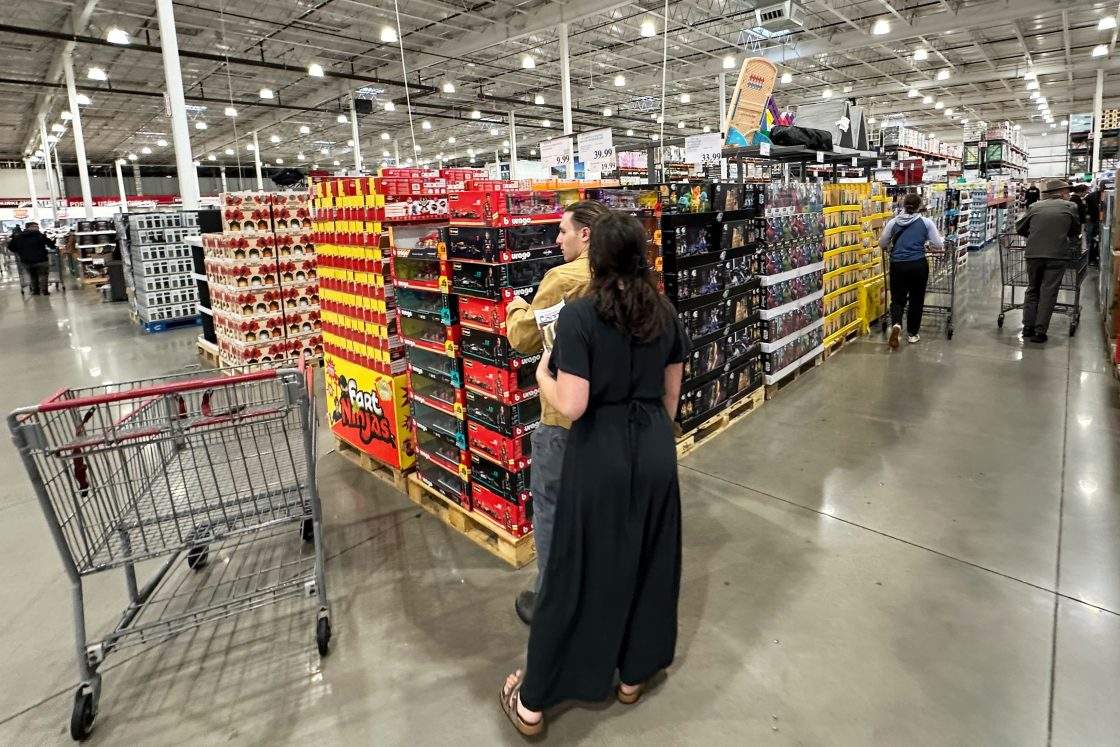
An 11.2% quarterly sales jump paired with rising shopper interest in lower-cost protein looks like straightforward retail momentum, yet it exposes a tension between top-line volume and unit gross profit that standard headlines gloss over. To evaluate what is actually happening beneath the surface, this analysis separates verified financial disclosures from analytical hypotheses, models the cost-per-gram mechanics driving shoppers toward economical protein staples, examines how warehouse membership economics subsidize aggressive staple pricing, and maps the operational constraints that cap how far cheap protein can carry growth.
Deconstructing the Headline Growth Numbers
Headline revenue growth rarely moves in a straight line with underlying store-level demand. In its fiscal fourth quarter, Costco reported net sales up 11.2% to $93.9 billion compared with $84.4 billion a year earlier, while full-year net sales reached $297.2 billion, up 10.1%, across 939 warehouses worldwide. Diluted earnings per share rose to $6.75 in the quarter from $5.87 in the prior-year period, aided by $0.15 per share from tariff refunds, bringing full-year diluted earnings per share to $20.76 versus $18.21.
The gap between headline sales and adjusted comparable sales tells the real story. Total company comparable sales increased 9.4% for the quarter, but dropped to 6.7% once fuel price swings and foreign exchange movements were stripped out. Geographic performance also diverged sharply: U.S. comparable sales rose 10.7% on a reported basis and 7.2% adjusted, whereas Canada posted 4.6% adjusted comparable sales growth. Meanwhile, digitally enabled sales expanded 19.5%, and membership fee income climbed from $1.72 billion to $1.85 billion.
Known facts versus educated hypotheses:
- Known facts: Quarterly net sales grew 11.2% to $93.9 billion, adjusted comparable sales rose 6.7% company-wide and 7.2% in the U.S., digitally enabled sales grew 19.5%, membership fees reached $1.85 billion, cash and equivalents ended the fiscal year at $20.2 billion up from $14.2 billion, and a headline report highlighted consumers eyeing lower-cost protein.
- Educated hypotheses: Shoppers gravitating toward lower-cost protein are likely trading down within animal and dairy categories toward higher-efficiency staples, using bulk warehouse pack sizes to lower unit costs per serving, and pairing staple grocery trips with higher-frequency digital or basket-building items.
- Unverified specifics: Publicly available earnings summaries in this set do not break out exact dollar sales or unit growth specifically for the protein aisle, nor do they quantify the exact share of customers switching from higher-priced cuts to lower-cost alternatives.
When a competitor article treats an 11% sales increase and a shift toward lower-cost protein as proof of unalloyed pricing power, it conflates volume and traffic resilience with high-margin mix expansion. Lower-cost items often pull foot traffic and lift unit counts while compressing merchandise gross margin percentages.
The Cost Function of Protein and Consumer Trade-Down
Shoppers do not buy protein in the abstract; they solve a constrained household budget problem under changing retail prices. When food inflation or broader living costs squeeze disposable income, consumers re-rank protein sources by cost per gram of usable protein, satiety per dollar, and preparation convenience.
Consider how a household budget behaves when beef or specialty packaged foods become expensive relative to poultry, eggs, cultured dairy, or bulk protein powders. A shopper who previously bought higher-priced steaks or specialty ready-made entrees has three main adjustment paths:
- Intra-category substitution: Moving from higher-cost cuts or specialty proteins to lower-cost staples such as chicken thighs, ground poultry, eggs, or plain or high-protein yogurt.
- Pack-size arbitrage: Buying larger multi-pack or bulk formats where fixed packaging, processing, and logistics costs are spread across more servings.
- Format shifting: Substituting whole cuts with processed, frozen, or powdered formats when price-per-gram or time-to-table favors them, though retail price spikes in categories like whey or specialty protein goods can erode that advantage over time.
The first consequence of this trade-down dynamic is higher trip frequency or steadier staple basket attachment among cost-conscious households. The second consequence is a shift in basket mix: staples bring shoppers into the warehouse reliably, yet their lower retail price points require higher unit volume just to hold dollar sales steady.
A simple illustration clarifies the math without inventing store data. Suppose a shopper shifts part of a weekly food allocation away from a $14-per-pound specialty cut toward a staple protein priced at half the per-pound rate. Even if the shopper buys more total weight to hit target household protein intake, total revenue per pound sold falls unless offset by additional items in the cart. For a high-volume retailer, that trade-off works only when staple turnover accelerates enough to keep fixed warehouse overhead well-amortized.
Why Warehouse Economics Absorb Staple Price Compression
Traditional grocers often get trapped when shoppers migrate to cheaper proteins because low-margin food volume drags down operating profit if store labor and real estate costs are heavy. A warehouse club operates on a different profit architecture.
The primary structural mechanism is membership fee profit decoupling. Because a large share of club profitability is anchored by recurring membership fees—which reached $1.85 billion in the fourth quarter—the retailer can price staple goods aggressively to protect renewal value and drive traffic without relying on wide merchandise markups on every SKU.
Operational mechanisms supporting low-cost protein volume:
- Curated SKU concentration: Carrying a narrow assortment per category concentrates purchasing power with suppliers and speeds up shelf replenishment.
- High inventory turns: Rapid sell-through on high-demand staples reduces working-capital tie-up and limits markdowns.
- Freight and pallet density: Moving full pallets and large case packs lowers per-unit inbound and warehouse handling costs compared with fragmented small-pack distribution.
- Digital fulfillment pairing: With digitally enabled sales growing 19.5%, online ordering and replenishment extend staple reach beyond spontaneous warehouse visits.
The second operational advantage lies in cross-category basket expansion. A shopper entering a warehouse specifically for budget-friendly protein staples faces wide aisles of adjacent consumables, seasonal goods, and household essentials. Even if the anchor protein item carries thin gross margin, incremental attachments across the rest of the cart stabilize overall gross profit dollars.
Operational Friction and Strategic Boundaries
Relying on lower-cost protein demand is not a frictionless growth engine. Every link in the protein supply chain carries physical and financial constraints that management teams must actively police.
Cold-chain economics create the sharpest ceiling on fresh and chilled proteins. Meat, poultry, seafood, eggs, and dairy require strict temperature control from processing plant to warehouse to home refrigerator. Any slowdown in turnover or cold-storage bottleneck raises spoilage and shrink risk, which directly penalizes unit economics on low-margin staples.
Household size and cash-flow timing introduce a second constraint. Bulk packages lower unit cost over time, but they demand a higher upfront cash outlay at checkout and adequate freezer or pantry space at home. Smaller households or cash-constrained shoppers with tight pay-cycle liquidity may still buy smaller quantities elsewhere even when warehouse unit prices look superior on paper.
Input-cost volatility adds a third layer of risk. Feed grains, livestock disease cycles, dairy supply shifts, and surging demand for whey and protein-fortified foods can push wholesale costs higher unpredictably. When wholesale input costs climb, retailers face a narrow choice between absorbing margin compression to protect price perception or passing increases through and testing price elasticity. Trade and tariff shifts—evidenced by the $0.15 per-share quarterly benefit from tariff refunds—further demonstrate how policy changes can alter landed costs across imported goods and supply chains.
Finally, strong staple sales do not automatically guarantee valuation expansion. When growth leans heavily on lower-priced necessity items and fuel or currency effects distort top-line comparisons, investors scrutinize whether underlying unit margins, renewal rates, and cash conversion ($20.2 billion in cash and equivalents at year-end) can compound sustainably once promotional or macro tailwinds normalize.
Strategic Play for Merchandising and Category Leaders
To turn staple-driven traffic into durable profit rather than low-margin volume churn, merchandising and category leaders should engineer a tiered protein ladder anchored by high-turn core staples, paired with disciplined margin guardrails on adjacent items. Audit SKU velocity and cold-chain shrink weekly at the item level so slow-moving high-cost SKUs do not clog high-value space needed for fast-turning staples, and tie digital replenishment prompts to complementary high-attachment basket items rather than discounting core protein leaders further.


