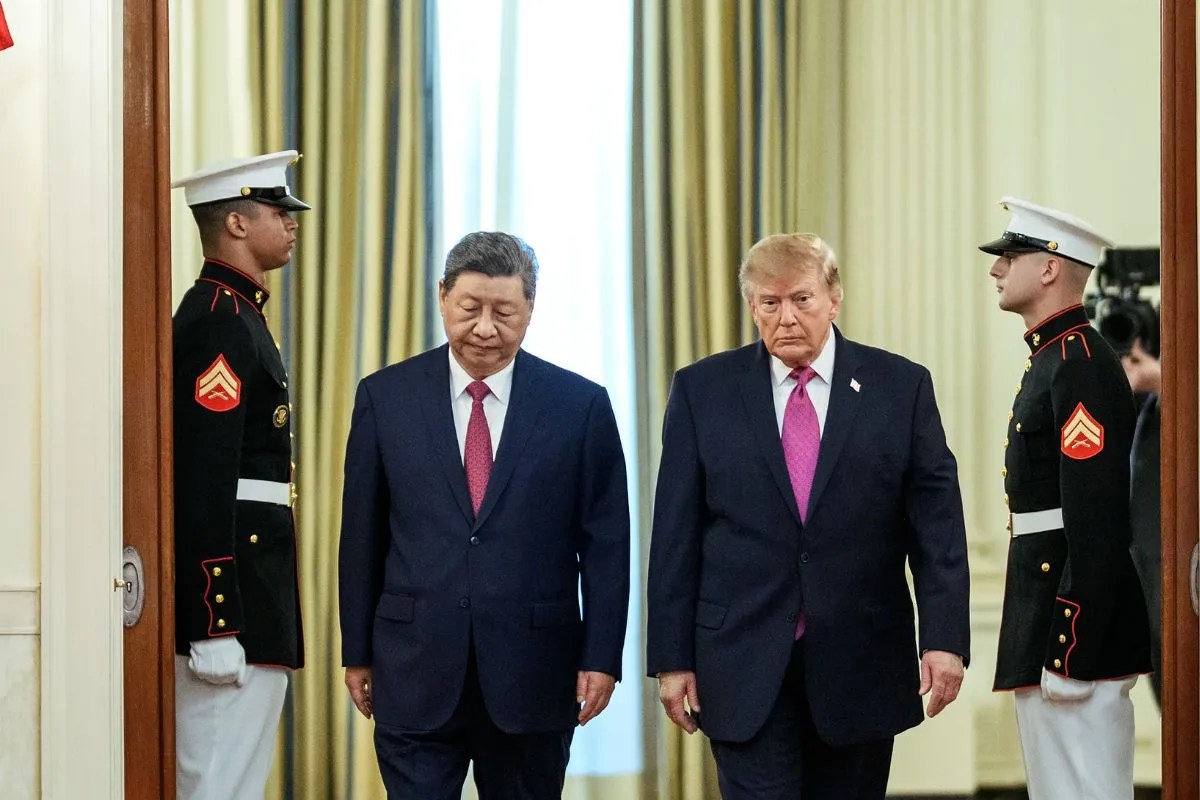
Every time Chinese President Xi Jinping steps up to a podium and declares there is "no room for Taiwan independence," headlines across the globe flash red. Cable news panels speculate about an imminent invasion. Markets jitter for a few hours. Then, usually, life goes on.
That cycle misses the actual point. Meanwhile, you can explore related stories here: Viral Rebukes and Military Signaling Why The Standard Read Is Broken.
When Xi reiterates Beijing's hardline stance on Taiwan reunification, he isn't just rattling a saber for Western cameras. He's laying down domestic political markers, signaling specific red lines to Washington, and tightening a long-term strategic squeeze that relies far more on gray-zone pressure than an immediate amphibious assault. If you only read the surface-level wire reports—like the standard summaries noting Xi's recurring pledges to oppose separatist activities—you miss the mechanics of how Beijing actually operates.
Why Xi's Rhetoric Sounds Harder Now
Let's be clear about what Xi actually says and why the wording matters. In major speeches—from the 20th Party Congress to New Year addresses and meetings with visiting delegations—Xi consistently pairs two ideas. First, he frames Taiwan reunification as a "historical inevitability" tied directly to the "great rejuvenation of the Chinese nation." Second, he refuses to renounce the use of force, while claiming that force is aimed solely at "external interference" and a tiny minority of separatists, rather than the broader Taiwanese public. To explore the full picture, check out the recent report by Associated Press.
Notice the shift over the last decade. Under earlier leaders like Hu Jintao, Beijing's messaging leaned heavily on peaceful development and economic integration, banking on the idea that closer trade ties would naturally pull Taipei toward Beijing. Xi hasn't abandoned economic carrots entirely, yet his tone is noticeably less patient.
Why the change? Three realities in Taipei and Washington forced Beijing's hand.
- Identity shifts in Taiwan: Polling from National Chengchi University's Election Study Center shows a dramatic long-term drop in people in Taiwan identifying primarily as Chinese, alongside a clear majority favoring the status quo over immediate unification. Beijing sees time working against voluntary political absorption.
- Political continuity in Taipei: The Democratic Progressive Party (DPP) won an unprecedented third consecutive presidential term with Lai Ching-te taking office in May 2024. Beijing views Lai as an obstinate separatist, leaving almost zero room for the kind of cross-strait dialogue that occurred during the Ma Ying-jeou administration between 2008 and 2016.
- U.S. policy evolution: While Washington officially maintains its "One China" policy—distinct from Beijing's "One China" principle—frequent congressional visits, expanded arms sales, and President Joe Biden's repeated statements that U.S. forces would defend Taiwan convinced Beijing that strategic ambiguity is eroding.
When Xi says there's "no room" for independence, he is speaking to a domestic audience that has been told for decades that resolving the Taiwan question is a core test of Chinese Communist Party legitimacy. Backing down isn't an option for him politically.
The 1992 Consensus Roadblock
You can't understand the current stalemate without looking at a piece of deliberate diplomatic ambiguity from over thirty years ago. It's called the 1992 Consensus.
Back in 1992, semi-official representatives from Beijing and Taipei met in Hong Kong. They reached a verbal understanding that both sides belong to "One China," while leaving each side free to interpret what "One China" actually means. To Beijing, it meant the People's Republic of China. To Taipei's Kuomintang (KMT) government at the time, it meant the Republic of China—the official name of Taiwan's government.
It was a clever workaround. It allowed trade, tourism, and direct flights to flourish during the 2000s.
Here's the catch. In a major January 2019 speech, Xi effectively redefined the 1992 Consensus by tying it directly to "One Country, Two Systems"—the governance model applied to Hong Kong. That move proved toxic in Taiwanese politics. Watching Beijing's crackdown on Hong Kong's pro-democracy movement in 2019 and 2020 convinced the vast majority of Taiwanese voters, across party lines, that "One Country, Two Systems" was a broken promise.
Today, Beijing insists that any resumption of official talks requires Taipei to accept the 1992 Consensus. Taipei's ruling party refuses, arguing that accepting Beijing's current definition equals surrendering Taiwan's sovereignty before negotiations even start. Neither side can blink without committing political suicide at home.
Gray-Zone Pressure Over Open War
If you watch military analysts at think tanks like the Center for Strategic and International Studies (CSIS) or the Institute for the Study of War, you'll notice they spend less time predicting a D-Day style invasion tomorrow morning and more time tracking daily attrition.
An amphibious invasion across the 100-mile-wide Taiwan Strait would be the most complex military operation in human history. Weather windows are narrow, typically limited to spring and autumn. Taiwan's mountainous coastline offers few suitable landing beaches. Worse for Beijing, a full-scale war would trigger severe economic sanctions, threaten vital maritime trade routes, and risk direct military conflict with the United States and regional allies like Japan.
So Beijing uses a different playbook. It's called gray-zone coercion—actions designed to intimidate, exhaust, and isolate Taiwan without crossing the threshold into formal warfare.
Consider what that looks like on a weekly basis:
- Erasing the median line: For decades, both sides respected an unofficial maritime and aerial boundary running down the middle of the Taiwan Strait. Following former U.S. House Speaker Nancy Pelosi's visit to Taipei in August 2022, the People's Liberation Army (PLA) began crossing that line routinely. Today, PLA aircraft and naval vessels operate near Taiwan almost daily, wearing down Taiwan's air force pilots and aging fighter jets.
- Rehearsal blockades: Exercises like "Joint Sword-2024A" and "Joint Sword-2024B" surrounded Taiwan with naval ships and coast guard cutters. Instead of practicing beach landings, the PLA practiced sealing off Taiwan's major ports and energy import routes. Taiwan imports roughly 98 percent of its energy; a quarantine or partial blockade could choke the island's economy without firing a shot at a city.
- Diplomatic strangulation: Since 2016, Beijing has peeled away ten of Taiwan's diplomatic allies, leaving Taipei with official diplomatic ties to just twelve countries, mostly small nations in Latin America, the Caribbean, and the Pacific.
- Legal warfare: In June 2024, Chinese judicial authorities issued guidelines threatening severe criminal penalties, including the death penalty in extreme cases, for "diehard" Taiwan independence supporters—even in absentia.
This strategy aims to convince people in Taiwan that resistance is futile and that Washington won't save them, pushing Taipei toward political capitulation without requiring Beijing to risk a catastrophic war.
Why This Matters Outside East Asia
It's tempting to view the Taiwan Strait as a regional dispute between Beijing and Taipei. That's a dangerous miscalculation.
Roughly half of the world's container fleet passes through the Taiwan Strait every year. Any military blockade or conflict would instantly snarl global shipping lanes, driving up freight and insurance costs worldwide.
Then there's silicon. Taiwan Semiconductor Manufacturing Company (TSMC) produces the vast majority of the world's most advanced logic chips—the processors powering everything from your smartphone and laptop to AI data centers and advanced defense systems. Even with TSMC building new fabrication plants in Arizona, Japan, and Germany, the cutting-edge manufacturing ecosystem remains heavily concentrated in Taiwan. Bloomberg Economics has estimated that a war over Taiwan could cost the global economy around $10 trillion, dwarfing the economic shock of the 2008 financial crisis or the COVID-19 pandemic.
You don't have to care about cross-strait politics to feel the impact if deterrence fails. Your supply chain already runs through Hsinchu and Tainan.
How to Read Future Headlines Without the Panic
Whenever Xi makes another headline-grabbing statement about reunification, media coverage tends to swing between complacency and alarmism. Neither helps you understand what's actually happening.
Instead of reacting to the rhetoric alone, watch the concrete indicators that signal real shifts in the status quo:
- Watch the Coast Guard, not just the Navy: When Beijing uses China Coast Guard vessels to inspect or shadow ships near Taiwan's outlying islands like Kinmen, it's asserting domestic law enforcement jurisdiction rather than military presence. That's a legal precedent play.
- Track energy and financial moves in Beijing: A leadership preparing for imminent war typically insulates its financial reserves from Western sanctions, stockpiles critical commodities, and restricts outbound capital aggressively. Rhetoric without logistical mobilization is usually political signaling.
- Pay attention to U.S. arms delivery backlogs: Billions of dollars in approved U.S. weapons sales to Taiwan have faced multi-year production delays. How fast Washington clears that backlog tells you far more about deterrence than diplomatic speeches do.
- Look at Taiwanese domestic politics: Watch how Taiwan's legislature—where opposition parties hold significant sway—handles defense budgets, energy security, and civil defense spending. Internal gridlock in Taipei encourages Beijing just as much as external pressure does.
Xi Jinping's refusal to leave room for Taiwan independence isn't breaking news—it has been the bedrock of Communist Party doctrine for decades. What has changed is Beijing's military capability, its willingness to squeeze Taiwan's international space, and its impatience with the status quo. Understanding that distinction keeps you from getting blindsided by the next flare-up in the Taiwan Strait.