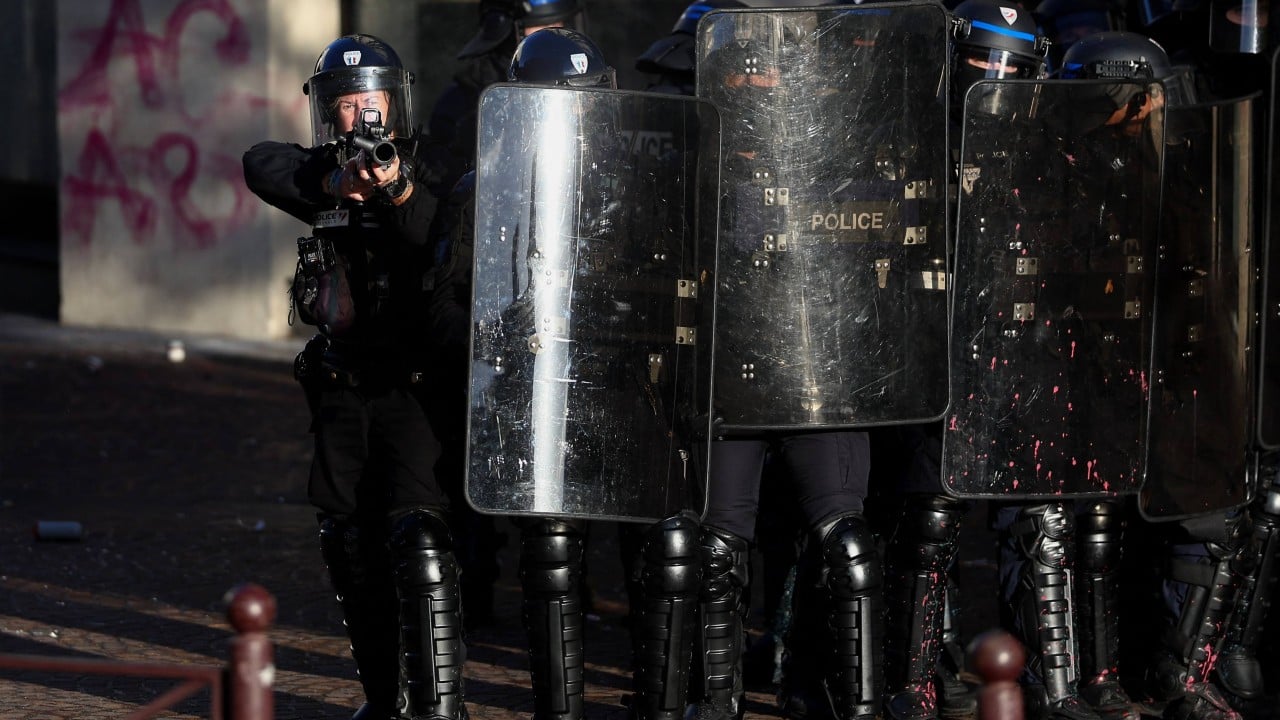
Standard media accounts of French street unrest treat police force and protester injuries as a straightforward tug-of-war between rioters and security forces. That framing misses the structural mechanics driving escalation: a force-spectrum gap between lethal firearms and blunt or chemical munitions, mixed crowds where peaceful demonstrators, students, and small violent actors occupy the same space, and an accountability bottleneck that weakens deterrence on both sides.
To understand why demonstrations over living costs, labor grievances, and school conditions repeatedly turn into severe clashes across French cities, analysts need to move past surface-level incident counts and examine the system as a coupled feedback loop. In this model, tactical choices by security forces shape crowd composition and grievance intensity, while crowd fragmentation and property damage alter the operational directives issued to officers and gendarmes.
Why Standard Coverage Misses the Escalation Loop
Conventional reporting on French unrest tends to present events as a sequence of isolated flashpoints—a high school blockade here, a commercial street ransacked there, a watchdog probe announced weeks later. While accurate on individual episodes, that episodic structure obscures three underlying mechanisms:
- Crowd heterogeneity: Large protests rarely consist of a single actor. High school students, union marchers, bystanders, opportunistic looters, and small militant groups operating in black bloc formations often converge in the same districts. Broad area tools affect everyone in range, not just the individuals throwing projectiles or breaking storefronts.
- Asymmetric injury risk: Less-lethal munitions are designed to incapacitate, disperse, or disorient without killing, yet kinetic impacts and explosive or chemical devices carry non-trivial risks of severe trauma, including eye and hand injuries. When minors or non-violent participants suffer life-altering injuries, public anger shifts from the original policy dispute to the policing itself.
- Information lag and rumor amplification: During fast-moving street disorder, official explanations take hours or days, whereas social media spreads unverified claims of fatalities or severe abuse in minutes. Even false rumors can trigger immediate retaliatory surges before facts are established.
In operational terms, public order policing in France operates under competing pressures. Ministry leaders and police unions emphasize the duty to protect public buildings, businesses, and officers from violent attacks and looting. Critics, civil rights bodies, and local officials point to disproportionate force, collateral harm to young demonstrators, and investigative friction. Treating these positions as pure moral slogans rather than competing system constraints leaves policymakers trapped between permissive disorder and injurious crackdown.
The Force Spectrum and the Intermediate Force Dilemma
At the center of the debate over French riot policing is what authorities call "intermediate force"—tools sitting between verbal commands or physical containment and lethal firearms. In public security doctrine, intermediate options exist to give officers graduated responses when crowds refuse to disperse or when violent actors attack infrastructure or personnel.
Core Hardware Categories and Their Trade-Offs
French security forces deploy a mix of impact launchers, chemical dispersants, acoustic/flash devices, and close-quarter gear, each carrying distinct operational strengths and failure modes:
- 40 mm impact launchers (such as LBD 40 / GL06): Single-shot devices firing blunt impact projectiles intended to stop a specific threat at distance. Their operational advantage is targeted delivery compared with area munitions, but accuracy degrades under stress, movement, and poor visibility, creating severe risk if rounds strike the head, face, or neck.
- 56 mm launchers and tear gas grenades (such as Cougar 56 and CM2L): Area-denial tools that project chemical irritants—sometimes paired with an acoustic report—to break up gatherings and clear streets. They are effective at moving dense crowds across wide avenues, yet wind shifts, enclosed streets, and high crowd density routinely expose peaceful marchers, students, and nearby residents or musicians.
- Stun and distraction grenades (such as ASSD): Devices engineered to produce an intense blast and bang to startle and disorient. Adapted from tactical and military contexts rather than routine street assembly policing, they carry high injury potential at close range, prompting suspensions or tight restrictions after severe limb injuries.
- Contact and deterrent gear (polycarbonate tonfas, riot shields, and strobe shields): Tools used to hold lines, parry blows, or visually disorient advancing groups with flashing LEDs. They preserve physical standoff in theory, but close-quarter contact remains a frequent site of disputed baton strikes and rapid escalation.
Notice the structural trap embedded in the intermediate-force argument. If authorities withdraw a tool without replacing it with lower-harm containment tactics—such as targeted arrest teams, mobile barriers, or clearer separation of violent factions—officers may feel forced to rely on heavier remaining options or escalate directly when lines are breached. Conversely, if broad or high-impact tools are deployed indiscriminately in mixed crowds, every serious injury fuels fresh mobilization and delegitimizes crowd-control operations.
Known Facts vs. Working Hypotheses
Rigorous analysis requires separating documented facts from contested claims:
- Known facts: Demonstrations and school blockades have involved serious injuries to teenagers, widespread property damage and looting during major flare-ups, thousands of arrests, and formal reviews or suspensions involving specific munitions such as stun grenades. International and domestic legal standards on assembly policing require evaluating necessity, proportionality, targeting, and special protections for minors on a case-by-case basis.
- Educated hypotheses (and contested assertions): Officials frequently attribute rapid violent outbreaks and street provocations to organized ultraleft or black bloc actors whose tactics draw in opportunistic looters. At the same time, security personnel and investigators themselves note that intelligence and attribution during chaotic multi-site events are often incomplete or circumstantial, while critics argue that aggressive crowd tactics actively inflame peaceful participants.
How Crowd Dynamics Turn Protests Into Street Clashes
A protest does not turn into a riot solely because grievances exist; it crosses that threshold when specific catalysts interact with urban layout and force posture. Three causal links explain why unrest spreads rapidly once ignited.
First, spatial bottlenecking turns symbolic squares into friction zones. When large crowds gather in central plazas and side streets narrow or fill up, dispersing a crowd with tear gas or loud munitions pushes thousands of people into adjacent commercial corridors. Small, mobile groups bent on vandalism or confrontation can use that confusion to break windows, erect barricades, or loot shops while police resources are stretched across multiple fronts.
Second, collective grievance transfer shifts the target of anger. A demonstration that begins over tuition, school conditions, or cost-of-living pressures has a defined policy grievance. Once demonstrators—especially young or first-time protesters—experience heavy chemical exposure, baton charges, or peer injuries, the conflict acquires an immediate experiential grievance against the state apparatus itself. That shift makes de-escalation harder even when political leaders offer concessions or warnings.
Third, attribution failure creates a two-sided accountability deficit. On the protester side, masked or dispersed actors blend into larger crowds, complicating immediate identification and targeted containment. On the policing side, area munitions and non-lethal projectiles often lack individual ballistic or serial traceability at the moment of deployment, making post-incident reconstruction slow and contentious when oversight bodies investigate injuries. When neither side trusts rapid, verifiable accountability, rumors fill the vacuum and raise the baseline hostility of the next mobilization.
Operational Playbook for Reducing Escalation Without Ceding Order
Lowering both injury rates and street disorder requires treating crowd management as a precision logistics and command problem rather than a binary choice between leniency and force. A practical sequence for authorities and command staff includes four steps:
- Map crowd segments before deployment: Separate intelligence and command planning for peaceful marchers and student assemblies from known risk corridors and violent agitator tactics, avoiding pre-emptive blanket measures that penalize non-violent participants at assembly points.
- Enforce strict munition rules and traceability: Restrict high-risk impact and explosive devices where crowd density, youth presence, or confined spaces elevate severe-injury probabilities, while pairing issued equipment with clear unit logging and traceable marking where feasible.
- Prioritize targeted containment over broad dispersal: Pair perimeter protection of vulnerable storefronts and civic buildings with mobile arrest and extraction teams focused on identifiable offenders, rather than pushing entire crowds into residential or commercial side streets.
- Publish rapid, verified incident updates: Establish a fast operational communication loop to refute false casualty or abuse rumors early while preserving independent oversight investigations, preventing viral misinformation from sparking secondary riots.
Real-World Limits and Constraints
Even well-designed crowd-control protocols face hard boundaries in practice. No command model can completely eliminate collateral harm when thousands of people, narrow urban streets, smoke, and fast-moving agitators collide simultaneously. Manpower limits mean security forces can be stretched thin when unrest erupts across multiple cities or neighborhoods at once. Furthermore, political polarization often rewards uncompromising rhetoric from both hardline security advocates and vocal protest factions, leaving operational commanders with narrow room to adjust tactics mid-crisis.
Strategic Play for Public Order Command
To break the recurring cycle of high-injury clashes and street disorder, French interior and policing leadership should pair a hard moratorium on high-risk explosive munitions in dense street assemblies with dedicated, rapidly deployable containment units tasked solely with isolating violent offenders and protecting commercial corridors. Treating containment precision and rapid rumor verification as core operational metrics—alongside officer and public safety—will do more to curb future unrest than relying on broad area munitions alone.


