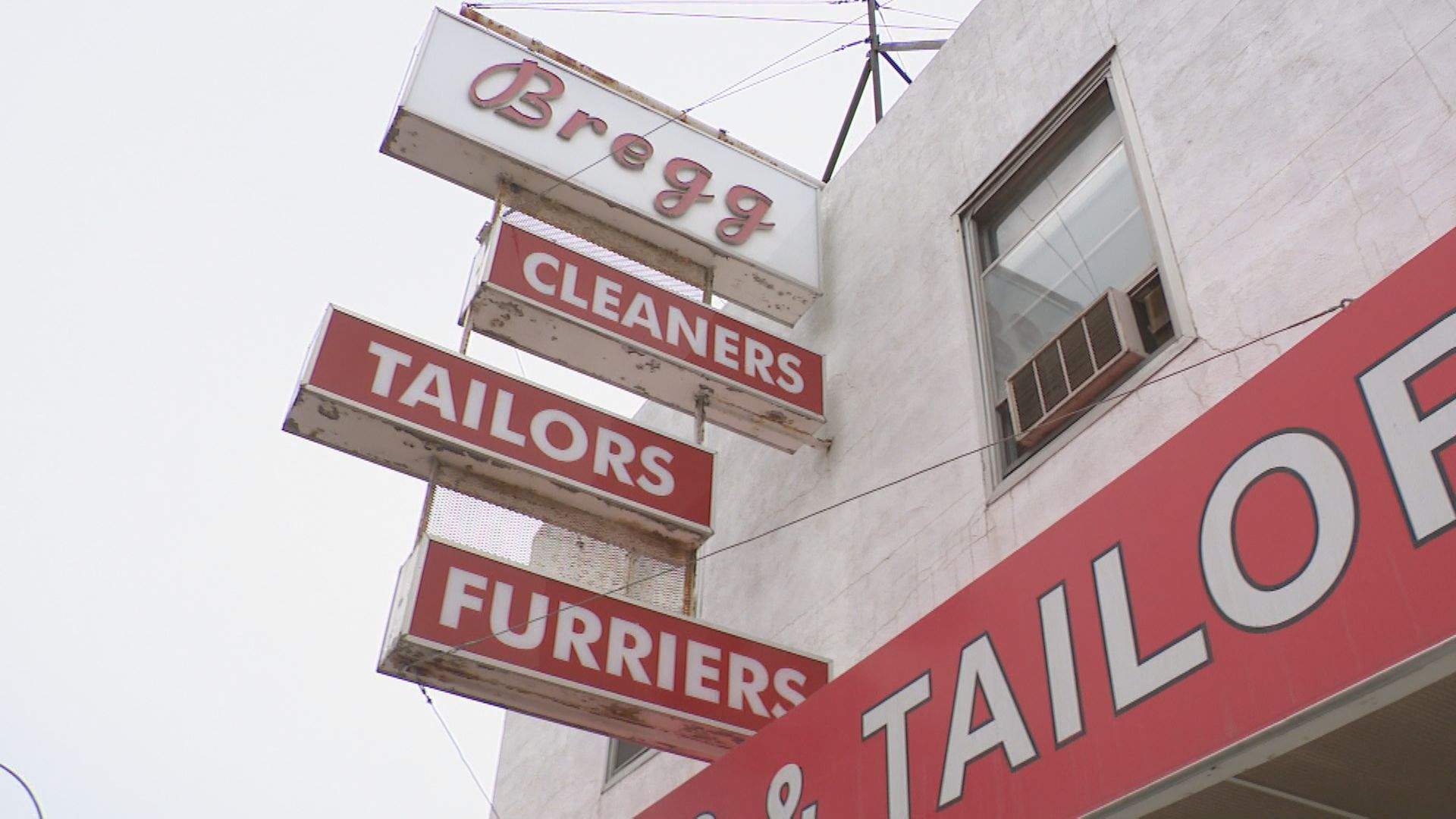
Long-standing commercial enterprises do not fail because of a sudden loss of operational will; they fail when macroeconomic shifts compress margins past the point of mechanical viability. The closure of Bregg Cleaners and Tailors after nearly nine decades of continuous operation in downtown Regina serves as a masterclass in structural economic erosion. When a commercial entity with deep municipal roots shutters its doors, observers frequently attribute the collapse to sentiment or isolated market anomalies. This interpretation is analytically lazy. By examining the fundamental cost functions, demand destruction mechanics, and asset liquidation failures inherent in traditional service-sector retail, we can map the exact sequence that turns a ninety-year operational history into an unrecoverable deficit.
The Cost Function of Fixed-Asset Service Providers
The baseline mechanics of traditional garment care rest on a high fixed-cost structure coupled with inelastic operational overhead. Operating a brick-and-mortar cleaning and tailoring facility requires continuous capital expenditure on specialized inputs: chemical solvents, utilities, commercial laundering machinery, and physical real estate.
When analyzing the cost function of legacy storefronts, inflation does not scale linearly; it compresses net operating income exponentially. As input prices for solvents, hangers, and utilities rise year-over-year, the business faces an immediate pricing ceiling. Urban consumer markets exhibit fierce price sensitivity for commoditized services like standard laundering. If a business attempts to pass 100 percent of rising input costs onto the consumer, transaction volume drops instantly. If it absorbs the costs, operating margins contract into negative territory.
Physical infrastructure compounds this vulnerability. Owning commercial real estate built in the mid-twentieth century—such as the 1947-vintage building on Albert Street—presents a distinct asset liquidity trap. In a declining commercial core, legacy real estate ceases to function as a liquid store of value. When the underlying business model becomes obsolete, the building itself fails to attract prospective buyers or alternative tenants, leaving operators trapped with an illiquid asset that drains capital through property taxes and maintenance overhead.
Demand Compression and Structural Shifts in Labor
The collapse of top-line revenue for traditional dry cleaners is driven by two permanent behavioral shifts: the decentralization of the corporate workforce and the casualization of daily attire.
For decades, the economic engine of downtown service businesses relied on a predictable cadence: office workers commuting five days a week, wearing structured garments requiring professional laundering, pressing, and periodic mending. The permanent institutionalization of remote and hybrid work models permanently severed this routine. Basements and home offices replaced corporate suites, eliminating the uniform of white-collar professional life.
This behavioral pivot triggered a cascade of supply-side contraction across the municipality. In historical periods of peak density, Regina sustained over twenty independent dry-cleaning operators. Decades of volume erosion systematically winnowed that cohort down to a handful of survivors. When a sector contracts by 80 percent over a generation, remaining operators absorb a temporarily inflated share of the residual market, creating an illusion of stability. However, this is merely a temporary consolidation effect. Once the total addressable market shrinks below the minimum efficient scale required to cover fixed infrastructural costs, the entire remaining cohort reaches a tipping point simultaneously.
The Asset Liquidation and Succession Vacuum
A critical vulnerability of multi-generational family enterprises lies in the friction of generational transfer and terminal asset liquidation. Small-scale service businesses operate with minimal corporate capitalization, meaning the owner-operator functions as the chief executive, head of maintenance, customer relations manager, and primary source of working capital injection.
When the operating environment deteriorates, the market value of the business enterprise drops to zero. Prospective buyers evaluate acquisitions based on projected discounted cash flows. If cash flows are negative or trending downward due to structural macro shifts, external capital will not step in. The family is left attempting to monetize a commercial real estate asset in a submarket with zero buyer liquidity. The absence of acquisition offers forces an orderly wind-down rather than a strategic sale, converting decades of accumulated brand equity into worthless goodwill overnight.
Strategic Execution for Legacy Operators Facing Contraction
To prevent terminal failure in high-overhead, low-margin service sectors, operators must decouple revenue generation from localized foot traffic and inflexible pricing models.
First, enterprises must institute a dynamic cost-tiering model that separates core structural overhead from variable volume. Traditional operators make the fatal error of maintaining full processing capacity during demand troughs. Transitioning to a hub-and-spoke processing model—where multiple intake storefronts feed a single centralized industrial plant—reduces redundant utility and real estate exposure.
Second, pricing architecture must shift away from transactional unit economics toward subscription-based wardrobe management. By locking clients into recurring monthly retainers for scheduled pickup, maintenance, and seasonal storage, businesses transform erratic consumer habits into predictable, recurring cash flow streams.
Finally, asset management must remain divorced from sentimental longevity. When a commercial real estate footprint exceeds the revenue-generating capacity of core operations, holding the physical asset in hopes of a market rebound introduces terminal risk. Capital must be liberated from dead-weight brick-and-mortar assets before cash reserves are entirely depleted by operating losses.