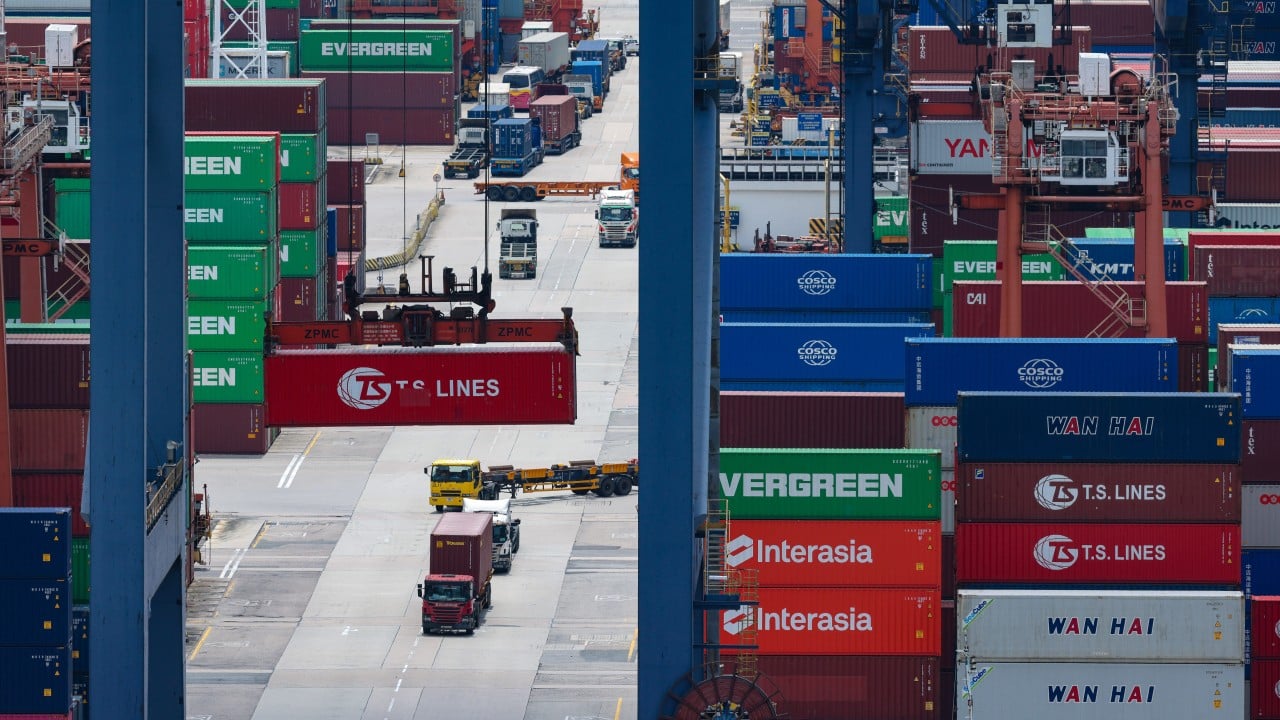
Macroeconomic indicators rarely shift by half in a single baseline cycle without severe structural undercurrents. When total merchandise exports from Hong Kong reached HK$667.9 billion, registering a 53 percent year-on-year expansion, conventional financial commentary categorized the event as a cyclical rebound. This interpretation misses the operational reality. Trade velocity of this magnitude reflects a fundamental realignment in global supply chains, driven by specific technological inputs and shifting intermediary logistics rather than uniform global demand recovery. Deconstructing this expansion requires isolating the primary vectors driving the throughput, the cost functions governing the trade corridors, and the structural vulnerabilities hidden behind record nominal valuations.
The Technological Vector and Product Concentration
The primary driver behind the export acceleration is not a broad-based revival across all industrial sectors, but an extreme concentration in specific high-value nodes. Electrical machinery, apparatus, appliances, and office machines dominate the ledger. Within these categories, automatic data processing equipment and semiconductor-adjacent components account for the vast majority of the marginal gain.
This creates a high-beta trade profile. Hong Kong functions primarily as a high-throughput entrepôt node for microelectronics, graphics processing units, and specialized hardware feeding global artificial intelligence infrastructure. When capital expenditure cycles spike among hyperscale data center operators globally, the physical supply chain routes through specialized logistics hubs. The 53 percent headline figure is largely a derivative of capital equipment deployment cycles for advanced computing hardware rather than organic growth in consumer retail goods.
[Global Hyperscale AI Demand]
       │
       ▼
[Semiconductor & Component Manufacturing]
       │
       ▼
[Hong Kong Intermediary Entrepot Hub]
       │
       ▼
[Final Destination Markets (Re-exports)]
The Intermediary Arbitrage and Logistics Cost Function
To understand why the movement of goods through Hong Kong exhibits such high volatility, one must analyze the cost function of regional transshipment. Hong Kong operates as an optimization layer for document processing, customs clearance, and financial settlement between mainland manufacturing centers and Western consumption markets.
When global supply chains face structural bottlenecks or rapid demand pulses for high-priority technology components, the speed-to-market premium rises. Shippers absorb higher freight rates and inventory holding costs because the margin on advanced electronic components dwarfs logistics overhead. The concurrent surge in imports—scaling at over 50 percent during the same observation window—demonstrates that this is an active processing loop. Goods enter the customs territory to be repackaged, cleared, and re-exported rather than absorbed locally.
This dynamic highlights the operational sensitivity of the entrepôt model. Hong Kong trade statistics do not measure domestic manufacturing output; they measure transaction velocity and routing efficiency. When supply chain routing preferences tilt back toward southern Chinese ports and associated financial gateways, nominal export values experience step-function increases.
Vulnerabilities Beneath the Nominal Record
While headline nominal figures suggest robust economic health, relying on gross trade value introduces severe analytical distortions. Three structural risks threaten this high-throughput model:
- Margin Compression via Input Costs: High-value electronics require precision handling, secure transport, and specialized warehousing. If logistics labor costs and prime industrial real estate expenses in the territory outpace the efficiency gains of the transport network, net economic value capture declines even as gross trade volume expands.
- Geographic Concentration Risk: Because the export surge relies heavily on technology hardware feeding a narrow band of destination markets, any regulatory friction, semiconductor export controls, or capital expenditure slowdown in the primary tech sector will transmit directly into an export contraction. The beta works in both directions.
- Substitution Risk in Logistics Nodes: Regional ports across Southeast Asia and mainland China continually upgrade their customs clearance efficiency and logistics tech stacks. As direct shipping routes bypass traditional intermediary hubs to reduce touchpoints, the long-term structural demand for Hong Kong re-export services faces persistent downward pressure.
Strategic Capital Allocation
Navigating an economy driven by volatile entrepôt trade requires shifting operational focus from gross volume metrics to net margin capture per transaction. Enterprises operating within this logistics corridor must hedge against sudden volatility in hardware demand cycles by diversifying service offerings toward specialized supply chain engineering rather than generic freight forwarding. Capital expenditure should target automated inventory tracking and high-security handling infrastructure to protect operating margins against rising structural overhead. Relying on gross trade milestones as indicators of long-term economic stability creates strategic blind spots; true operational resilience lies in optimizing the velocity of capital through the intermediary chain.