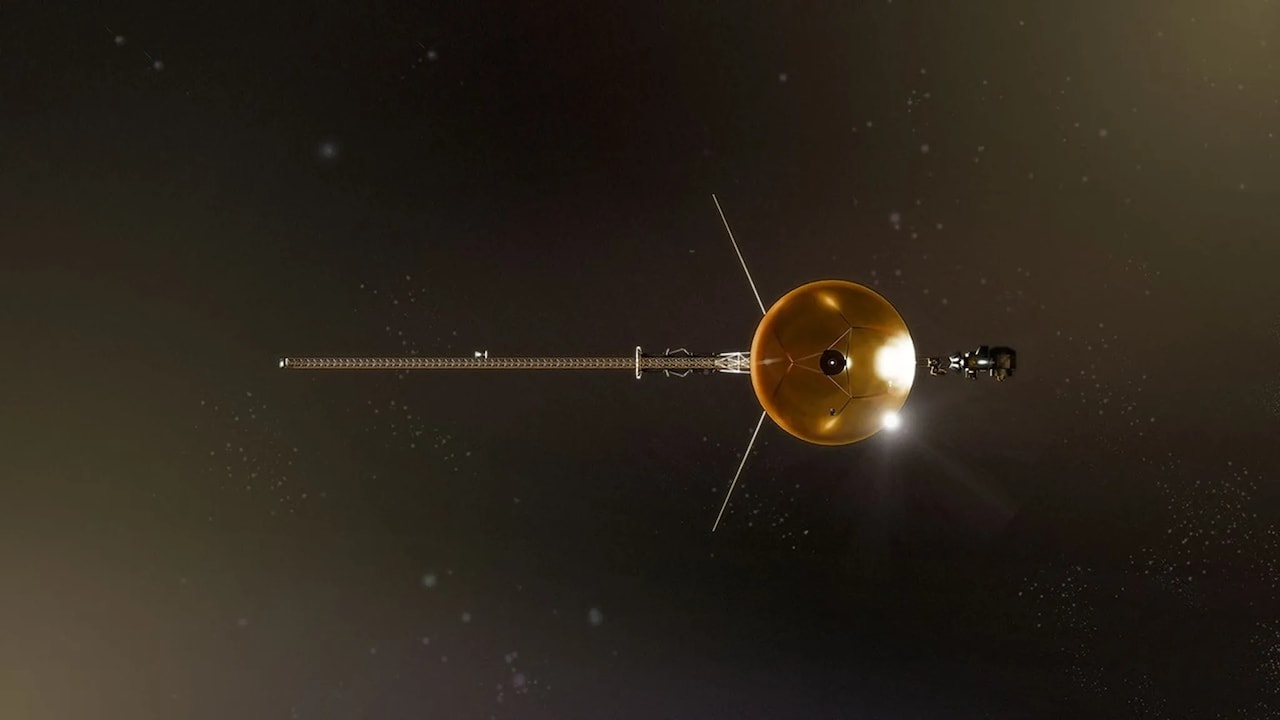
Engineering artifacts built during the Cold War rarely survive fifty months of operation, let alone half a century of deep space traversal. Voyager 1 represents an anomaly in systems design, operating at an extreme distance where the round-trip light travel time exceeds 44 hours. Managing this spacecraft requires navigating severe power degradation, extreme thermal gradients, and signal attenuation that reduces incoming carrier power to fractions of a nanowatt.
The Distance Function and Signal Degradation
The primary bottleneck governing Voyager 1 operations is not hardware obsolescence, but the fundamental physics of inverse-square radiation propagation. As a radio frequency signal travels outward from the spacecraft's 3.7-meter high-gain antenna toward Earth, the wavefront expands spherically, leading to severe power loss per unit area.
The Deep Space Network must capture transmissions arriving at power levels near negative 157 dBm. At this threshold, thermal noise from the receiver electronics and cosmic background radiation threaten to obscure the carrier frequency entirely.
- Transmitter Output Power: Approximately 22 watts from a dual-redundant X-band traveling wave tube amplifier.
- Path Loss: The signal traverses over 24 billion kilometers, resulting in a space loss magnitude that requires Earth-based 70-meter antenna dishes just to maintain a usable signal-to-noise ratio.
- Propagation Delay: A command uplink takes over 22 hours to reach the spacecraft, and telemetry downlink requires an identical duration to register at ground stations in Goldstone, Madrid, and Canberra. Closed-loop control is impossible; every sequence must be pre-programmed, verified, and executed autonomously onboard.
Power Budgets and Isotope Decay
Voyager 1 does not rely on solar panels. Beyond the orbit of Jupiter, solar irradiance drops below operational thresholds for photovoltaic cells, necessitating a radioisotope thermoelectric generator architecture fueled by plutonium-238 dioxide.
The decay of plutonium-238 follows a predictable half-life curve of approximately 87.7 years. Consequently, the thermal output of the three RTGs decreases by roughly 0.79 watts per year, translating directly into a steady reduction in electrical power generation.
Initial Power Output (1977): ~470 Watts
Power Output Milestone (2020s): ~240 Watts
Operational Consequence: Systematic shedding of non-essential subsystems, including instrument heaters and attitude control telemetry loops.
To prevent total system failure, flight operations teams have turned off science instruments, diagnostic sensors, and secondary heaters. Maintaining a positive thermal balance for the remaining core systems—specifically the command and data subsystem and the attitude control computer—requires aggressive power management. When a subsystem draws power, it generates waste heat that prevents propellant lines and thruster valves from freezing in the absolute zero environment of interstellar space.
Interstellar Medium Interaction and Boundary Dynamics
Crossing the heliopause into the local interstellar medium shifted Voyager 1 from a solar-wind-dominated regime to a plasma-density-dominated environment. This transition introduced distinct diagnostic challenges.
Plasma wave science instruments measure the electron density of the interstellar medium directly. Instead of recording the thin, hot solar wind, the instrument captures dense, cold plasma signatures that confirm the spacecraft has escaped the heliosphere's protective magnetic bubble.
- The Termination Shock: The boundary where solar wind decelerates abruptly from supersonic to subsonic speeds relative to the interstellar medium.
- The Heliosheath: The turbulent outer shell of the heliosphere where compressed solar wind interacts with galactic cosmic rays.
- The Interstellar Medium: The unperturbed galactic environment characterized by higher ambient electron densities and interstellar magnetic fields.
Measuring these regions requires interpreting telemetry spikes that travel down the telemetry stream at low bit rates—currently constrained to 160 bits per second via the S-band or X-band transmitters. This narrow bandwidth forces ground controllers to prioritize engineering telemetry over science data collection during power-constrained anomalies.
Architectural Longevity and Software Workarounds
The flight data subsystem relies on custom, radiation-hardened logic hardware designed in the mid-1970s. Memory capacity is exceptionally limited by modern standards, forcing engineers to write highly optimized assembly routines that minimize instruction cycles.
When a memory fault occurred in a portion of the FDS subsystem, recovery teams could not patch the code using standard high-level deployment pipelines. Engineers dissected the memory map bit by bit, relocating routine instructions to unused storage blocks and rerouting pointers to bypass corrupted hardware addresses over a 44-hour communication loop.
The long-term viability of the mission depends entirely on thermal inertia and thruster branch management. As attitude control thrusters fire to keep the high-gain antenna pointed precisely at Earth, the fuel lines accumulate combustion byproducts that degrade thruster efficiency. Mitigating this degradation involves switching to secondary thruster branches that have remained dormant for decades, a process requiring careful thermal pre-heating to avoid structural fracture of the propellant tubing.
Execution requires prioritizing structural survival over data return. As the RTG output continues its linear decline, mission controllers must systematically decommission active instruments one by one, trading scientific yield for extended spacecraft lifetime until the final telemetry packet fades below the noise floor of the Deep Space Network.