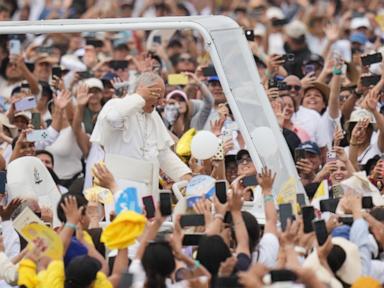
In January 2018, during a crowded motorcade in Trujillo, Peru, a woman threw a rosary toward Pope Francis, striking him directly in the face and leaving a visible bruise under his left eye. The incident made headlines worldwide not because of malice, but because of the Vatican's response. Rather than pressing charges or tightening the perimeter, the pontiff publicly forgave the thrower, turning a startling security breach into a global lesson on radical grace and the impossible physics of protecting a populist pope.
The physical mechanics of the moment were deceptively simple. A plastic or wooden bead necklace, tossed from several yards away by an enthusiastic pilgrim hoping for a blessing, turned into a blunt-force object the instant it met the forward momentum of an open-top vehicle. The popemobile was moving at a steady crawl through a sea of hundreds of thousands of people lining the streets of Peru's third-largest city. In that environment, even a well-intentioned gift carries kinetic energy.
For veteran security analysts who have spent decades watching Vatican protocols evolve, the Trujillo incident was never really about a stray rosary. It was about the inherent contradiction at the center of modern papal protection.
The Physics of the Open-Top Popemobile
To understand how an object can strike the leader of the Catholic Church in the face, you have to look at the vehicle itself. After the 1981 assassination attempt on Pope John Paul II in St. Peter's Square, the Vatican introduced bulletproof glass enclosures onto the popemobile. For decades, that thick transparent barrier defined the visual language of papal travel. It kept the pontiff visible while neutralizing the threat of small-arms fire and thrown objects.
Pope Francis systematically dismantled that protocol. Almost immediately after his election in 2013, he rejected the enclosed vehicles, famously comparing the bulletproof glass box to a "sardine can" that walled him off from the people he came to see. By insisting on open-sided vehicles during international trips—including his 2018 apostolic journey to Chile and Peru—he deliberately traded ballistic protection for human proximity.
That decision fundamentally altered the risk calculation for the Corps of Gendarmerie of the Vatican City State and the local tactical units tasked with securing the route. When a head of state rides in an open vehicle, the threat profile shifts immediately from high-velocity projectiles to low-velocity, high-volume clutter.
Crowds in Latin America, where Catholicism carries a deeply tactile, physical expression of faith, do not merely wave. They throw flowers, hats, letters, flags, scarves, and religious articles toward the vehicle, hoping the items will touch the pope or his clothing and become third-class relics.
In Trujillo, a city still recovering from devastating El Niño floods the previous year, the emotional intensity along the motorcade route was extraordinarily high. People pressed against metal barricades five and six deep. Security officers walking alongside the vehicle—the human shield known as the close-protection detail—had to track thousands of hands simultaneously. Catching every airborne object in a crowd of that density is mathematically impossible. One rosary slipped past the outstretched hands of the bodyguards, arched through the air, and caught the pontiff squarely near the eye.
Why the Vatican Never Pressed Charges
Most state security apparatuses operate on strict deterrence. If someone throws an object at a president or prime minister, regardless of intent, local law enforcement detains the individual, confiscates the item, and pursues charges ranging from disorderly conduct to assault. The logic is straightforward. Failing to punish a breach invites copycats and signals vulnerability.
The Holy See operates under an entirely different doctrine. When the rosary struck Francis, he flinched, rubbed his eye, and kept waving. Later, the Vatican press office confirmed that the pope was uninjured beyond minor bruising and had no desire to see the woman punished. The message from Rome was unambiguous: an act of clumsy devotion is not a crime.
This posture has deep historical roots in the modern papacy. The most famous precedent occurred in December 1983, when Pope John Paul II visited Rome's Rebibbia prison to meet privately with Mehmet Ali Ağca, the Turkish gunman who had shot him four times in St. Peter's Square two years earlier. John Paul II held the assassin's hand, spoke with him quietly for twenty minutes, and publicly declared that he had forgiven him completely.
While a stray rosary in Peru bears zero moral equivalence to an assassination attempt, the institutional reflex is identical. For the Vatican, public forgiveness is not a PR strategy designed to soften a news cycle. It is the core product. A pope who demands the arrest of an overzealous grandmother for throwing a rosary undermines the central theological claim of his office.
Yet that theological commitment creates an acute operational headache for the men and women paid to keep him alive.
The Invisible War Between Access and Protection
Inside the Vatican's security apparatus, led for years by veteran commanders like Domenico Giani and later Gianluca Gauzzi Broccoletti, every international trip requires months of negotiation between two competing mandates. The first mandate comes from the Apostolic Palace and the Secretariat of State: the pope must be accessible to the poor, the sick, and the faithful on the margins. The second mandate comes from basic executive protection standards: keep the principal away from uncontrolled crowds.
In executive protection circles, this is known as the access-versus-security paradox. Standard VIP security relies on layers of containment—magnetometers, sterile zones, elevated motorcade speeds, and armored glass. When the principal refuses those layers, security teams have to rely on intelligence, crowd psychology, and physical agility.
During the 2018 trip to Peru, local police deployed tens of thousands of officers across Lima, Puerto Maldonado, and Trujillo. Snipers occupied rooftops. Bomb-sniffing dogs swept the routes hours before dawn. Plainclothes officers infiltrated the crowds along the barricades to watch for suspicious behavior.
None of those countermeasures stop a 60-year-old devotee holding a plastic rosary.
Threat assessment teams train their eyes to spot indicators of hostile intent—bulging jackets, rigid posture, fixation on the target, or attempts to breach physical barriers. A pilgrim smiling, crying, and tossing a religious item exhibits none of the behavioral markers of an attacker. By the time the arm moves upward and releases the object, the reaction window for a close-protection agent walking beside a moving vehicle is measured in fractions of a second.
What Happens to the Object After Impact
One of the least understood aspects of these motorcade incidents is the immediate aftermath inside the vehicle. When an object lands inside the popemobile, it does not simply get tossed back into the street.
Close-protection officers riding on the rear step of the vehicle or walking immediately adjacent to the doors are trained to scoop up thrown items instantly. Anything heavy, sharp, or unidentifiable is immediately sequestered for inspection. Soft items like letters, scarves, and rosaries are typically collected in bags carried by support personnel following in the secondary vehicles.
In the case of the Trujillo rosary, the impact was visible on international television feeds within seconds. Photographers traveling on the press flatbed truck directly ahead of the popemobile captured the swelling under the pontiff's left eye almost immediately. By the time the motorcade reached its next stop, the bruise had darkened, giving the 81-year-old pope the appearance of a boxer who had just gone three rounds.
Rather than retreating from the cameras or applying heavy makeup to conceal the mark, Francis carried on with his schedule in Trujillo, presiding over an outdoor Mass before hundreds of thousands of people and visiting the impoverished Buenos Aires neighborhood, which had been devastated by mudslides. The bruise remained visible for days, serving as a quiet reminder of the physical vulnerability he had willingly accepted.
The Pattern of Close Calls in Modern Papal Travel
The Trujillo rosary strike was not an isolated fluke. Throughout his papacy, Francis experienced a string of physical collisions with enthusiastic crowds that would have triggered major security overhauls for any secular world leader.
In 2015, during a visit to Morelia, Mexico, a crowd surged forward while Francis was greeting people along a barricade, pulling him off balance and causing him to fall onto a person in a wheelchair. The pope recovered quickly, though cameras caught a rare flash of visible frustration on his face as he scolded the crowd for being selfish and crushing those at the front.
In 2017, during a motorcade in Cartagena, Colombia, the popemobile braked suddenly to avoid hitting someone in the crowd. Francis, standing and holding onto the safety rail, pitched forward and struck his face against the vertical support bar of the vehicle's canopy. He suffered a deep cut above his left eyebrow and a bruised cheekbone, staining his white cassock with blood. When asked about the injury later that day, he joked with reporters that he had been "punched" and was fine.
Two years after Peru, in December 2019, a woman in St. Peter's Square grabbed Francis's hand and yanked him violently toward the barrier while he was walking past pilgrims on New Year's Eve. Caught off guard and pulled backward, the pontiff slapped the woman's hand twice to free himself before walking away. The next day, during his Angelus address, he publicly apologized for losing his patience, admitting that even he sets a bad example at times.
Taken together, these incidents reveal a consistent operational reality. When a global figure steps into dense, emotionally charged crowds without physical barriers, minor injuries are not a failure of security. They are a statistical certainty.
Why Crowds Throw Objects at Religious Figures
To outside observers, throwing a hard object at someone you claim to revere seems completely irrational. In the anthropology of popular religion, however, the impulse makes complete sense.
Across many Catholic cultures, particularly in Latin America and Southern Europe, faith is deeply physical. Pilgrims travel vast distances and wait in the sun for twelve hours not just to see the pope, but to establish some tangible point of contact. In Catholic tradition, an object that has touched a holy person or a sacred site becomes a sacramental—a physical sign of spiritual blessing.
When the popemobile passes by at ten miles per hour, barriers prevent ninety-nine percent of the crowd from reaching the vehicle. Throwing a rosary, a baby's shoe, or a prayer card is a desperate attempt to bridge that ten-foot gap. The pilgrim hopes the item will land in the vehicle, touch the pope's hands or robes, and be tossed back by a guard.
Security planners know this dynamic well, yet they cannot ban people from bringing rosaries to a papal event. Local bishops and event organizers routinely broadcast announcements before motorcades, urging crowds not to throw items at the vehicle for safety reasons. Those warnings almost always fail the moment the white vehicle rounds the corner and the roar of the crowd drowns out the loudspeakers.
The Unsolvable Dilemma of Modern Protection
Could the Vatican eliminate this risk tomorrow? Technically, yes. Reintroducing the enclosed bulletproof glass cabin, elevating motorcade speeds to twenty-five miles per hour, and pushing crowd barricades back fifty feet would drop the probability of a thrown-object injury to near zero.
The cost, however, would be measured in relevance. The visual power of the papacy in the twenty-first century depends heavily on contrast. In an era where politicians, billionaires, and celebrities move through public spaces surrounded by heavy armor, tinted glass, and aggressive security perimeters, a world leader standing exposed in an open truck sends an unmistakable signal.
The bruise under Pope Francis's eye in Trujillo became an enduring image precisely because it broke the polished, untouchable aura of global leadership. It showed an elderly man taking an accidental hit from one of his own followers, absorbing the pain, and refusing to retaliate.
For security professionals, that willingness to bleed for accessibility remains the hardest variable to manage. You can train bodyguards to intercept knives, scan rooftops for rifles, and sweep streets for explosives. You cannot armor-plate a leader who insists on standing in the open, and you cannot deter a crowd when the target himself forgives the thrower before the bruise has even finished forming.


