Dust gets everywhere. In the dry seasons of Rwanda, it coats the leaves of eucalyptus trees, settles deep into the creases of worn work shirts, and hangs like a golden haze over the dirt roads of Kigali. For generations, that dust was just an annoyance. Then came the plastic.
It arrived quietly. First as flimsy carrier bags carried home from open-air markets, then as discarded water bottles tossed from buses, and eventually as a rising tide of multi-colored polymer film that snagged on thorn bushes and choked the drainage ditches. You can sweep it up, but it stays. You can burn it, but the acrid smoke fills your lungs with ghosts.
Consider a hypothetical afternoon in a neighborhood on the outskirts of the capital. A mother named Chantal stands outside her modest home, looking down at a cracked concrete threshold. Rain is coming. The seasonal downpours in this part of East Africa do not merely fall; they strike. They turn the red earth into slick grease, undermine foundations, and test every roof sheet for weakness. Chantal’s home has weathered ten rainy seasons, but the floor is giving way, eroded by moisture seeping up from the ground, and the metal sheets overhead rattle a frantic warning against the wind.
She needs building materials. Real ones. Durable ones. But importing fired clay bricks or hauling heavy, traditional cement blocks costs money she earned through grueling hours at the local weaving cooperative—money that also needs to pay for school fees and maize.
So what do you do when the earth beneath your feet is washing away, and the landscape around you is filling with indestructible trash?
You look closer at the trash.
Researchers at institutions in Rwanda did not start this journey with a massive industrial plant or a fleet of carbon-fiber drones. They started with a pile of discarded polyethylene—the stuff grocery bags are made of—and a pile of organic waste that most people walk right past.
Sisal.
If you have never held a raw sisal leaf, imagine a rigid, sword-shaped dagger thick with moisture and fierce plant defense. Inside that tough green exterior lie fibers so strong they have been used for centuries to make marine rigging and heavy-duty twine. When raw plastic melts, it is chaotic. It pools, it smokes, it drips unpredictably, and on its own, it lacks structural integrity. It behaves like hot glass—brittle under stress, prone to snapping when a heavy boot comes down hard.
But add sisal fiber to that molten matrix, and something remarkable happens.
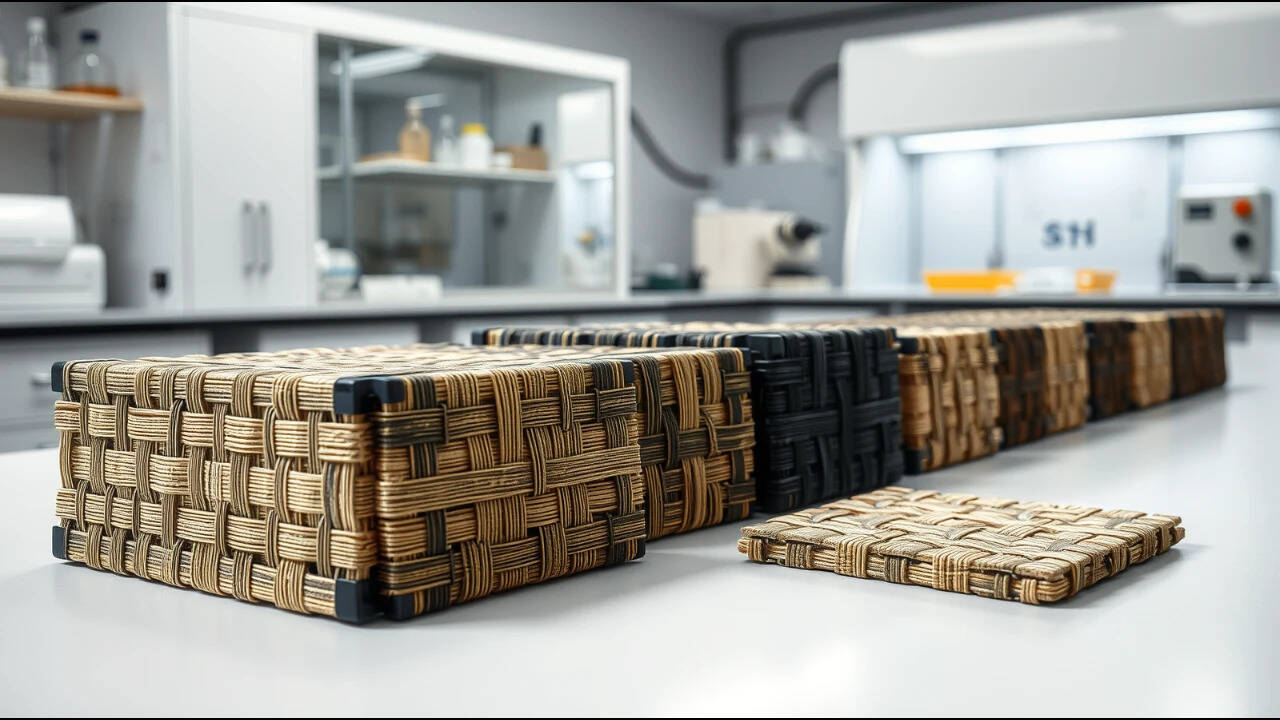
Think of it the way ancient builders mixed straw into mud bricks. The clay provided the mass, but the straw provided the tensile strength, acting as a microscopic web that caught fractures before they could spread. In the modern laboratory experiments that birthed the sisal-reinforced plastic tile, shredded waste plastic acts as the waterproof binder, while natural sisal fibers act as the skeleton.
When researchers pressed these composite materials into roof and floor tiles under controlled heat and pressure, they found something extraordinary. The tiles did not shatter under a heavy hammer blow. They did not absorb water during simulated monsoon tests. And most importantly, they transformed a municipal liability into shelter.
Walk into a test facility where these tiles are cured, and you will notice the sensory contrast immediately. There is no chemical reek of burning petroleum. Instead, there is a faint, earthy aroma of heated plant matter—sisal meeting polymer—hanging in the humid air. The tiles themselves do not look like cheap plastic novelties. They have a dense, matte texture, speckled with the subtle, fibrous grain of natural rope. They look heavy. They look permanent.
Why does this matter beyond the laboratory walls? Because construction in developing urban and rural communities is a quiet crisis of cost and logistics. Traditional fired clay bricks require massive amounts of firewood, driving deforestation in regions where trees are desperately needed to anchor topsoil. Cement production is one of the world's leading industrial contributors to carbon emissions, and every bag hauled up unpaved hillside roads adds to the price tag of a family home.
Meanwhile, municipal waste streams are clogged with packaging materials that municipal authorities struggle to manage.
The equation is brutal in its simplicity. Too much plastic. Too little affordable timber or brick. Too many homes vulnerable to weather extremes.
The sisal-reinforced tile cuts straight through that Gordian knot. It takes the very waste choking the drainage canals and repurposes it into the very shield families need to stay dry.
Imagine Chantal walking into a community center built with these composite floor tiles. The rain is hammering down outside, sending sheets of water across the courtyard. Inside, the floor remains completely dry. There is no damp chill rising from the ground. When she taps her knuckles against the dark, textured surface, it gives a dull, solid thud—the sound of resilience.
This is not a story about high-tech wizardry funded by distant venture capitalists. It is a story about local ingenuity looking at a local problem and refusing to accept the standard limitations. It is about recognizing that the materials of the future do not need to be mined from pristine quarries or synthesized in sterile cleanrooms. Sometimes, they are already lying in a ditch, waiting for someone clever enough to weave them together.
The rain continues to fall outside, drumming a relentless rhythm against the tin roofs of the city. But down below, where the foot traffic is heaviest and the earth is softest, a new kind of stone is taking root. It is made of grocery bags and stiff green leaves, pressed together under heat and human will, standing guard against the weather.


