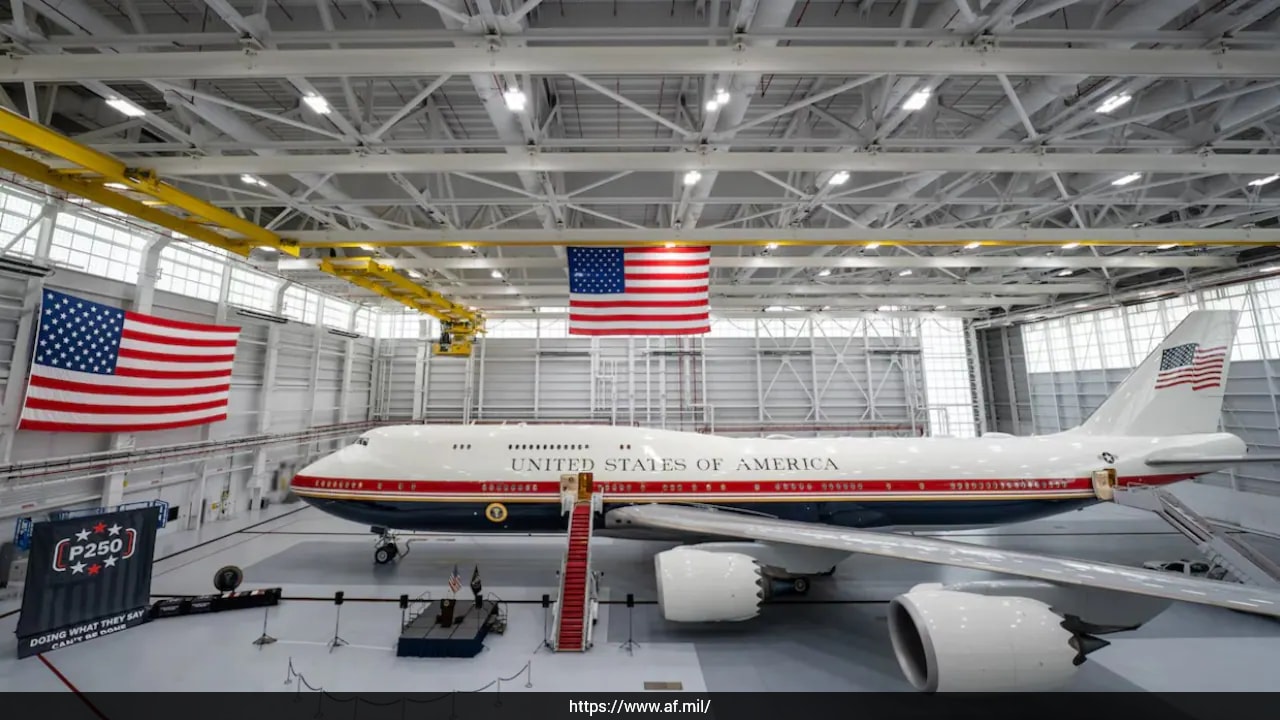
You don't expect the leader of the free world to travel in a second-hand royal yacht of the skies, let alone one given away by a foreign emir. Yet, the giant Boeing 747-8 sitting at Joint Base Andrews tells a completely different story. It replaces the iconic, decades-old plane we all know from the movies, turning decades of military protocol upside down.
This isn't just an upgrade. It's a massive shift in how the American presidency projects power globally.
The United States government accepted a $400 million Boeing 747-8 jumbo jet from the Qatari royal family. For months, critics shouted about conflicts of interest and security vulnerabilities. Supporters praised it as a brilliant way to save taxpayers hundreds of millions of dollars. Now, the plane is painted in a deep navy blue, red, and gold paint scheme, ready to carry the commander-in-chief to international summits.
What most people get completely wrong about this aircraft is the idea that it's just another military transport with nicer seats. It's a flying palace that trades classic American military minimalism for Middle Eastern luxury, and the details behind how it got here are wilder than you think.
The Bridge Plane Solving a Billion Dollar Logjam
To understand why the Pentagon accepted a luxury jet from Qatar, you have to look at the massive failure of the original Air Force One replacement program.
Boeing has been under contract since 2017 to deliver two heavily modified 747-8s to replace the aging VC-25A fleet, which has been flying since the George H.W. Bush era. Those older planes are expensive to maintain. Parts are scarce. They are basically flying museums.
But the new Boeing program ran into severe delays, supply chain disasters, and spiraling costs. The planes were supposed to be ready years ago. Instead, the timeline slipped all the way to 2028. Facing the reality that the current presidential planes might not survive the intense travel schedule of a second term, the administration looked for a shortcut.
Enter the Qatari royal family. They had a pristine, barely used Boeing Business Jet variant sitting in their hangar. It was valued at roughly $400 million. Last year, the administration cut a deal to accept the aircraft. The Pentagon designated the plane as the VC-25B Bridge. It serves as a literal stopgap to keep the executive branch moving until Boeing can deliver the permanent fleet.
Middle Eastern Luxury Meets American Military Might
If you walked inside the traditional Air Force One, you'd find functional spaces. It looks like a high-end government office building that happens to fly. There are brown leather chairs, utilitarian conference tables, and workspaces designed for staff to grind through policy papers at 30,000 feet.
The Qatari jet tears up that playbook completely. The Air Force explicitly stated that it prioritized operational readiness over aesthetics, meaning they left the original interior layout minimally changed.
The original interior was designed by the famous Cabinet Alberto Pinto. We are talking about custom rugs from Tai Ping Carpets, premium sycamore and wacapou wood fixtures, and high-end artwork. The layout features:
- Two full bathrooms and nine additional lavatories
- A massive master bedroom suite alongside a dedicated guest bedroom
- Multiple lounge areas equipped with cream and tan leather seating
- A private executive office outfitted with gold accents and dark wood paneling
American technicians added the mandatory operational touches. The seat belts now sport the presidential seal. A framed print of the newly refurbished Reflecting Pool hangs on one of the main walls.
But while the luxury remains intact, defense contractor L3Harris spent months ripping into the plane's skin to install military hardware. A presidential aircraft must survive a nuclear blast, navigate through heavy electronic warfare jamming, and maintain secure communications with nuclear missile silos. The Pentagon claims the plane is fully secure, but the blend of royal luxury and secret defense tech is entirely unprecedented.
The Legal Loopholes and the Future Presidential Library
Accepting a $400 million gift from a foreign government isn't exactly standard operating procedure for an American president. The Foreign Emoluments Clause of the U.S. Constitution strictly limits what officials can receive from foreign powers to prevent undue influence.
The legal gymnastics required to pull this off involved heavy coordination between Attorney General Pam Bondi and White House counsel David Warrington. They determined that the gift is legally permissible because it wasn't given to an individual. It was given to the United States government.
There's a fascinating catch in the paperwork. Right before the current term ends, the aircraft will be officially transferred out of the military fleet and into a private presidential library foundation. This allows the plane to be preserved as a historical exhibit, but it also creates a bizarre scenario where a highly modified, military-grade jumbo jet transitions directly from the executive airlift wing into private hands.
Taxpayers didn't get out completely clean either. While the plane itself was free, overhauling it and installing the secure defense systems cost just under $400 million. The Air Force also had to spend millions building a massive new hangar at Joint Base Andrews because the 747-8 is significantly larger than the older 747-2 models. Crews even had to build a full three-dimensional physical mockup of the interior so pilots and secret service agents could practice navigating the new layout before the actual plane arrived.
What Happens Next for the Presidential Fleet
The new Air Force One is scheduled to lead a massive flyover of Washington for the nation's 250th birthday on July 4. After that, it takes over the heavy lifting for major international trips, including the upcoming NATO summit in Ankara, Turkey.
If you want to track how this changes global diplomacy, look at how other world leaders react when this massive, gold-and-navy beast touches down on foreign tarmac. It's no longer just a symbol of American industrial power. It's a statement about a new era of personalized, high-stakes international deals.
Keep an eye on the upcoming defense budget hearings. Lawmakers are already asking hard questions about why an interim plane could be retrofitted so quickly for under $400 million, while the permanent Boeing project is years behind schedule and costing billions. The success or failure of this Qatari bridge plane will likely rewrite the rules for how the military purchases VIP transport aircraft for the next fifty years.