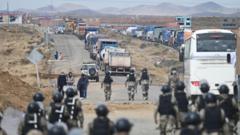
Bolivian Minister of Public Works Mauricio Zamora survived two separate dynamite ambushes orchestrated by anti-government protesters on the La Paz–Oruro highway while leading a military and police convoy to clear critical roadblocks. The assault forced a retreat of security forces and left the cabinet member’s whereabouts unknown for several tense hours. This escalation marks a terrifying transformation in Bolivia's political crisis, moving from standard civic disruption to a armed insurrection designed to bring down the state.
For three weeks, the landlocked South American nation has fractured under a wave of aggressive road blockades. While international observers initially classified the unrest as standard economic pushback against President Rodrigo Paz, the targeted hunting of a cabinet minister reveals a deeper, more calculated plot. This is no longer an economic protest. It is a coordinated attempt to paralyze the nation, isolate its major urban centers, and bypass democratic institutions through sheer violence. For a different perspective, check out: this related article.
The Highway Ambush
Minister Zamora departed La Paz at dawn leading the Banderas Blancas (White Flags) humanitarian corridor operation. The convoy consisted of roughly 2,000 police and military personnel driving 150 vehicles. The explicit mission was to reopen the 227-kilometer artery linking the seat of government to the city of Oruro, allowing food, fuel, and medical supplies to reach stranded populations.
The white flags meant nothing to the cells waiting on the altiplano. Related coverage on the subject has been provided by TIME.
Protesters attacked the convoy at La Ventilla and Achica Arriba using stones and crude barriers. The operation deteriorated completely when the convoy reached the community of Copata. There, organized groups launched industrial dynamite from the high cliffs flanking the asphalt.
"The villagers did not only start to ambush us from the front," Zamora stated after resurfacing in a secure location. "They were coming from behind."
A police radio frequency intercepted during the battle captured a protest leader transmitting orders in real-time. The command was explicit: "We have to bring him down." This was a directive to assassinate or capture a sitting government minister, mirroring the infamous 2016 lynching of Deputy Interior Minister Rodolfo Illanes by striking miners. Realizing the tactical disadvantage, military and police commanders ordered a hasty retreat, leaving the highway firmly under insurgent control.
The Mechanics of the Siege
To understand how a decentralized group of protesters can hold a state hostage, one must look at Bolivia’s unique geography. The country relies heavily on a few narrow, high-altitude transport corridors that connect agricultural lowlands like Santa Cruz to the mountainous political centers of Cochabamba and La Paz.
By dropping dynamite to trigger rockslides or felling trees across these specific choke points, small groups can completely choke the national economy.
| Region / Highway Impact | Primary Commodity Blocked | Economic Impact |
|---|---|---|
| La Paz–Oruro Axis | Fuel, imported goods, humanitarian medical supplies | Total isolation of the administrative capital |
| Cochabamba Corridors | Poultry, dairy, basic grains | Skyrocketing food scarcity across urban centers |
| Santa Cruz Arteries | Soy, beef, export-bound agricultural products | Massive losses in foreign currency reserves |
The economic cost of these blockades has reached a staggering $100 million to $150 million per day. But the human toll is worse. At least four citizens have died due to the blockades: three because emergency medical vehicles could not navigate past the boulders and burning tires, and one during active street clashes.
The Shadow of Fugitive Politics
The rhetoric blaring from the protest barricades claims this fight is about inflation, currency shortages, and fuel lines. The reality is far more cynical. This insurrection is the direct result of a fractured ruling party and a powerful faction's desperation to shield its leadership from criminal prosecution.
The blockades are heavily concentrated in regions loyal to former President Evo Morales, who has been banned from running in upcoming presidential elections by the Constitutional Court. More pressingly, Morales faces active warrants regarding allegations of statutory rape and human trafficking dating back to his time in office.
By weaponizing his rural, indigenous base, the former president is using the street to demand what he cannot achieve via the ballot box or escape in a courtroom. The strategy is simple: create total chaos, starve the capital, force President Rodrigo Paz to resign, and secure blanket immunity.
The administration’s attempts at dialogue have backfired completely. While President Paz spoke to international media expressing his willingness to negotiate, his ministers were dodging explosives on the highway. The government's soft-handed approach, intended to avoid creating martyrs, has instead signaled weakness to the insurgent factions.
A Failed State in the Making
The ambush of Mauricio Zamora changes the rules of engagement. When a sovereign state cannot guarantee the safety of its own military-backed cabinet ministers on a primary national highway, its monopoly on force has effectively evaporated.
The international community routinely misinterprets Bolivian unrest through a romanticized lens of grassroots indigenous activism. This perspective ignores the sophisticated logistics driving the current crisis. The protesters are well-funded, armed with commercial explosives, and guided by centralized communications networks.
President Paz faces a critical dilemma. Continuing to pursue peaceful dialogue with actors who utilize targeted ambushes risks a complete collapse of state authority. Conversely, deploying the full kinetic force of the military to clear the roads will inevitably lead to bloodshed, playing directly into the hands of opposition leaders who want to frame the administration as a brutal dictatorship.
The Banderas Blancas initiative proved that symbols of peace hold no currency on the Altiplano. Bolivia is no longer dealing with a political disagreement or an economic strike. It is dealing with a slow-motion coup d'état carried out mile by mile, highway by highway, stick of dynamite by stick of dynamite.