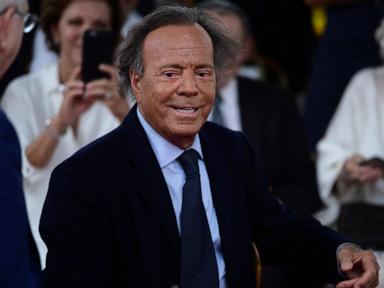
The velvet curtain never really drops for a man who has sold three hundred million records. Even in retirement, even in the quiet, sun-drenched stillness of a Caribbean estate, the applause lingers in the architecture. It lives in the high ceilings, the heavy mahogany doors, and the unspoken deference of everyone who crosses the threshold.
For decades, Julio Iglesias was not merely a singer. He was an atmosphere. He was the baritone murmur in your grandmother’s living room, the glossy vinyl sleeve tucked into a mahogany cabinet, the ultimate embodiment of the romantic Latin lover whose charm seemed as effortless as breathing. When news broke that Spain’s High Court—the Audiencia Nacional—had opened an investigation into allegations of sexual misconduct against him, the collective gasp across Madrid, Miami, and Buenos Aires wasn't just about legal liability. It was the sound of a cultural monument cracking down the middle.
Wait.
Before we rush to take sides, before we retreat into the comfortable tribalism of celebrity defense or instant condemnation, we need to look closely at the room where this story actually takes place. Because this isn't really a story about a famous singer. It is a story about what happens when absolute fame builds a private kingdom where the normal rules of gravity—and accountability—cease to function.
The Architecture of Untouchability
To understand how an accusation against a global icon reaches the desks of magistrates in Madrid, you have to understand the ecosystem of extreme celebrity. Imagine, for a moment, a hypothetical scenario. Picture a young woman—let’s call her Elena, though her real name is shielded by the strict privacy protocols of the Spanish judiciary—stepping onto a sprawling, gated property in the Dominican Republic or the Bahamas. She is there to work. Perhaps she is a domestic staffer, a physical therapist, or an administrative assistant hired to keep the machinery of a billionaire’s life running smoothly.
Inside those gates, the outside world ceases to exist. There is no human resources department. There is no union representative standing by the water cooler. There is only the Principal—the man whose face is on postage stamps and platinum plaques, the man whose signature pays for your mother’s medication and your brother’s schooling.
In that environment, power isn't a loud, cartoonish villain twirling a mustache. It is the air pressure in the room. It is the subtle shift in a conversation when a door clicks shut. It is the terrifying math a worker has to do in three seconds flat: If I object to this touch, if I pull away from this embrace, do I lose my job, my visa, my reputation, and my family’s livelihood?
I have spent years covering the fallout of institutional silence, sitting across from people whose voices shook so hard they could barely hold a paper cup of water. What strikes you first isn't anger. It is exhaustion. It is the sheer, crushing weight of carrying a secret that everyone around you pretends is just "the way things are." For decades, the entertainment industry operated on a tacit agreement: genius excuses appetite. Charm absolves intrusion. If a man sings about love to millions, we forgive him for confusing possession with affection behind closed doors.
The allegations brought before Spain’s High Court shatter that quiet bargain. According to court filings and investigative reporting that brought these claims into the light, former female employees alleged a pattern of inappropriate sexual behavior, unwanted physical contact, and abuses of power within the singer’s private residences. While the legal proceedings examine the specific merits, timelines, and jurisdictional reach of these accusations, the emotional core of the case is already glaringly clear.
Why Madrid Is Listening Now
You might wonder why a Spanish court is examining events alleged to have occurred thousands of miles away on private estates in the Caribbean. Legally, the answer lies in the reach of Spanish jurisdiction over its citizens for certain serious offenses committed abroad, a mechanism designed precisely to prevent wealth and geography from becoming a permanent shield against justice.
Culturally, however, the answer is far simpler. Spain has changed.
Think of the legal system like a massive, rusted iron gate. For generations, that gate barely budged when the person standing behind it was a national treasure. In the 1970s and 1980s, Julio Iglesias was Spain’s greatest soft-power export, a suave ambassador who conquered the Anglo-Saxon market without ever losing his accent. Critiquing him felt almost unpatriotic. When old television interviews resurface today—clips showing the singer forcefully kissing female hosts or making remarks that would end a career in ten seconds flat in 2026—they serve as a jarring time capsule. Back then, the studio audience laughed. The hosts smiled tightly and moved on.
That laughter was the mortar that held the wall of silence together.
Over the last decade, particularly following seismic shifts in Spanish jurisprudence—most notably the legislative reforms sparked by high-profile consent cases that redefined how courts evaluate coercion and intimidation—the burden of proof has begun to evolve. The law no longer asks only whether a victim fought back with nails and teeth. It asks whether the environment itself made refusal impossible. It examines the invisible walls of economic dependency, isolation, and status.
When the Audiencia Nacional agrees to investigate, it is not issuing a verdict. Presumption of innocence remains the bedrock of any civilized court, and Iglesias’s legal team has vigorously defended his reputation, challenging the veracity and context of the claims. Every accused person deserves a rigorous defense, and every fact must survive the harsh glare of cross-examination. Yet the mere existence of the inquiry signals that the velvet curtain no longer blocks the view of the magistrate.
The Heavy Cost of Nostalgia
There is a specific kind of grief that hits fans when a beloved artist is accused of misconduct. It feels almost personal, like discovering a dark secret about an uncle whose stories you grew up loving. You want to push it away. You want to say, He’s eighty-something years old, why bring this up now? or That was just how men of his generation acted.
I get that impulse. Honestly, I do. Nostalgia is a warm blanket, and cold legal documents are a brutal wake-up call. Nobody wants to stain the soundtrack of their parents' youth. When To All the Girls I've Loved Before plays over the speakers in a quiet restaurant, it evokes memory, warmth, and a simpler era. Letting reality intrude on that melody feels like a theft.
But consider what happens when we let nostalgia override accountability.
If we decide that a man’s age, his net worth, or his cultural legacy grants him immunity from scrutiny, we are sending a crystal-clear message to every young worker stepping into a powerful person's orbit today. We are telling them that their bodily autonomy is negotiable if the person across from them is famous enough. We are saying that the pain of an ordinary person weighs less on the scales of justice than the comfort of a legend.
The confusion people feel right now—the tension between admiring the art and questioning the artist—is not a flaw in our thinking. It is the exact friction required for moral growth. You do not have to burn your old vinyl records to acknowledge that the man who sang on them must answer to the same laws as a construction worker in Seville or a nurse in Valencia.
What Happens in the Quiet Rooms
Step back into that hypothetical Caribbean estate for one last look. Strip away the fame, the private jets, the Grammy awards, and the decades of adoration. Strip it all down to two human beings standing in a hallway.
One holds all the cards—the money, the influence, the power to open or slam every door in the industry. The other holds only their dignity and the hope that their boundaries will be respected without them having to beg for it.
When a court steps into that hallway years later, it isn't trying to rewrite music history. It cannot erase the melodies that defined a generation, nor can it undo the genuine joy millions of listeners found in those songs. What it can do—what it must do—is establish that no estate is big enough to sit outside the law, and no voice is famous enough to drown out the quiet testimony of someone who finally decided to speak.
The investigation in Spain will wind its way through depositions, motions, and evidentiary hearings, moving at the slow, deliberate pace of justice. Headlines will flare up and fade away as the news cycle hungers for fresh spectacle.
Yet somewhere in a magistrate's office in Madrid, a stack of paper sits on a wooden desk, holding the weight of lives that were never meant to be footnotes to a superstar's biography. And for the first time in half a century, the music has stopped long enough for someone to actually read every single page.