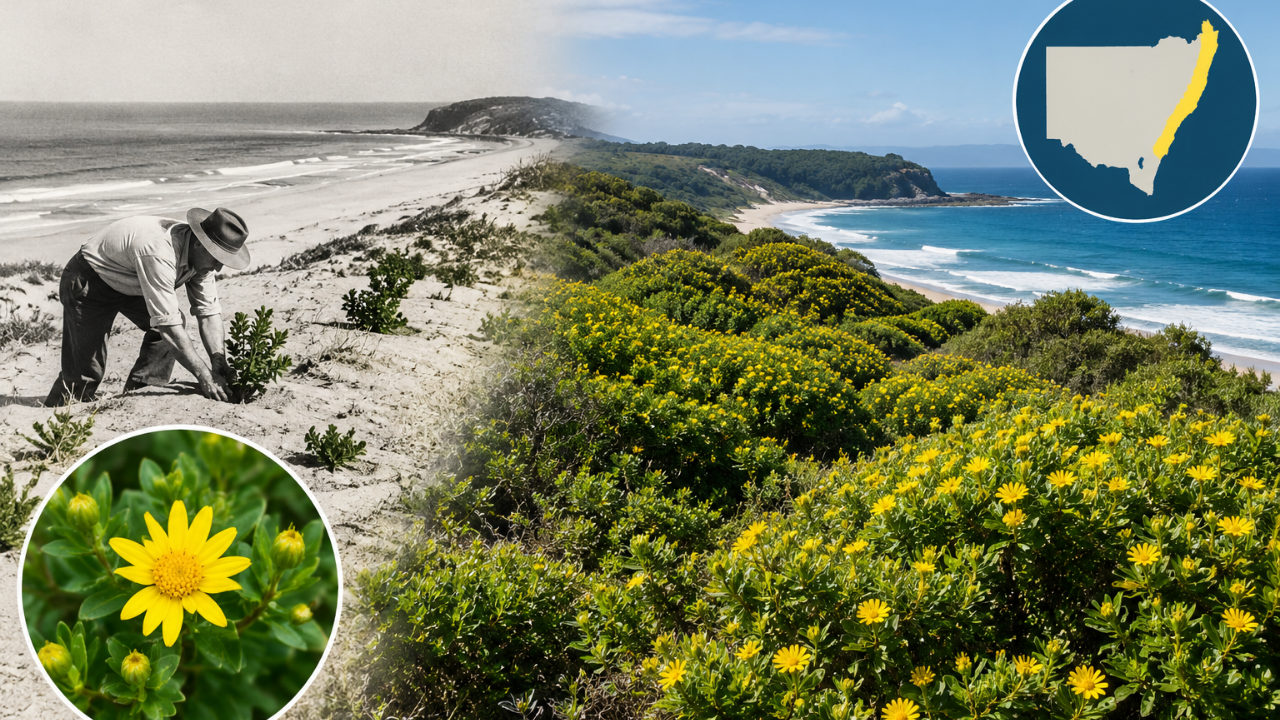
The introduction of exotic species for environmental remediation often triggers unintended macro-level consequences, shifting a localized structural fix into a systemic ecological liability. Beginning in 1946, the New South Wales government systematically planted the South African bitou bush, known scientifically as Chrysanthemoides monilifera subsp. rotundata, across coastal sand masses to arrest wind erosion and stabilise shifting dunes. This intervention prioritized immediate mechanical stability over long-term biological resilience. Decades later, the species occupies roughly 46 percent of the state coastline, displacing native flora, disrupting food webs, and establishing dense monocultures that actively modify dune geomorphology. Evaluating this trajectory requires examining the original functional objectives, the biological traits that drove hyper-adaptation, and the economic and operational hurdles of mitigation.
The Original Objective and Mechanical Efficacy
Mid-20th-century coastal management faced a severe erosion crisis driven by sand mining, grazing, and vehicular traffic. Shifting dunes threatened infrastructure, property, and local waterways. The selection of bitou bush was rooted in specific physiological traits designed to solve this exact physical problem.
The plant exhibits extreme tolerance to maritime salt spray, high wind velocities, mobile sand burial, and oligotrophic (nutrient-poor) sandy substrates. Its sprawling growth habit and dense root network create a physical matrix that traps wind-blown sand, rapidly locking loose sediment into fixed landforms. From a purely civil engineering perspective, the initial deployment achieved its mandate. Dunes stabilized, sediment loss dropped, and the immediate physical infrastructure behind the littoral zone was protected.
However, this mechanical focus failed to account for evolutionary isolation and feedback loops within native ecosystems. The traits that made bitou bush an effective sand binder—rapid biomass accumulation, high fecundity, and tolerance to stress—also positioned it as a hyper-competitor against indigenous species.
The Biological Engine of Invasion
The transition of bitou bush from a localized stabilization tool to a widespread invasive threat is governed by three primary ecological mechanisms.
First, reproductive output and seed dispersal vectors operate at high efficiency. A single mature shrub produces thousands of seeds annually. These seeds are encased in fleshy, nutrient-rich fruits that attract native and introduced frugivores, including silvereyes, currawongs, and foxes. Ingestion by fauna facilitates long-distance endozoochory, allowing the plant to leapfrog natural barriers and colonize undisturbed headlands, national parks, and offshore islands. Seedlings routinely germinate directly from animal scat, which provides an initial localized nutrient burst.
Second, resource competition creates asymmetric displacement. Bitou bush grows into a dense, woody evergreen shrub standing two to three meters tall. It outcompetes native coastal heathland and forest species by preempting light, water, and soil nutrients. Underneath its dense canopy, light levels drop below the compensation point for native understorey species, resulting in local extinctions of specialized flora such as native grasses, orchids, and low-growing shrubs.
Third, the species alters native disturbance regimes. Dunes dominated by bitou bush accumulate large volumes of dry, highly combustible biomass compared to sparse native dune vegetation. When fires occur, they burn with higher intensity and frequency, damaging fire-sensitive native species that lack adaptations to frequent high-severity blazes, while bitou bush regenerates rapidly from surviving root crowns or the persistent soil seed bank.
The Cost Function of Eradication
Mitigating a widespread biological invasion involves nonlinear economic and logistical expenses. Unlike initial planting—which relied on broadcast spreading and minimal maintenance—reversing the infestation requires targeted, resource-intensive intervention.
Manual removal is labor-intensive and economically unviable at a regional scale, though necessary in sensitive native habitats where selective removal protects rare fauna and flora. Contractors must cut larger stems at the base and apply targeted herbicide to the stump to prevent resprouting, leaving dead roots in place to maintain temporary structural cohesion of the sand until native vegetation can establish. Blanket aerial herbicide spraying reduces operational costs across inaccessible coastal terrain, but requires precise calibration to minimize collateral damage to non-target native canopy species.
Furthermore, eradication creates a secondary management problem known as the secondary weed invasion vacuum. Stripping a dense monoculture of bitou bush exposes bare, nutrient-poor sand susceptible to wind erosion and immediate re-colonization by secondary exotics like bitou bush seedlings or bridal creeper. True ecological restoration requires active revegetation using native colonizers, such as the native pigface or coastal wattle, multiplying the labor and financial inputs per hectare treated.
Strategic Capital Allocation for Littoral Management
Managing widespread coastal invaders requires transitioning from reactive patch-clearing to asset-based threat abatement planning. Because complete eradication across all infested coastlines is economically and logistically impossible given current resource constraints, land managers utilize spatial prioritization matrices. Capital and labor must be concentrated on high-value biodiversity assets—such as endangered Littoral Rainforest ecological communities and habitats supporting threatened fauna—where intervention yields the highest marginal ecological return. Buffer zones must be established around uninfested or lightly infested sectors to halt the lateral migration of seed banks, protecting unaffected biological corridors before attempting reclamation of heavily degraded monocultures.


