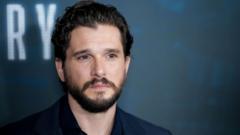
Casting decisions in franchise television are rarely artistic whim; they are risk-mitigation instruments designed to maximize subscription retention while minimizing variance in audience reception. When unconfirmed reports or speculative fan discourse connect an actor of Kit Harington's specific commercial profile to a major intellectual property property like HBO's upcoming Harry Potter adaptation—specifically for the role of Gilderoy Lockhart—the market response reveals how modern streaming platforms value recognizable equity versus unknown talent.
Analyzing this hypothetical or rumored casting requires stripping away fandom sentiment and evaluating it through three core analytical dimensions: brand continuity, demographic capture efficiency, and the cost function of legacy casting. Warner Bros Discovery operates under a strict capital-allocation framework where every marquee name attached to a prestige reboot serves to hedge against viewer fatigue and franchise erosion.
The Brand Continuity Dilemma
Every franchise reboot faces a dual-market problem. It must simultaneously satisfy purists who hold a static memory of the original cinematic adaptations and capture a younger, net-new cohort encountering the source material for the first time.
Gilderoy Lockhart is a narrative pivot point. He is a satirical embodiment of vanity, institutional failure, and fraudulent charm. In the original 2002 film adaptation of Harry Potter and the Chamber of Secrets, Kenneth Branagh executed this role with a theatricality that became a baseline benchmark for the audience.
When a studio introduces a high-profile actor into a recurring or serialized adaptation of an established character, the choice alters the baseline production risk. Harington brings immediate cultural cachet derived from his tenure on Game of Thrones. That specific equity carries heavy audience baggage. Viewers do not see an institutional blank slate; they see Jon Snow entering a magical academic institution.
This creates a cognitive friction point. In production strategy, this friction can either alienate viewers or act as an anchor that stabilizes the show's perceived quality during its early, vulnerable first season.
Demographic Capture Efficiency
Streaming platforms do not commission multi-hundred-million-dollar fantasy series to please existing fans alone. They build them to drive top-of-funnel acquisitions.
The original Harry Potter films skewed toward a family audience, but the generation that grew up with those films now possesses independent disposable income and decision-making power over household streaming subscriptions. Casting an actor who anchored a defining prestige drama of the 2010s acts as a cross-demographic bridge.
The audience overlap between gritty medieval political fantasy and high-fantasy children's literature is narrower than marketing departments pretend. However, the intersection contains high-value subscribers. By inserting an actor known for brooding seriousness into a comedic, highly pompous role, the casting department creates a secondary marketing vector: tonal subversion.
The mechanism works through contrast. When an actor famous for solemn stoicism plays an incompetent, narcissist fraud, the novelty generates organic earned media across trade publications and social channels. This reduces the marginal cost of customer acquisition compared to launching an entirely unknown theater actor into the role.
The Cost Function of Legacy Talent
Talent acquisition in prestige television operates on a sliding scale of budget allocation versus return on investment.
Supporting characters like Lockhart appear in a finite narrative window—primarily a single academic year within the overarching multi-season arc. Committing a recognizable star to a role with limited long-term screen time introduces budget inefficiencies if the upfront quote outpaces the character's contribution to subscriber retention.
Conversely, utilizing established talent in modular, limited-arc roles prevents cast inflation over a decade-long television production lifecycle. Main characters tied to long-term contracts command exponential salary escalations as a series proves its viability. Guest or secondary recurring roles with high-tier talent cap the studio's long-term financial exposure while importing immediate prestige value to season one.
This structural approach protects the production margin. If the series falters on writing or direction, recognizable actors serve as shock absorbers for critical reception, providing trade publications with familiar touchstones to anchor their reviews.
Strategic Casting Execution
The operational reality of casting a character defined by his absolute lack of substance requires an actor capable of playing self-delusion with absolute sincerity. Irony ruins Lockhart; earnest vanity makes him dangerous and funny.
Harington's comedic timing in supporting cinematic work suggests an underutilized capacity for self-deprecation, a prerequisite for pulling off a character whose entire structural function in the plot is to expose the cracks in institutional competence at Hogwarts.
The ultimate test for Warner Bros Discovery is not whether fans remember Kenneth Branagh's performance, but whether the new series can establish an independent visual and tonal identity. Relying on cross-over star power provides a temporary scaffolding for the first season, but sustained viewership depends entirely on whether the broader ensemble can justify the immense capital expenditure required to rebuild a literary universe for episodic television.
To maximize the return on this production tier, the casting strategy must balance legacy recognition with narrative utility, ensuring that every marquee name serves as an engine for world-building rather than a distraction from it.