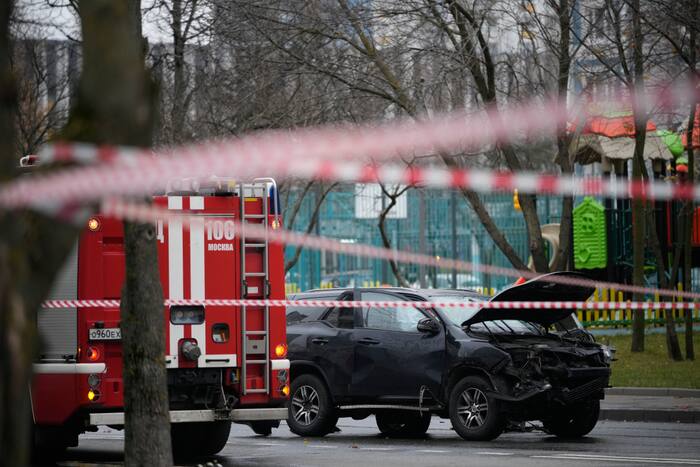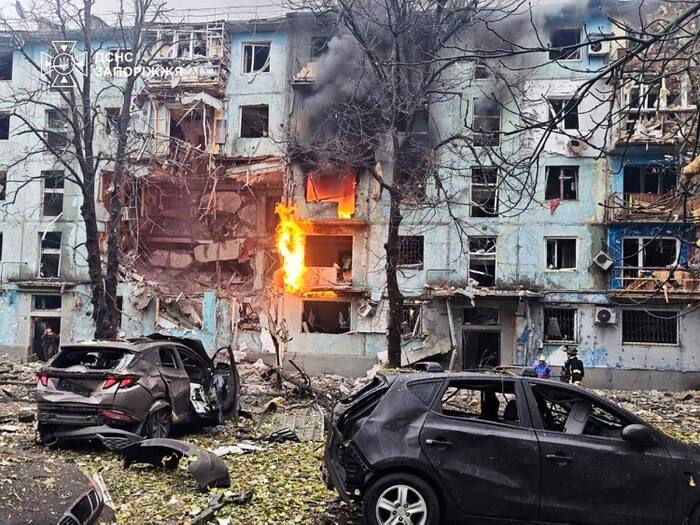
Deploying nearly 1,200 unmanned aerial vehicles in a single operational window represents a deliberate shift from tactical attrition to systemic exhaustion, timed directly to alter the baseline of US-led diplomatic negotiations over European security. When an actor pairs maximum-volume kinetic output with high-level diplomatic talks, the objective is rarely localized territorial gain. Instead, the operation functions as a forcing mechanism to expose asymmetric cost curves in air defense, establish escalatory dominance prior to formal bargaining, and widen the geographic scope of the security architecture under discussion.
Standard reporting on mass drone engagements treats the raw count of launched systems as a simple metric of intensity. That framing misses the structural mechanics of modern integrated air defense systems (IADS) and coercive diplomacy. To understand how a 1,200-unit salvo reshapes diplomatic tracks in Washington, Brussels, and Moscow, analysts must separate the operational physics of air defense saturation from the political signaling embedded in the timing.
The Cost Function of Integrated Air Defense Saturation
Air defense networks are engineered around finite interceptor magazines, radar tracking capacity, and operator endurance. A mass salvo of approximately 1,200 uncrewed systems targets all three bottlenecks simultaneously through a three-part operational sequence.
Magazine Depletion via Decoy Layering
Modern long-range strike packages do not consist of 1,200 uniform warheads. They rely on mixed-tier compositions: low-cost, radar-reflecting decoys mixed with one-way attack drones and higher-velocity cruise or ballistic threats. An air defense battery cannot reliably distinguish a cheap foam-and-composite airframe from a high-explosive payload until late in the engagement envelope. Defenders face a binary risk calculation: expend high-value surface-to-air missiles (SAMs) against uncertain targets, or conserve interceptors and accept infrastructure damage. Over a multi-hour wave, the defender's cost-per-intercept exceeds the attacker's cost-per-launch by orders of magnitude.Sensor and Battle Management Saturation
Every radar array and command-and-control (C2) node possesses a hard ceiling on simultaneous track-while-scan engagements. Launching four-figure volumes across wide azimuths forces defending radars to split energy across hundreds of low-altitude, slow-moving vectors. This creates tracking gaps—blind corridors through which higher-tier munitions can transit undetected. Even when electronic warfare (EW) jamming degrades satellite navigation on incoming drones, inertial navigation backups keep the airframes moving along predetermined vectors, still forcing kinetic or electronic engagement from the defender.Geographic Dispersion and Rear-Area Exposure
Concentrating 1,200 systems forces the defending state to pull mobile air defense assets away from front-line tactical formations to protect deep-rear industrial, energy, and command infrastructure. This redistribution creates immediate vulnerabilities along the primary line of contact, degrading the defender's ability to shield ground troops from tactical aviation and reconnaissance drones.
The primary limitation of mass-salvo doctrine is industrial replenishment. Sustaining four-figure launch volumes requires decentralized manufacturing pipelines, resilient supply chains for commercial dual-use microelectronics, and vast pre-positioned stockpiles. A single 1,200-drone operation signals accumulated surge capacity rather than a repeatable daily baseline.
Coercive Diplomacy and the Bargaining Range
In international relations theory, military escalation immediately preceding diplomatic summits serves to reset the bargaining range—the spectrum of outcomes both sides prefer over continued conflict. By executing a large-scale strike as US-led talks convene to address wider European security, the initiating state alters three diplomatic variables.
First, it eliminates the narrative of imminent operational exhaustion. Negotiating positions harden or soften based on perceived trajectory. A demonstration of deep-strike reach across wide geographic distances forces mediators to price ongoing infrastructure vulnerability into any proposed ceasefire or security guarantee.
Second, it expands the geographic definition of the conflict theater. When deep-strike systems penetrate hundreds of kilometers beyond active front lines, neighboring states bordering the conflict zone face immediate spillover risks—ranging from airspace violations and electronic warfare interference to stray debris. Consequently, bilateral talks inevitably expand into multilateral discussions covering continental air-defense integration, forward-deployed deterrence postures, and regional escalation management.
Third, it tests alliance cohesion under acute resource strain. Western security partners supplying air defense interceptors must balance immediate replenishment requests against their own national readiness minimums. High-volume drone campaigns expose global production bottlenecks in solid rocket motors, seeker heads, and air-defense radars, turning industrial manufacturing capacity into the decisive variable at the negotiating table.
Three Structural Bottlenecks in European Security Talks
As US-led diplomatic initiatives broaden from localized ceasefire mechanics to wider European security frameworks, negotiators confront three structural constraints that cannot be resolved through diplomatic phrasing alone.
The Asymmetry of Verification Regimes
Traditional arms control treaties relied on counting large, easily observable platforms: heavy bombers, ballistic missile silos, and armored divisions. One-way attack drones are small, modular, and assembled in distributed civilian-style workshops using commercial off-the-shelf components. Any European security architecture attempting to cap long-range strike capabilities faces a severe verification gap. Satellite imagery cannot reliably audit decentralized drone production, rendering traditional numerical limits unenforceable without intrusive, continuous on-site inspection protocols that neither side will accept.Air Defense Integration vs. National Sovereignty
Widening the talks to cover broader European security requires establishing an integrated regional air and missile defense shield along NATO's eastern flank. Achieving seamless sensor-to-shooter integration across multiple national militaries requires standardized data links, pre-delegated rules of engagement for cross-border intercepts, and shared interceptor stockpiles. Political friction emerges immediately over command authority: nations remain reluctant to cede automated firing decisions over their sovereign airspace to a centralized multinational command structure.The Escalation Threshold of Deep-Strike Parity
Deterrence stability depends on clear thresholds. When long-range uncrewed systems routinely strike logistics hubs, refineries, and airfields deep inside sovereign territory, the historical firebreak between tactical battlefield support and strategic homeland bombardment disappears. Negotiators must establish explicit geographic exclusion zones or infrastructure sanctuaries—such as power grids and nuclear facilities—to prevent miscalculation from triggering uncontrolled horizontal escalation across Europe.
Calculating the Strategic Trajectory
Diplomatic frameworks built on static territorial lines will fail if they ignore the industrial and kinetic realities demonstrated by mass-salvo operations. The intersection of cheap, scalable unmanned strike capacity and expensive, supply-constrained air defense creates an unstable equilibrium that favors offensive disruption over defensive containment.
To build a durable European security architecture out of the current US-led talks, defense planners and negotiators must abandon legacy arms-control templates and execute three concrete shifts:
- Transition Air Defense Procurement to Asymmetric Counters: Stop relying on multi-million-dollar surface-to-air missiles to attrit low-cost unmanned salvos. European defense industrial policy must prioritize directed-energy systems, high-rate-of-fire radar-guided autocannons, and automated interceptor drones to invert the cost-exchange ratio back in favor of the defender.
- Codify Infrastructure Sanctuaries Over Numerical Caps: Because drone stockpiles cannot be verified via national technical means, security agreements must focus on verifiable behavioral red lines—specifically mutual bans on strikes against critical energy transmission nodes and cross-border airspace incursions—backed by automated, pre-agreed punitive sanctions and rapid-response interceptor deployments.
- Institutionalize Joint Munitions Pooling: European security guarantees require binding industrial production quotas and shared interceptor reserves managed at the alliance level, eliminating the single-nation stockpile bottlenecks that mass saturation strikes are specifically engineered to exploit.