The air at 22,000 feet does not want you there. It is thin, predatory, and strips the warmth from your lungs before you can even register the cold. Up here, the atmosphere contains less than half the oxygen found at sea level. Your brain slows down. Your fingers stiffen into useless claws. Now, imagine steering a highly sensitive paramotor—essentially a fan strapped to your back beneath a giant fabric wing—through violent, unpredictable thermal currents directly over the mouth of a volcano that could awake at any moment.
Most people look at a mountain and think of the view. A rare few look at the highest active volcano on Earth and think of a landing strip.
When Anshuman Das, an extreme aviator originally from India but long rooted in the vibrant adventure community of Thailand, stared at the topographic maps of Ojos del Salado, he wasn't just looking at a geographic giant. Straddling the border of Chile and Argentina in the Andes, the mountain rises 6,893 meters into the sky. It is a place of brutal beauty, jagged rock, and permanent ice, holding the title of the world’s highest active volcano. To the standard traveler, it is a fortress of nature. To Das, it was a question waiting for an answer.
The ambition was simple to state but nearly impossible to execute: fly a paramotor higher than anyone had ever managed in this category, and land it on the roof of the volcanic world.
The Mechanics of a Silent Ghost
To understand the sheer audacity of this feat, you have to understand the machine. A paramotor is a beautiful contradiction. It is the simplest form of motorized aviation available to humanity, relying on a lightweight motor, a propeller, and a paraglider wing. But simplicity breeds vulnerability.
In the dense, heavy air of a coastal beach, a paramotor lifts off with effortless grace. The air pushes back against the wing, creating lift, while the motor provides forward thrust. But as you ascend, the rules of physics begin to warp. The air thinned out. With fewer air molecules for the propeller to bite into, thrust dropped dramatically. The engine, starved of oxygen, choked and gasped for fuel.
Das knew that taking standard equipment into the Andes was a recipe for a swift, catastrophic descent. The preparation wasn't just about physical stamina; it was an engineering puzzle. He spent months modifying the engine, tweaking the carburetor to handle an environment that resembled the upper atmosphere more than Earth, and selecting a wing that could maintain inflation in a place where the wind can change direction in a heartbeat.
Every gram counted. Carrying too much fuel meant the machine would be too heavy to climb in the thin air. Carrying too little meant running out of power over a desolate wilderness of jagged volcanic rock and freezing glaciers. It was a mathematical tightrope balance where a single miscalculation meant freezing to death long before rescue teams could ever reach the coordinates.
The Invisible Wall
The expedition arrived in the Atacama region, a desert so dry and Martian that NASA uses it to test planetary rovers. The mountain loomed in the distance, a massive, snow-dusted sentinel cutting through the deep blue South American sky.
Acclimatization is a slow, agonizing tax on the human spirit. For days, the team moved upward by fractions, letting their bodies manufacture the red blood cells needed to survive. Headaches became a constant companion. Sleep was elusive, broken by the sound of gale-force winds tearing at the fabric of their tents.
Then came the morning of the attempt.
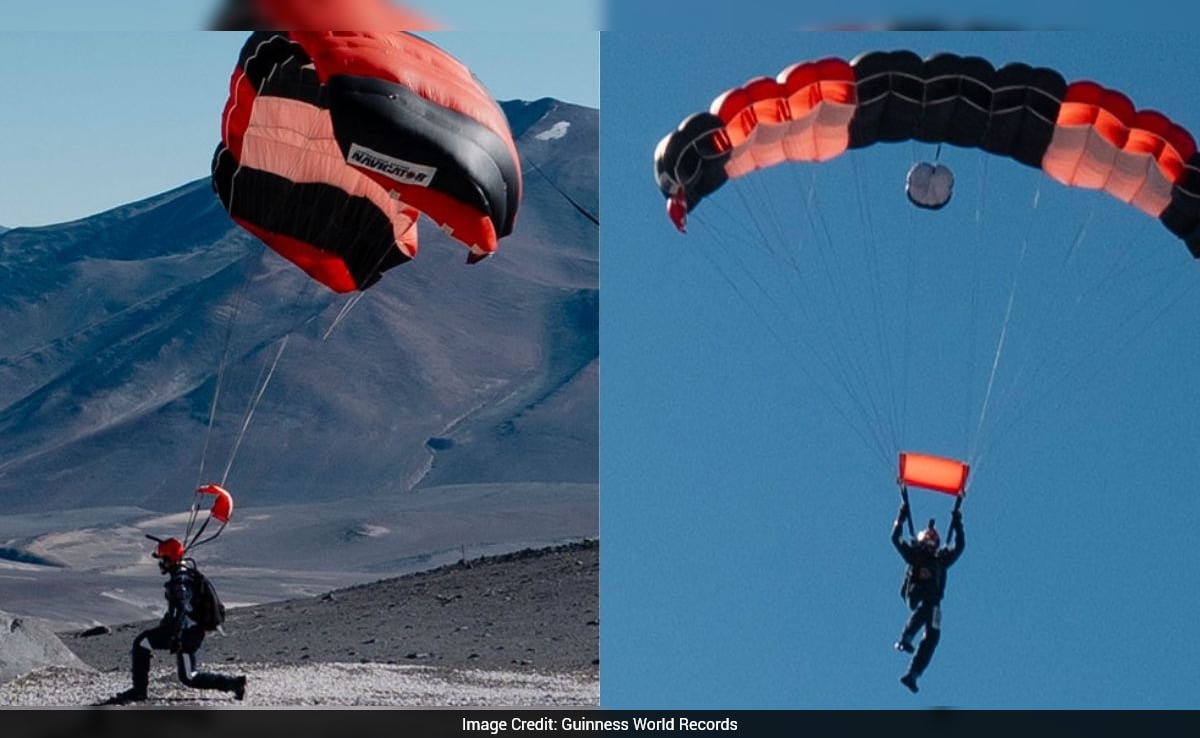
The weather window was terrifyingly brief. In the high Andes, mornings can be deceptively calm before the afternoon sun heats the valley floors, sending massive columns of turbulent air roaring up the mountainsides. Das strapped the heavy motor to his back. The weight pressed into his shoulders, a reminder of the gravity he was trying to escape. He started the engine. The sound was a sharp, mechanical buzz, echoing oddly against the immense silence of the desert floor.
He ran. In the thin air, running feels like moving through wet cement. Your lungs scream for oxygen that isn't there. But then, the wing caught the breeze, inflated, and lifted him off the rocky earth.
The ascent was a battle against unseen monsters. Mountain waves—massive, invisible undulating currents of air created by the wind crashing against the peaks—slammed into the paraglider. One moment, Das was climbing steadily; the next, an invisible downdraft would drop him hundreds of feet in seconds, the fabric of his wing rustling ominously above his head.
He had to read the mountain. He watched the drift of volcanic dust, the shape of the snowfields, and the tilt of the ridges to guess where the rising air currents were hiding. It was a masterclass in intuitive physics, guided by years of flight experience and an absolute refusal to panic.
The Landing on the Roof of the World
The summit of Ojos del Salado is not a peaceful plateau. It is a jagged, chaotic rim of rock surrounding a crater that still breathes sulfurous gases into the sky.
As Das neared the record-breaking altitude, the world below flattened into a sweeping tapestry of brown, rust, and white. He was flying at an altitude usually reserved for twin-engine airplanes and commercial charters, exposed to the elements with nothing but a flight suit and a reserve parachute.
The critical moment approached. Setting a world record for altitude is one thing, but Das wanted the definitive exclamation point: a successful landing and take-off on the highest active volcano on the planet.
The approach was terrifying. The air near the summit was incredibly turbulent, swirling violently as it hit the volcanic rim. If he came in too fast, he would crash into the boulders. If he came in too slow, the wing would stall, dropping him like a stone into the crater. He lined up against the fierce wind, using it as a brake, modulating the throttle with precise, microscopic movements of his frozen fingers.
The tires of his lightweight trike touched the volcanic ash.
For a brief, surreal moment, the engine went quiet. Anshuman Das stood where no paramotor pilot had ever stood before, looking down at the curving horizon of the Earth from the top of an active volcano. He had stepped across the boundary of what was deemed possible for a foot-launched motorized aircraft.
But the triumph was only half complete. The mountain does not let you stay.
The Great Escape
Landing on a mountain peak is an achievement; getting off it alive is the survival strategy. The air was so thin that generating enough lift to take off again required a perfect harmony of wind and speed.
Das could feel the cold seeping through his boots, the frost forming on his visor. The human body deteriorates rapidly at that altitude without supplemental oxygen. There was no time to celebrate. He refueled the machine from a small auxiliary tank he carried, checked the lines of his glider, and turned the machine back into the howling wind.
The take-off run was a leap of absolute faith. He charged toward the steep, rocky drop-off of the volcano’s edge, the motor screaming at maximum RPM, fighting for every ounce of thrust. For a second, he plunged downward over the lip of the crater, the ground dropping away beneath him before the thin air finally caught the nylon wing, stiffened it, and bore him aloft once more.
The flight down was a long, sweeping glide into warmth, safety, and history. When his feet finally touched the desert floor at base camp, the silence that followed the engine cut was different. It wasn't the hostile silence of the peak, but the quiet peace of a mission accomplished.
We often think of records as numbers in a book—a specific altitude, a latitude, a date. But those numbers are just footprints left behind by human curiosity. What Das proved over the smoking rim of Ojos del Salado wasn't just that a small motor could push a human being to the edge of space. He proved that even in the most hostile environments on our planet, where the air fails and the ground threatens to explode, human ingenuity and raw courage can find a way to land, take a breath, and fly away.