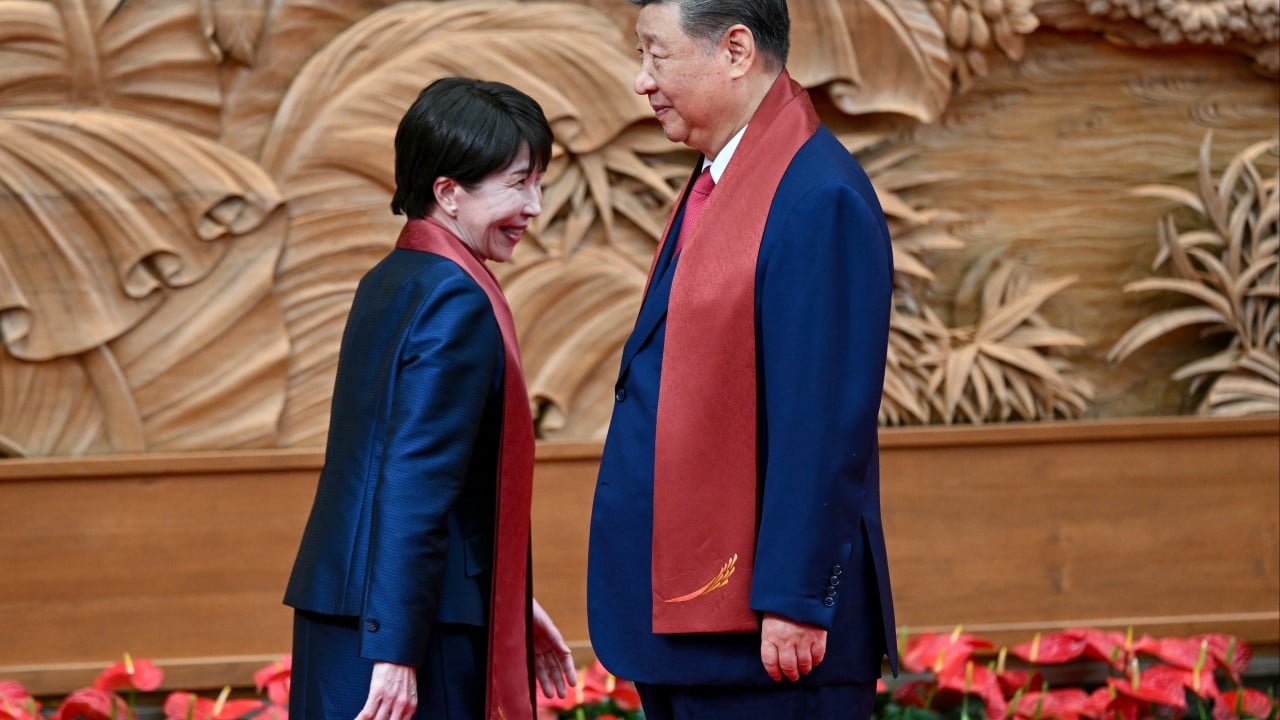
Eleven seconds.
Count them out loud right now, watching the second hand of a clock sweep across its face while your palm stays pressed against someone else’s skin. One. Two. Three. By four, the polite social reflex has expired. By seven, the muscles in your forearm begin to register the subtle tension of another person’s grip—whether they are pulling you closer, holding you at bay, or waiting for you to blink first. By eleven, two grown adults standing under the unforgiving glare of television lights have stopped performing a greeting and started negotiating a truce in silence. You might also find this related story insightful: The Structural Deconstruction of Joko Widodo’s Post-Presidency Political Capital.
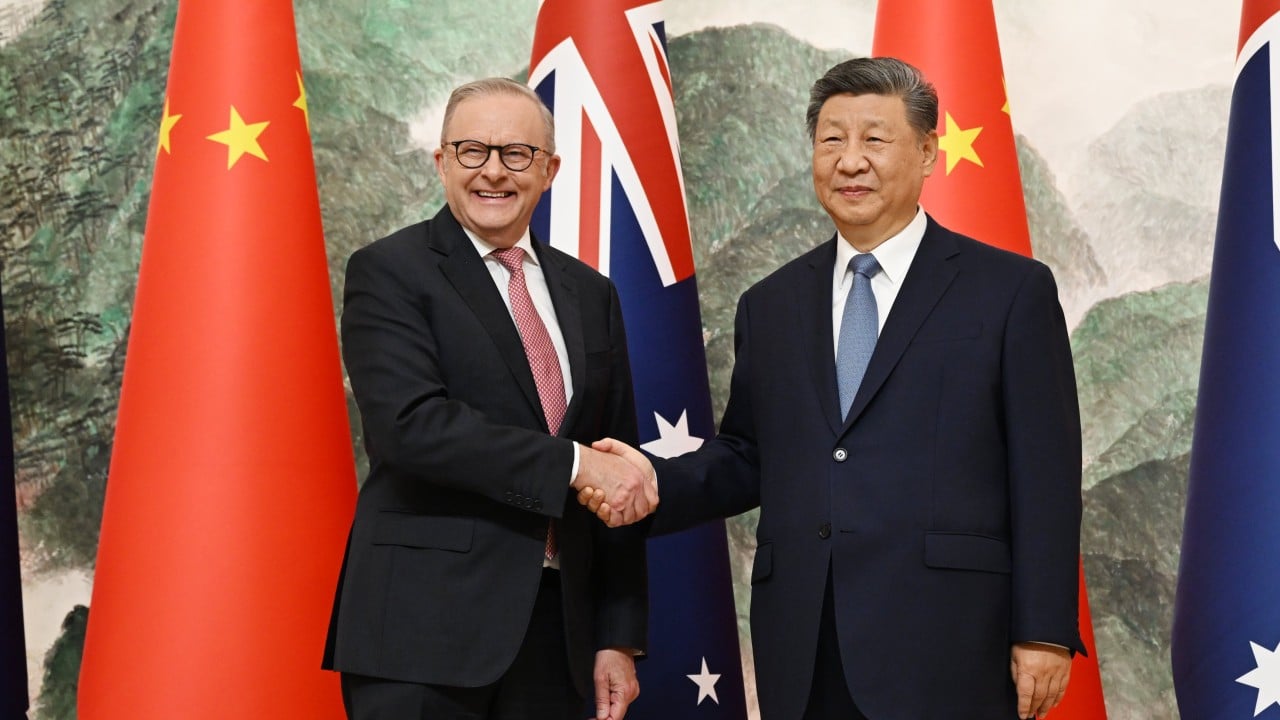
That was the exact duration of the handshake between Sanae Takaichi and Xi Jinping on the sidelines of the Asia-Pacific Economic Cooperation summit.
In the sterile vocabulary of wire-service journalism, the moment was filed away as a "more proactive approach" by Japan’s prime minister toward Beijing. Diplomatic analysts noted the duration with stopwatches, dissected the angle of their shoulders, and concluded that Tokyo was signaling a calculated willingness to engage. Cold facts. Clean angles. Completely stripped of the human electricity that actually moves nations. As highlighted in recent coverage by Al Jazeera, the effects are significant.
Because if you have ever stood across a conference table from a rival who holds the power to ruin your livelihood—or sat in a cramped Tokyo freight office watching shipping manifests stall because of a diplomatic freeze—you know that eleven seconds is never just protocol. It is a pulse check between two giants trying to figure out if they can afford another winter of mutual hostility.
The Weight of a Grip When Nobody Wants to Blink
To understand what happened in those eleven seconds at APEC, you first have to understand the exhausting theater of East Asian statecraft. Diplomacy between Tokyo and Beijing rarely announces its turning points with trumpet blasts. Instead, it communicates through micro-adjustments: a slightly warmer adjective in a press communiqué, an extra beat of eye contact before turning toward the flags, a hand held just long enough to tell the cameras that neither leader is scrambling for the exit.
Sanae Takaichi arrived at that summit carrying the heavy baggage of expectation. For years, her political identity had been forged in the fires of hawkish clarity—a reputation built on unambiguous defense posture, skepticism toward Beijing’s regional ambitions, and an ideological lineage closely tied to the late Shinzo Abe. When hardliners ascend to high office, markets and ministries brace for frost. Exporters in Osaka quietly hedge their currency exposure; semiconductor executives in Kumamoto double-check their supply-chain contingencies; fishermen near disputed waters watch the horizon a little more closely.
Yet leadership has a way of bending ideology against the hard edge of arithmetic.
Consider a hypothetical scenario that plays out every week in the logistics hubs linking Yokohama and Shanghai. Picture Kenji, a mid-level supply-chain director for a precision-machinery firm outside Nagoya. Kenji does not care about ideological purity or historical grievances debated in parliament. He cares about whether the specialized optical sensors his factory needs will clear customs on Tuesday, and whether the Chinese buyers who account for a third of his company’s annual revenue will quietly shift their orders to a German competitor if political rhetoric turns toxic. When Tokyo and Beijing stop talking, Kenji loses sleep. When they stand together for eleven seconds on a global stage, Kenji’s phone stops ringing with panicked calls from his distributors.
Takaichi’s decision to lean forward—to initiate, hold, and steady that encounter with Xi Jinping—was not an abandonment of principle. It was an acknowledgment of Kenji’s reality.
In high-stakes negotiations, there is an intuitive rule that seasoned mediators learn early: silence is an accelerant. When two neighbors share thousands of miles of maritime proximity and hundreds of billions of dollars in intertwined trade, refusing to speak does not preserve your strength. It simply hands the steering wheel to accidents, miscalculations, and the loudest voices on the fringes. By choosing a proactive posture at APEC, Takaichi traded the cheap applause of domestic hardliners for the much harder, quieter work of keeping a floor under the relationship.
Why Eleven Seconds Felt Like an Eternity
I still remember the first time I watched a high-level bilateral encounter unfold up close from a press riser, separated from the leaders by sixty feet of carpeted floor and a wall of telephoto lenses. On television, these moments look effortless, almost choreographed. In the room, the air feels thick enough to chew.
You can hear the rapid-fire click-click-click of sixty camera shutters firing in unison—a sound like a swarm of mechanical locusts—every time a hand moves an inch. You can see the aides hovering just out of frame, their eyes darting between their principal’s jawline and the clock on the wall. Every micro-expression is an audit. If the smile is too broad, critics back home call it appeasement. If the jaw is too tight, foreign ministries spend the next seventy-two hours issuing "clarifications" to calm jittery bond markets.
In that environment, eleven seconds is a deliberate act of defiance against the impulse to rush past discomfort.
Think about the choreography of modern summits. Leaders are herded from room to room on five-minute intervals, fed talking points on index cards, and positioned on tape marks on the carpet so the lighting hits their faces evenly. The standard diplomatic handshake lasts three to four seconds—long enough for the photographers to get the shot, short enough to avoid accidental intimacy.
Holding on for eleven seconds requires mutual consent. Neither Xi Jinping nor Sanae Takaichi could have prolonged that contact alone without turning it into an awkward tug-of-war. One person extends the gesture; the other accepts the tempo.
Experts who analyzed the footage pointed to three subtle signals embedded in those seconds:
- The initiation and posture: Rather than waiting passively for Beijing to dictate the pace of engagement, Takaichi stepped into the frame with visible intent, signaling that Japan would actively manage its China relationship rather than merely react to it.
- The absence of haste: By refusing to break contact quickly, both leaders communicated to their respective bureaucracies—from customs officials to central bankers—that the channel at the top remains open.
- The strategic framing: In diplomatic signaling, duration equals priority. Giving Xi those unhurried seconds in front of the global press told other APEC nations that Tokyo intends to be an indispensable diplomatic actor in the Indo-Pacific, not a spectator waiting on Washington’s cues.
Let’s be honest about something, though. It is easy to read too much poetry into a photograph. Skeptics—and there are plenty of seasoned diplomats among them—will tell you that a warm handshake in November has never stopped a coast guard vessel from crossing a median line in January. They are right to be cautious. Nobody in Tokyo or Beijing is naive enough to believe that structural rivalries dissolve because two leaders held eye contact under stage lights.
The Invisible Ledger Behind the Smiles
To grasp why Takaichi adopted this proactive approach now, you have to look past the podium and examine the quiet pressures squeezing both capitals. Statecraft is rarely driven by sudden bursts of goodwill; it is driven by converging necessities.
Start with the economic ledger. Japan’s economy, navigating inflation shifts, demographic headwinds, and the delicate transition away from ultra-loose monetary policy, cannot afford an unnecessary shock to its largest trading partner. Japanese corporations have spent decades building intricate manufacturing ecosystems across mainland China. Unwinding that interdependence overnight is a fantasy spoken only by people who have never had to move a chemical supply chain or re-qualify an automotive parts supplier.
At the same time, Beijing faces its own sobering math. Sluggish domestic consumption, real estate drag, and intensifying trade friction with Western capitals have made foreign capital and technological cooperation far more precious than they were five years ago. Alienating Tokyo completely would push Japan even deeper into restrictive export-control coalitions, choking off access to specialized industrial equipment and materials that Chinese factories still rely on.
Consider a metaphor that veteran trade negotiators often use behind closed doors: two neighbors living in wooden houses built wall-to-wall on a narrow street. You may argue fiercely over where the property line sits, and you may keep a bucket of water by your front door just in case. Yet neither of you has any interest in letting sparks fly across the alley, because when one roof catches fire, both families lose everything.
That shared vulnerability is the invisible hand guiding Takaichi’s outreach.
Historical patterns confirm this rhythm. Time and again over the past half-century, moments of acute Sino-Japanese tension have been followed by calculated resets initiated by leaders whose conservative credentials insulated them from accusations of weakness. Richard Nixon could go to China precisely because nobody doubted his anti-communist bona fides. Shinzo Abe could rebuild working ties with Xi Jinping after years of deep freeze precisely because his nationalist credentials were beyond reproach.
Takaichi appears to be testing that exact playbook. By establishing her posture early at APEC, she is trying to carve out diplomatic room to maneuver—showing domestic voters that she can stand eye-to-eye with Xi Jinping as an equal while reassuring business leaders that pragmatism still has a seat at the cabinet table.
What Happens When the Cameras Pack Up
Of course, the hardest part of any diplomatic opening begins the morning after the summit ends, when the red carpets are rolled up and the actual dossiers land back on ministers’ desks.
A handshake creates oxygen, not agreements. Across the East China Sea, the underlying friction points remain stubbornly intact: maritime disputes around the Senkaku Islands, export restrictions on critical minerals and dual-use technologies, the detention of Japanese nationals in China, and deep anxiety in Tokyo over stability across the Taiwan Strait. None of those issues vanished during those eleven seconds.
If you ask ordinary people in Tokyo or Beijing how they feel about the relationship, you rarely hear the measured optimism of summit communiqués. Instead, you hear fatigue—a quiet resignation that politics keeps complicating lives that would otherwise naturally connect. A university researcher in Kyoto wonders if her joint climate conference with colleagues from Nanjing will get visa approval this spring. A restaurant owner in Ginza watches tour-group bookings fluctuate every time a headline flares up on evening television.
This is where the true test of Takaichi’s proactive approach lies. Can a symbolic gesture at APEC translate into predictable, working-level problem solving?
Watch the unglamorous indicators over the coming months rather than the speeches:
- Ministerial traffic: Whether foreign, finance, and trade ministers begin scheduling regular, unremarkable visits without requiring a crisis to justify the trip.
- Crisis hotlines: Whether defense officials actually use direct communication channels when naval or air encounters occur in contested airspace.
- Commercial predictability: Whether regulatory hurdles, visa processing, and customs inspections quietly smooth out for businesses operating between the two countries.
If those gears begin turning again, historians will look back at that APEC encounter as the hinge where a potential spiral was quietly arrested. If they stay rusted shut, those eleven seconds will be remembered as just another well-lit photograph in an album full of missed chances.
The Architecture of Restraint
We live in an era that rewards political performance—the viral soundbite, the dramatic walkout, the sharp elbow thrown for the benefit of a domestic audience scrolling on their phones. Against that backdrop, choosing patience looks almost radical.
It takes no courage to slam a door in front of cameras. Anyone can play the tough guy when the microphones are hot and the distance between capitals is measured in angry headlines. The far riskier bet—the one that leaves a leader exposed to second-guessing from allies and adversaries alike—is to step forward, extend a hand, and hold it there long enough for the room to go quiet.
When Sanae Takaichi and Xi Jinping finally released their grip and turned toward the waiting microphones, nothing on the map of Asia had changed. The borders were where they had been an hour earlier. The fleets were still at sea. The tariffs, the treaties, and the competing visions of regional order remained locked in place.
Yet in the fragile machinery of international politics, eleven seconds of deliberate stillness had reminded two nations that even rivals must first decide to stay in the room before they can ever hope to keep the peace.