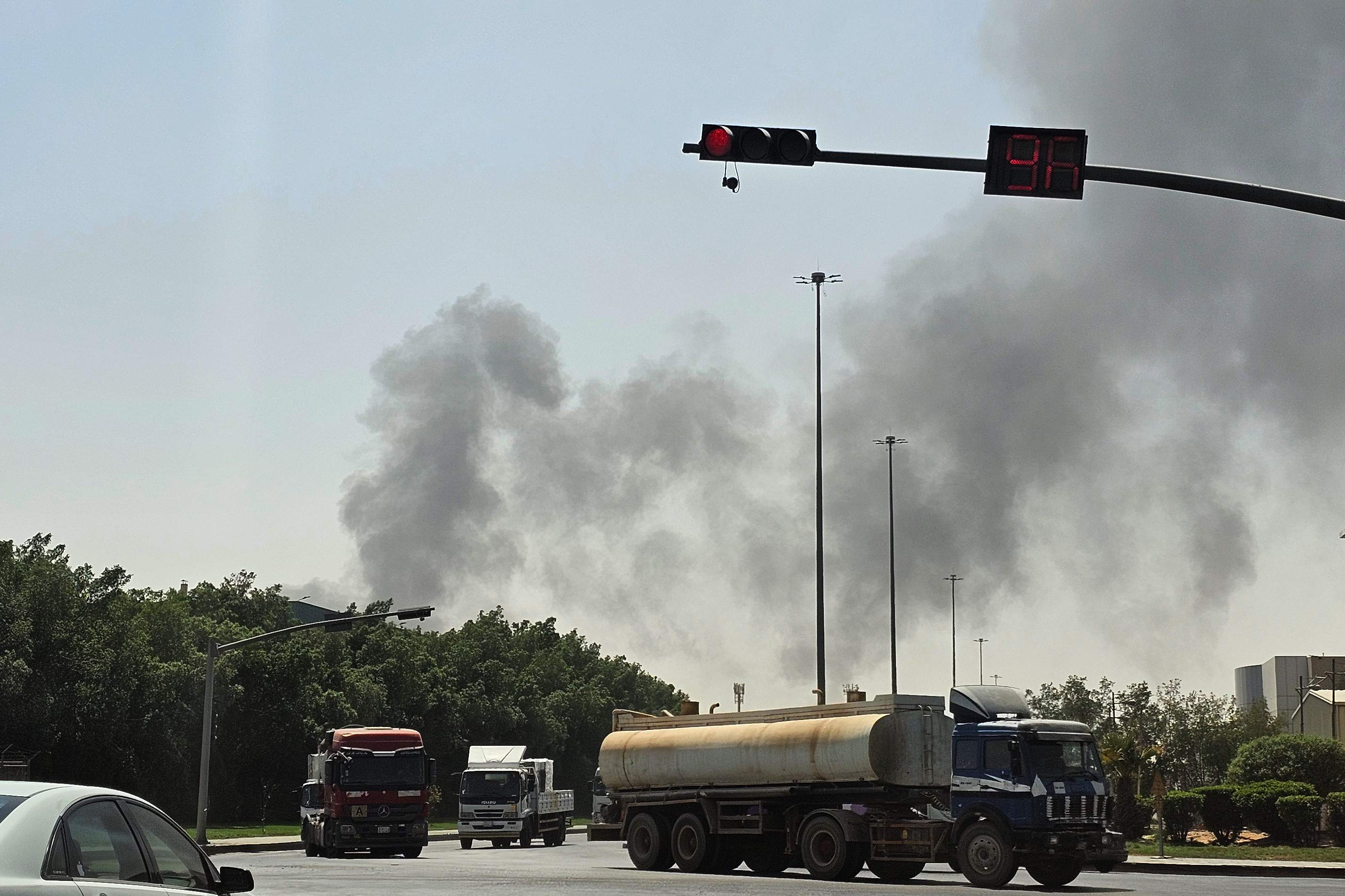
The acoustic signature of explosions over Riyadh alters the calculus of Middle Eastern security architecture, shifting the conflict from peripheral proxy friction to direct core-state exposure. When aerial interceptions occur over a capital city, the economic, political, and systemic consequences propagate far beyond the immediate blast radius. Analyzing this event requires stripping away episodic media sensationalism to evaluate the structural mechanics of capital-city vulnerability, the risk transmission channels across global energy and financial markets, and the strategic deterrence failures that permit such kinetic escalation.
The Tripartite Anatomy of Capital Vulnerability
A sovereign capital functions as the nerve center of state governance, international diplomacy, and economic capitalization. When kinetic threats breach its airspace, the vulnerability manifests across three distinct domains: administrative continuity, market perception, and psychological deterrence. You might also find this similar coverage insightful: The Line in the Pine Forest.
Administrative continuity depends on the physical security of command-and-control nodes. While modern state apparatuses maintain decentralized redundancy, the symbolic and operational disruption of urban strikes forces an immediate defensive posture. This defensive shift consumes cognitive bandwidth among leadership echelons, diverting strategic planning toward immediate crisis management and air-defense replenishment.
Market perception operates on a zero-tolerance threshold for sovereign risk. Capital cities anchor foreign direct investment and corporate headquarters. An explosion in Riyadh does not merely represent a localized tactical event; it triggers an immediate repricing of regional sovereign debt and equity risk premiums. Investors evaluate the distance between the point of impact and critical infrastructure nodes, recalculating the probability of operational disruption. As reported in detailed articles by BBC News, the implications are notable.
Psychological deterrence is the final pillar. Deterrence relies on the credible threat of disproportionate retaliation. When projectiles penetrate the airspace of a major regional power, the psychological equilibrium shifts. The adversary calculates that the cost of crossing traditional red lines remains manageable, which incentivizes further probe-and-response escalation cycles.
The Transmission Channels of Regional Shock
Geopolitical shocks do not remain confined within national borders. They travel through established systemic channels that amplify local instability into global economic friction.
The primary transmission mechanism is energy infrastructure exposure. The geographic proximity of major production facilities, refining hubs, and transit bottlenecks to urban conflict zones creates a permanent supply-chain anxiety premium. Even when physical assets remain undamaged, the threat vector alters futures pricing. Traders incorporate a geopolitical risk buffer into Brent crude benchmarks, driving up input costs for global industrial sectors.
The secondary channel involves maritime and logistics choke points. Escalation in the Arabian Peninsula immediately impacts the security calculus of the Red Sea, the Bab el-Mandeb strait, and the Persian Gulf. Shippers face heightened insurance premiums, longer transit routes around the African cape, and potential crew safety boycotts. These friction points increase shipping duration and container costs, feeding directly into persistent global inflation.
The tertiary channel is diplomatic alignment and intelligence signaling. Regional capitals are forced to recalibrate their security umbrellas. Allies reassess the reliability and speed of mutual defense commitments, while adversaries test the boundaries of defensive alliances. This diplomatic fluidity destabilizes multilateral frameworks, making negotiated ceasefires or de-escalation frameworks harder to construct.
The Deterrence Failure Mechanism
Understanding why kinetic events reach a capital requires examining the breakdown of traditional deterrence theory. Classical deterrence posits that mutually assured destruction or overwhelming conventional superiority prevents escalation. However, in asymmetric conflicts involving state and non-state actors, this model fractures.
Non-state actors or heavily backed proxies often operate with asymmetrical cost functions. For a central state, a war carries immense economic, infrastructural, and human costs. For an asymmetric actor integrated into a regional axis, the costs of localized retaliation are often absorbed by external sponsors or decentralized networks. This asymmetry creates a moral hazard: the actor initiating the launch bears minimal downside risk while achieving maximum propaganda and disruption value.
Furthermore, air defense economics favor the attacker. Interceptor missiles deployed by sophisticated defense systems like the Patriot or terminal high altitude area defense networks cost millions of dollars per unit, whereas incoming low-cost drones or ballistic variants represent a fraction of that expense. Over time, an asymmetric adversary can attempt to deplete sophisticated interception inventories through high-volume, low-cost saturation tactics. While advanced defenses maintain high interception success rates, the economic attrition of defense procurement introduces a long-term sustainability challenge for the defending state.
Strategic Realignment and Risk Mitigation
Managing capital vulnerability requires moving beyond reactive defense toward structural resilience. State planners must evaluate three core imperatives to insulate stability from kinetic shocks.
First, redundancy must be institutionalized across critical infrastructure. Relying on centralized national grids or single-point logistical hubs creates catastrophic single points of failure. Decentralized power generation, localized water security, and redundant financial communication channels ensure that a tactical disruption in a primary urban center does not paralyze national administration.
Second, diplomatic and intelligence architectures must establish unambiguous red lines combined with pre-calibrated, automatic responses. Ambiguity in deterrence invites testing. When adversaries understand that certain thresholds—such as targeting capital airspace—trigger immediate, severe, and non-negotiable countermeasures across multiple vectors, the calculus of provocation changes.
Third, intelligence capabilities must pivot toward proactive disruption of launch networks rather than relying exclusively on terminal defense. Intercepting a projectile milliseconds before impact is a tactical necessity, but dismantling the manufacturing, supply, and launch infrastructure at its source is the only sustainable path to strategic stability.
The sound of explosions over a capital signals that previous containment strategies have eroded. Restoring long-term stability requires treating the event not as an isolated anomaly, but as a diagnostic indicator of systemic shifts in regional power balances, requiring immediate structural adaptation across defense, economy, and diplomacy.