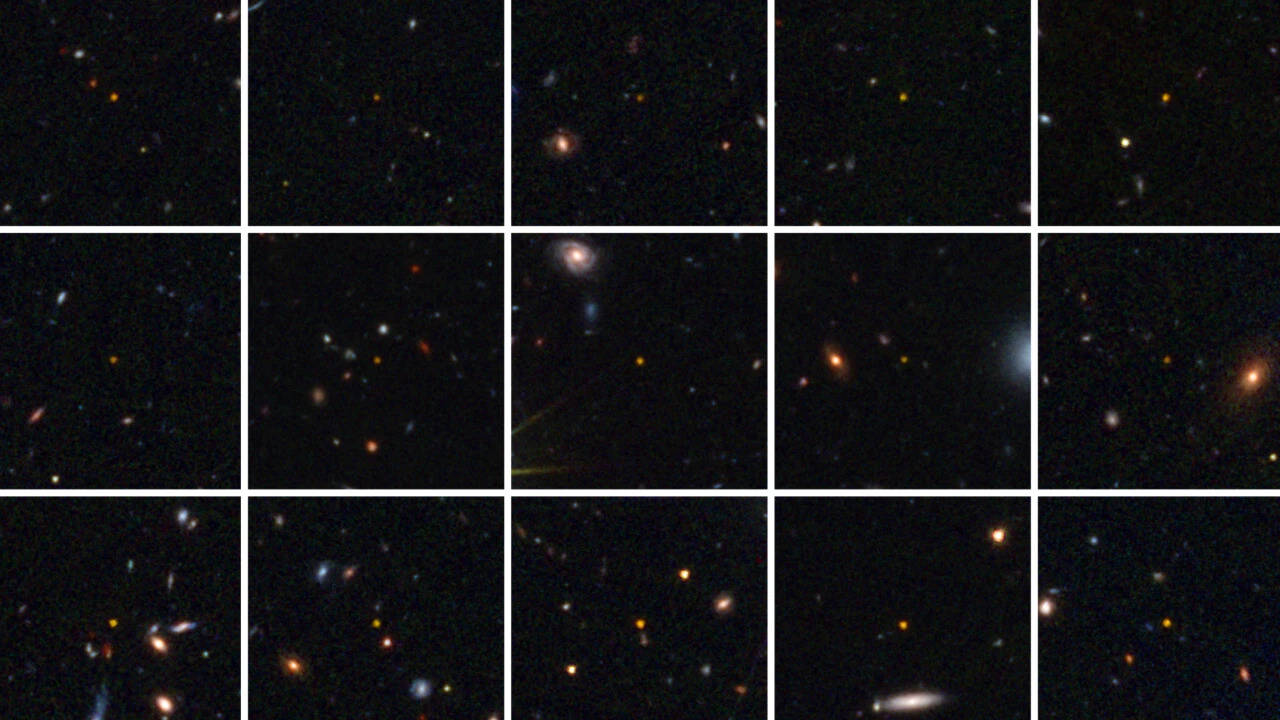
Supermassive black holes shouldn't be that big so early. Period.
When the European Space Agency's Euclid space telescope revealed 31 ancient quasars from the early universe—including two initial record-breakers and then an even more extreme record-smasher just months later—it handed astrophysicists a delightful headache. If you've ever watched a time-lapse of a sapling turning into a giant redwood in a single afternoon, you know that nagging feeling that the clock is running too fast. That's basically what researchers are looking at when they peer back into the first 770 million years after the Big Bang. For a different view, consider: this related article.
Most headlines treat a new cosmic distance record like a sports score. Another number on the board, another press release from a space agency. Honestly, that misses the real story. Euclid wasn't even built to be a dedicated quasar hunter. Launched in 2023 to map the dark universe across huge swaths of the sky, it turned into a high-speed census machine for the brightest, most distant galactic cores ever cataloged.
How Euclid Turned a Dark Universe Survey Into a Quasar Goldmine
To understand why 31 quasars matter so much, you have to look at how hard these things are to find. A quasar isn't a standalone star. It's the blazing heart of a distant galaxy where a supermassive black hole is pulling in surrounding gas and dust, heating that material to extreme temperatures so the disk shines brighter than all the stars in the host galaxy combined. Further insight regarding this has been shared by Ars Technica.
Because quasars are absurdly luminous, their light can travel across nearly the entire observable universe. The catch is rarity and distance. Truly ancient quasars sit billions of light-years away, and there aren't many of them per square degree of sky. If you point a narrow, ultra-detailed telescope at a tiny patch of sky, you might miss them completely. If you survey a huge area with blurry vision, you can't tell a distant quasar apart from foreground stars or cooler red objects.
Euclid hits a sweet spot. It pairs wide-field sky coverage with sharp near-infrared imaging above Earth's distorting atmosphere. As light from an early quasar travels toward us over more than 13 billion years, the expansion of space stretches its wavelengths toward the red and infrared end of the spectrum. By the time that light reaches Euclid, shorter ultraviolet and visible wavelengths can be wiped out by neutral hydrogen along the line of sight, leaving a signature "dropout" in visible light while showing up in infrared filters.
In July 2026, researchers led by Da-Ming Yang published a landmark study in Astronomy & Astrophysics reporting 31 new quasars spanning redshifts between 6.6 and 7.8. Twelve of those objects sit at redshift 7 or higher. Before Euclid, astronomers spent roughly 15 years building up around a dozen known quasars at or past that mark. Euclid matched and more than doubled that haul in roughly a year and a half of survey data.
The Two Record-Breakers That Shook Up Cosmic Dawn
Within that batch of 31 ancient quasars, two stood out immediately for rewriting the record book at the time:
- EUCL J172902.75+641018.1 clocked in at a redshift of 7.77.
- EUCL J125308.55+705432.3 arrived close behind at a redshift of 7.69.
Both objects were shining when the universe was under 670 million years old, beating the previous quasar redshift record of 7.64 set back in 2021. As ESA research fellow Antonio La Marca noted when the findings were highlighted, that haul more than doubled the known count of such ancient quasars and turned scattered finds into a genuine population census.
Then, just months later on November 24, 2026, Euclid broke its own record. A separate Astronomy & Astrophysics study led by Julien Wolf announced J1504+6252, nicknamed Dún Aonghasa after a prehistoric cliff-top stone fort on Inis Mór off Ireland's Atlantic coast. With a redshift of 8.13, it became the first quasar confirmed beyond redshift 8, pushing the observational frontier back by roughly another 40 million years to about 630 million years after the Big Bang.
That back-to-back sequence—31 quasars, two early record-breakers, and then Dún Aonghasa—is why covering this story as a single static snapshot misses the momentum. Euclid isn't just nudging the boundary; it's systematically clearing out the fog around the Epoch of Reionization, when early stars, galaxies, and black holes transformed a dark, neutral cosmos into the ionized universe we see today.
Redshift vs. Distance Without the Headaches
People trip over cosmic distances all the time, and I don't blame them. When you hear that light from Dún Aonghasa has been traveling for roughly 13.1 billion years—back when the universe was only about 5% of its current age—it's tempting to say the quasar is 13.1 billion light-years away.
Not quite. Space kept expanding while that light was en route. The region where that light originated billions of years ago has been carried much farther away since then—on the order of roughly 30 billion light-years today, depending on cosmological parameters. That's why astronomers rely on redshift (written as z). Redshift measures how much the universe expanded between when the light was emitted and when it was detected.
Higher redshift means looking further back into cosmic history. A redshift around 7 places an object within the first ~770 million years after the Big Bang. Pushing past 8 to 8.13 puts us right around the 630-million-year mark. Every step up that ladder shrinks the clock available for stars to form, collapse, merge, and feed colossal black holes.
Why a 360-Million-Solar-Mass Black Hole Is a Puzzle
Here's where things get genuinely spicy for black hole physics. Follow-up observations with ground- and space-based facilities—including the W. M. Keck Observatory, the Large Binocular Telescope, the Hubble Space Telescope, and the James Webb Space Telescope (JWST)—pinned down the nature of Dún Aonghasa and estimated its central black hole mass at roughly 360 million times the mass of the Sun.
Compare that to Sagittarius A*, the supermassive black hole sitting at the center of our own Milky Way, which weighs around 4 million solar masses. Dún Aonghasa's black hole is nearly a hundred times heavier than ours, and we're seeing it when the universe was barely 630 million years old.
Even weirder, observations of Dún Aonghasa suggest its black hole isn't feeding at a frenzied, maximum possible rate right now. Think about what that implies:
- If a black hole starts small—say, as the leftover core of a first-generation star—and grows steadily by swallowing gas at standard limits, building hundreds of millions of solar masses in just a few hundred million years is tight.
- If it's currently accreting at a relatively modest pace rather than gorging nonstop, either it grew in earlier bursts of rapid feeding or it started from a much bigger "seed".
Astrophysicists debate several possible seed pathways. One idea involves "heavy seeds" formed from the direct collapse of massive, pristine gas clouds in the early universe rather than ordinary stellar remnants. Another involves runaway mergers in dense star clusters. Researchers also discuss hypothetical primordial black holes formed even earlier, though findings like Dún Aonghasa don't prove they exist.
Let's be honest about uncertainty here, because good science shouldn't pretend every number is carved in granite. Estimating black hole masses in distant quasars from spectral line widths involves real calibration uncertainties—for Dún Aonghasa, different modeling approaches span roughly 200 million to nearly 800 million solar masses, making 360 million a solid working estimate rather than an exact scale reading. Still, even at the lower end of that range, growing that massive so early strains classic models.
Common Misconceptions About Quasar Discoveries
Whenever a telescope spots dozens of ancient quasars, a few myths pop up right away. Clearing them up saves a lot of confusion:
- "Euclid took crisp, detailed portraits of all 31 quasars by itself." Not quite. Euclid is a wide-survey telescope designed to spot rare candidates across huge regions of sky among millions of objects. Confirming exact redshifts and probing black hole properties relies on follow-up spectroscopy from instruments like Keck, the Large Binocular Telescope, Hubble, and JWST.
- "Finding 31 quasars means early galaxies were packed with them." High-redshift quasars are still rare jewels. At redshift 8, astronomers expect at most a few tens of quasars across Euclid's entire survey. Finding even one or two at that threshold is a big deal.
- "A quasar is a giant star." A quasar is an active galactic nucleus—a supermassive black hole actively accreting matter at the center of a galaxy. Calling it a star is a classic shortcut that hides the gravity and accretion physics driving the light.
What Makes This Moment Different From Past Quasar Hunts
Before wide-field space infrared surveys matured, finding a single quasar past redshift 7 felt like winning a lottery ticket after buying tickets for years. Surveys had to cover huge sky areas from the ground—where Earth's atmosphere brightens the infrared sky and blurs images—or rely on narrow space observations that covered tiny patches.
Euclid changes the math because it surveys massive areas cleanly from space over a multi-year mission. Over 18 months of data, it has already produced 31 new quasars in the $z \approx 6.6\text{--}7.8$ range and pushed past $z = 8$ with Dún Aonghasa. As more survey sky is processed and followed up with JWST and large ground-based observatories, astronomers won't just have isolated freak objects to argue over. They'll have a statistical sample to test how typical—or unusual—massive early black holes really were.
Practical Ways to Follow and Explore This Research
If you want to keep up with this work without getting lost in jargon, you don't need a PhD in astrophysics. A few concrete steps go a long way:
- Read primary mission updates directly: Check the ESA Euclid science portal for mission announcements, image releases, and links to peer-reviewed Astronomy & Astrophysics papers rather than relying solely on secondhand social posts.
- Look up the actual catalog designations: Search terms like
J1504+6252,Dún Aonghasa,EUCL J172902.75+641018.1, orEUCL J125308.55+705432.3to see how astronomers label sky coordinates and compare spectra and imaging. - Track JWST follow-ups on Euclid candidates: Watch for spectroscopic follow-up papers from the James Webb Space Telescope on Euclid's high-redshift sample. That's where rough infrared color selections turn into measured black hole masses, accretion rates, and host-galaxy properties.
Every new quasar Euclid pulls out of the infrared dark brings us closer to seeing how the universe's earliest monsters grew up.