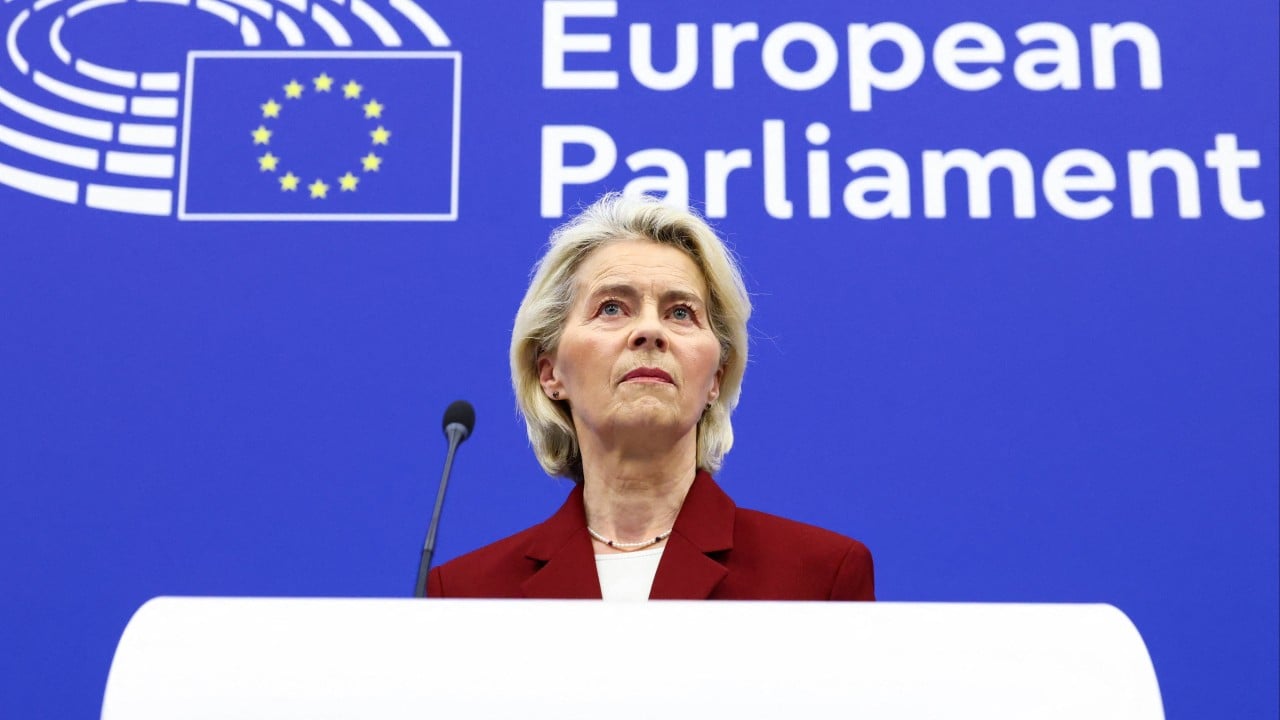
Ursula von der Leyen didn't mince words. When the European Commission President stood up to address global trade tensions, she didn't just talk about economic friction. She diagnosed an acute structural emergency. The phrase she used wasn't accidental. By warning that a second "China shock" is already reshaping Western economies, Brussels sent a blistering signal straight to Beijing.
This isn't diplomatic small talk. It's a fundamental reckoning. For years, European capitals hoped that open markets would naturally breed mutual cooperation. That bet failed. Today, European factories are facing an onslaught of heavily subsidized industrial overcapacity that domestic demand inside China simply cannot absorb.
The Reality Behind China Shock 2.0
The first China shock hit global manufacturing hubs in the late 1990s and early 2000s, driven by China's entry into the World Trade Organization and an explosion of low-cost labor. Back then, Western consumers got cheap t-shirts and household goods while manufacturing jobs vanished eastward.
This new iteration is entirely different. China isn't just dominating low-end assembly lines anymore. It has climbed the technological ladder with breathtaking speed. We are talking about electric vehicles, advanced wind turbines, heavy steel, and critical green technology. State-backed financing lets Chinese industrial giants produce far more than their local market can consume, forcing them to dump excess inventory onto global markets at rock-bottom prices.
European carmakers and industrial heartlands are feeling the squeeze. When entire manufacturing ecosystems face extinction due to state-subsidized pricing, governments stop looking away. Von der Leyen's messaging highlights a shift from passive observation to aggressive trade defense.
Supply Chains and the Rare Earth Trap
You cannot talk about industrial security without looking at raw materials. Europe remains overwhelmingly dependent on a single supplier for critical minerals. More than eighty percent of Europe's critical raw materials, and roughly ninety percent of its heavy rare earths, come from China.
That vulnerability isn't a theoretical risk. History shows what happens when supply choke points are weaponized. Back in 2010, export restrictions triggered a massive price spike for rare earths, sending shockwaves through high-tech manufacturing. Beijing learned how to adapt its tactics, flooding markets strategically to wipe out emerging Western competitors whenever alternative mines tried to sprout up.
Brussels wants to break this cycle. Proposals for G7 critical mineral alliances and specialized metals clubs aim to build alternative supply chains from scratch. But building a mine, a processing plant, and a recycling network takes years of capital and political will. Writing a speech is easy. Securing alternative neodymium and lithium supply lines is agonizingly hard.
Beijing Pushback and European Divisions
Beijing isn't sitting back quietly. Chinese officials and state media dismissed the rhetoric, accusing European leaders of falling into protectionist habits and parroting Washington's containment strategies. Critics in Beijing argue that European industries struggle because of structural inefficiencies and high local energy costs, not because of unfair trade practices.
At the same time, unity inside the European Union is far more fragile than Brussels cares to admit. While industrial powerhouses like France and Germany push for hardline anti-subsidy probes and protective tariffs on electric vehicles, other member states hold entirely different views. Some southern and eastern European governments view Beijing as an essential economic partner rather than an existential threat, fearing retaliation against their own export sectors.
This internal friction weakens the punch of any unified European policy. Von der Leyen has to walk a tightrope, convincing skeptical member states that joint action is the only shield against total industrial hollow-out.
What De-Risking Means for the Future
Forget the fantasy of total economic decoupling. European and Chinese supply chains are far too entangled for a clean break. Instead, the operative word in Brussels is de-risking.
De-risking translates into concrete legal armor. The European Union has already launched fast-moving anti-subsidy investigations into Chinese electric vehicles. Policymakers are tightening inbound and outbound investment screening mechanisms to ensure European capital doesn't fund military technologies or advanced intelligence capabilities in systemic rival nations. Export controls on high-end semiconductors and active pharmaceutical ingredients are expanding.
The underlying message to Beijing is straightforward. Trade will continue, but the era of unchecked, one-sided market access is over. If Beijing wants to flood European ports with subsidized overcapacity, Brussels is prepared to deploy every regulatory weapon in its arsenal to push back.
To see an in-depth breakdown of how European leadership frames these trade frictions and market pressures, you can watch this analysis on the European Commission President Von der Leyen warning. This video explores the specific structural imbalances and political motivations driving Europe's changing trade stance.