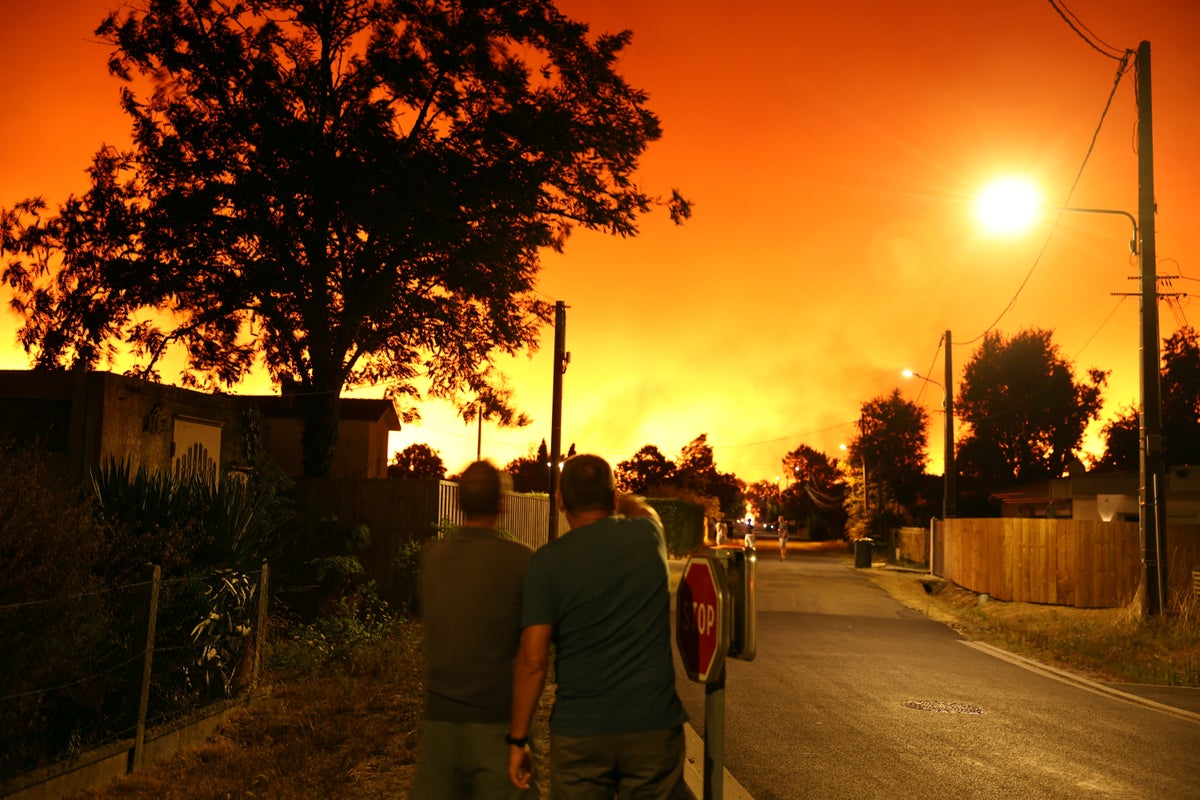
Structural Determinants of Southern European Conflagrations
Wildfire escalation across Southern Europe is driven by an compounding failure state: the intersection of prolonged atmospheric drought, structural changes in land management, and legacy emergency response architecture optimized for legacy climate baselines. The standard public narrative framing these events purely as localized natural disasters obscures the systemic vulnerabilities that dictate their frequency, intensity, and economic damage.
To understand why thousands face immediate evacuation across the Mediterranean basin and regional ecosystems face catastrophic degradation, fire activity must be evaluated as an outcome governed by three distinct operational vectors:
- Thermal and Moisture Deficits: Multi-month high-temperature anomalies drive fuel moisture levels below critical threshold limits (frequently below 8% in fine dead fuels), transforming rural biomass into volatile ignition media.
- Biomass Accumulation Vectors: Decades of rural depopulation and abandoned agricultural land have created unmanaged vegetation corridors, removing historical natural firebreaks and dramatically increasing fuel connectivity.
- Suppression Capacity Saturation: Atmospheric conditions generate fire intensity profiles exceeding 10,000 kilowatts per meter. At this output, physical containment via direct ground forces or aerial water drops becomes fluid dynamically ineffective.
The Fire Behavior Cascade
The escalation of a localized ignition into a regional crisis follows a predictable physical sequence. Media accounts typically report on the initial flame front and subsequent evacuation mandates as disconnected crisis events. A rigorous structural breakdown demonstrates that these phases are causally locked.
[Ignition Event]
       │
       ▼
[Critical Fuel Moisture Depletion (<8%)]
       │
       ▼
[Crown Fire Transition & Pyrocumulonimbus Generation]
       │
       ▼
[Spotting & Rapid Perimeter Expansion (>2-5 km/hr)]
       │
       ▼
[Municipal Infrastructure Encircling & Resource Exhaustion]
When high winds align with extreme vapor pressure deficits, ground-level fires transition into crown fires, occupying the upper canopy. This transition alters local wind patterns, generating micro-climates that propel embers kilometers ahead of the main fire front—a phenomenon known as spotting. Modern firefighting tactics rely heavily on containment lines; high-rate spotting renders traditional trenching and localized water delivery obsolete.
The resulting strain on civil defense systems triggers an exponential degradation of operational capability:
- Detection to Engagement Delays: High incident density saturates dispatch centers, increasing initial response times from minutes to hours.
- Resource Fragmenting: Emergency management teams are forced to abandon proactive perimeter containment to prioritize reactive life-safety evacuations.
- Critical Infrastructure Failure: High-radiant heat disables power transmission grids, shutting down municipal water pumping stations exactly when water pressure is required for defense perimeter operations.
Economic and Logistics Impact Metrics
The direct cost of wildfire damage extends far beyond destroyed structures and immediate emergency service expenditures. The regional economic footprint reflects severe long-term operational disruption.
| Impact Category | Immediate Variable | Secondary Consequence | Capital Horizon |
|---|---|---|---|
| Agricultural Capacity | Loss of perennial crop yield | Soil erosion, topsoil sterilization, loss of arable classification | 5–15 Years |
| Civil Infrastructure | Destruction of transport corridors and utility lines | Supply chain bottlenecks, elevated rebuilding logistics costs | 1–3 Years |
| Tourism Ecosystems | Immediate cancellations, structural asset loss | Brand devaluation, permanent shift in regional travel demand | 2–5 Years |
| Public Health Systems | Surge in acute respiratory admissions | Elevated long-term cardiovascular risks, air quality mitigation costs | Ongoing |
Defensive Architecture Limitations
Current containment strategies rely heavily on heavy mechanized suppression assets, such as aerial water tankers and specialized ground units. While effective during low-to-moderate intensity events, these tools display diminishing returns during severe climate-driven fire weather.
Aerial drops face severe physical constraints. High atmospheric turbulence, dense smoke columns reducing visibility below operational minimums, and extreme thermal updrafts limit aircraft dropping accuracy and safety. Water dropped from high altitudes under extreme heat frequently evaporates before striking the fuel canopy, rendering the investment inefficient.
Similarly, ground crews face severe physiological limitations. When ambient temperatures exceed 40°C alongside high radiant heat loads from active fronts, human operational shifts must be reduced significantly to prevent severe dehydration and heat stress, requiring double or triple the personnel deployment to cover the same tactical line.
Reallocating Capital to Integrated Fire Management
Mitigating the escalating European wildfire crisis requires shifting focus from pure suppression to preventive land management and strategic spatial planning. Municipalities and national governments must pivot capital allocation toward systematic fuel reduction frameworks.
Strategic prescribed burning programs, implemented during cool-season windows, reduce accumulated biomass and break fuel continuity across vast landscapes. Establishing permanent agricultural buffers and managed silvopastoral zones around human settlements creates physical barriers that slow fire progression, lowering energy output to levels where conventional firefighting forces can regain tactical control.
Building codes in high-risk zones must mandate non-combustible construction materials, standardized defensible space zones surrounding structures, and redundant off-grid municipal water systems capable of operating during full power grid failures. Emergency response frameworks need to transition from localized fire service deployment models to integrated, multi-national command structures equipped with predictive fire-behavior modeling tools that allocate assets dynamically before ignitions occur.