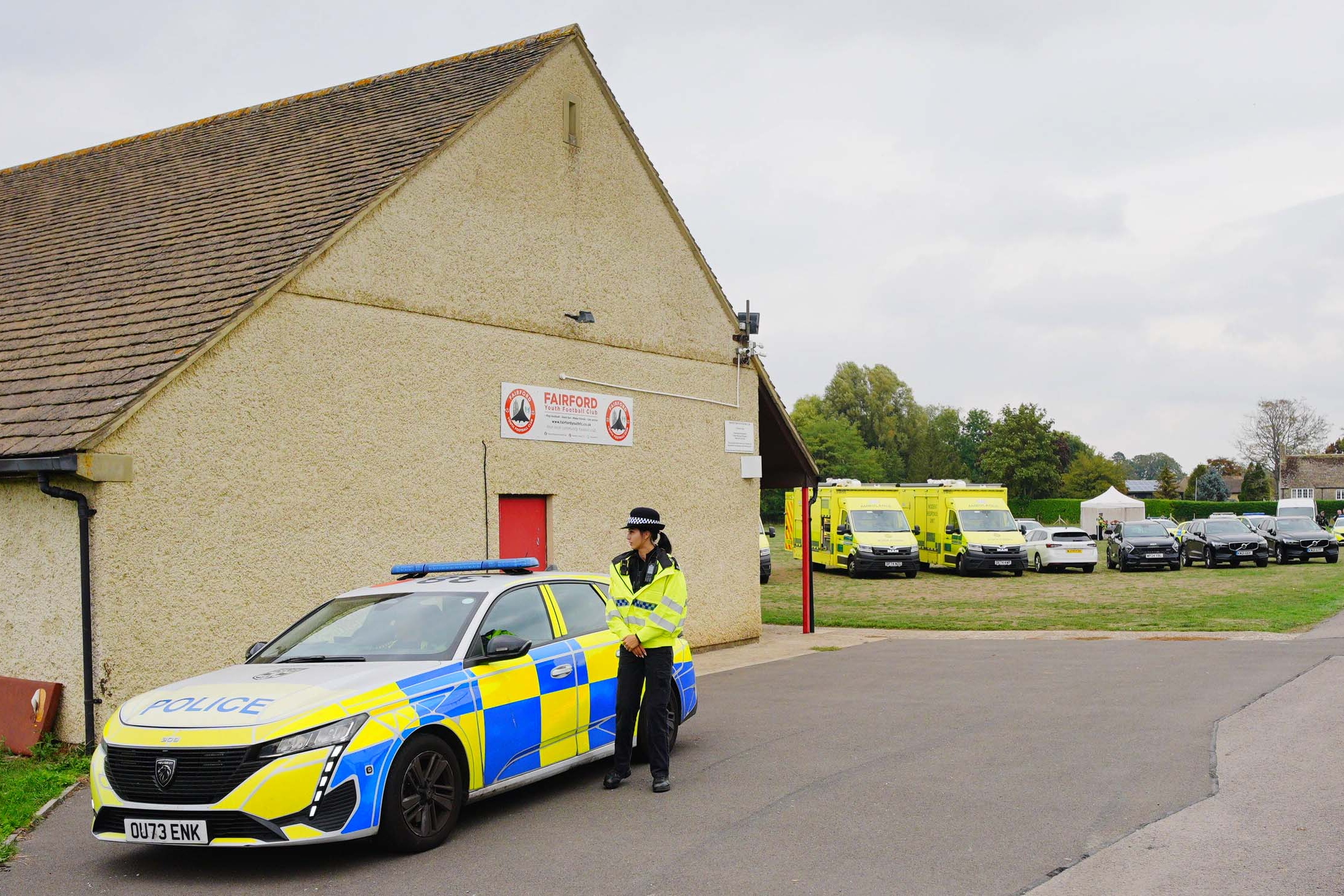
The media treats every perimeter breach near a military installation as a Hollywood thriller script. Flashing blue lights, midnight arrests, headlines screaming about explosives offenses near joint-use facilities, and the knee-jerk panic from commentators who think a chain-link fence is the vanguard of national defense.
It is lazy, terrified theater.
Let us look at the standard narrative following the recent arrests near the British base used by United States forces. The instant reaction from cable news and policy pundits is the same tired song: our borders are porous, our installations are sitting ducks, and hostile actors are probing our physical defenses for weak spots. They want you to believe that some mastermind packed a backpack with improvised ordnance and strolled up to a guard shack like an amateur.
That is not how modern asymmetric conflict operates. If someone wants to neutralize a joint military logistics hub today, they do not bring commercial-grade explosives to a gate with armed MPs. They do not leave a paper trail of clumsy reconnaissance that ends in a neat, orderly local police booking.
I have spent enough time around defense contractors and intelligence briefings to know the dirty secret of military infrastructure security: the physical perimeter is the least of anyone's worries.
The Illusion of the Perimeter
We are obsessed with walls, gates, and biometric scanners because they are tangible. You can take a photo of a security checkpoint. You can broadcast footage of a patrol vehicle. It gives the public a comforting illusion that protection is physical, measurable, and absolute.
When an arrest happens near a critical defense site, the media seizes on the physical proximity as proof of an impending kinetic attack. They ask the wrong question entirely: "How did unauthorized individuals get so close to a high-value asset?"
That question assumes the physical proximity was the point of the operation. It almost never is.
In intelligence circles, low-level operatives or duped proxies getting caught near a sensitive installation are often noise designed to drown out the silence elsewhere. Think about it from a resource-allocation standpoint. If a hostile state actor wants intelligence on American deployment rotations or supply lines moving through a UK hub, do they send guys with suspicious packages to wander around the perimeter fence? Or do they route a quiet query through an outsourced maintenance contractor three tiers down the supply chain? Do they drop an unencrypted sensor node into a public drainage ditch, or do they compromise a vendor's payroll server in a suburb three hundred miles away?
The arrests near the U.S.-used U.S. and British installations make great television, but they represent the lowest tier of threat vectors. They are the tactical equivalent of rattling the front door handle while the back window is wide open.
The Real Vulnerabilities Lie in the Boring Details
Let us address the actual mechanics of modern security failures. We talk endlessly about counter-terrorism and explosive detection, yet we routinely ignore the mundane vulnerabilities that actually compromise installations.
First, the supply chain. A joint-use base relies on a sprawling ecosystem of civilian contractors, catering services, hardware suppliers, and software maintenance teams. None of these entities operate under the same rigid operational security clearance as active-duty service members. A vulnerability in a commercial inventory management software used by a civilian logistics subcontractor poses a hundred times more risk than a suspicious vehicle idling near an access road.
Second, electronic reconnaissance. The physical perimeter does not block radio frequency emissions, cellular metadata harvesting, or drone-mounted sensor sweeps conducted from commercial airspace outside restricted zones. An adversary does not need to step foot on base property to map out shift changes, communication protocols, and electronic signatures.
By hyper-focusing on the physical explosives narrative, the press and public security apparatus allow the real vectors—cyber intrusion, supply chain infiltration, and signal intelligence gathering—to operate unbothered in the background. We are guarding the drawbridge while the moat is dry and full of tunnels.
What Protecting Critical Infrastructure Actually Requires
If you want to fix how we defend strategic military assets, you have to abandon the medieval mindset of thicker walls and more guards.
Stop treating every perimeter anomaly as an existential kinetic threat. Triage the noise. The moment we panic over petty trespassers or low-level suspicious packages, we expend valuable analytical bandwidth that should be directed toward digital hygiene and vendor vetting.
We need to audit our reliance on third-party civilian infrastructure. Every single software vendor with remote access to a base's logistics network should face the same scrutiny as a foreign national attempting to scale a fence. If your maintenance contractor is using outdated, unpatched software from a questionable subsidiary, your base is already compromised, regardless of how many guard dogs are pacing the tarmac.
Furthermore, recognize that deterrence today is asymmetric. A hostile actor does not need to blow up a hangar to achieve their strategic objective; they just need to delay a shipment, leak a deployment manifest, or create enough bureaucratic friction to stall joint operations.
The next time a sensational headline breaks about an arrest near a military installation, do not look at the handcuffs. Look at what distraction just bought someone else a free pass to steal data twenty miles away.
Wake up to the real battlefield.