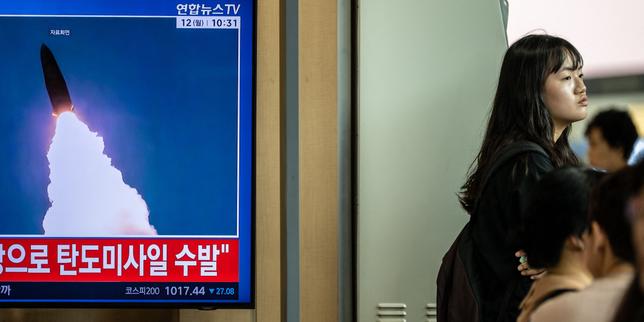
Another morning, another boilerplate news alert flashing across screens from Seoul to Washington. North Korea fires a handful of short-range ballistic projectiles toward the Sea of Japan. Foreign desks scramble, pundits dust off the exact same talking points they used in 2017, and the market shrugs by noon. Everyone treats these launches as erratic tantrums, desperate cries for attention, or sudden escalations on the brink of war.
It is the laziest consensus in modern geopolitics. And it keeps everyone completely blind to how Pyongyang actually operates.
When you read that Pyongyang launched projectiles, the immediate assumption is that Kim Jong Un is acting out because of economic pressure, domestic fatigue, or a desire to force a hesitant U.S. administration back to the negotiating table. That framing misses the entire structural reality of North Korea's defense strategy. They are not throwing temper tantrums. They are running a continuous, highly disciplined engineering loop.
The Engineering Reality Behind the Smoke
Let us look at what is actually happening on the ground. Modern missile development is not a static process where you design a weapon on paper, test it once, and put it in a silo. It requires iterative flight testing under varying atmospheric conditions, telemetry gathering, propellant burn analysis, and guidance system stress tests.
When Western defense analysts look at these launches, they see a provocation. When North Korean aerospace engineers look at them, they see data collection.
Think of it like a software company pushing continuous updates to production. You do not wait for a formal summit to patch bugs; you deploy, you measure telemetry, you iterate. Pyongyang has transformed the Sea of Japan into an open-air testing range because static bench tests only tell you so much. If you want to know if your solid-fuel motor handles thermal shock during atmospheric re-entry at Mach 6, you have to light the fuse and watch the telemetry stream back.
The Western media framing insists on viewing these tests through a diplomatic lens, as if every missile is a message addressed directly to the desk of the U.S. President. Sometimes a cigar is just a cigar, and sometimes a missile test is just hardware validation. By misdiagnosing routine R and D as an acute political crisis, foreign policy establishments walk straight into a self-imposed trap of perpetual anxiety.
The Economics of Perpetual Tension
To understand why this cycle never stops, you have to look at the fiscal efficiency of North Korea's military-industrial posture. For decades, sanctions were supposed to cripple their capacity to innovate. That theory has been thoroughly dismantled by reality.
When you isolate
Why Every Missile Launch Headline Is Total Theater And We Keep Falling For It
news
Another morning, another breathless alert about North Korea firing projectiles toward the Sea of Japan. The wire services spin up their standard machinery. Seoul issues a stern warning. Tokyo expresses profound concern. Washington reaffirms its ironclad commitment. The lazy consensus writes itself: an isolated, erratic regime is acting out, rattling its saber, pushing the region to the brink.
It is a neat, comforting narrative. It treats geopolitics like a cartoon where villains wake up and decide to cause trouble because they are evil.
It is also completely wrong.
Strip away the diplomatic theater and the ratings-driven panic, and you find a much colder, more predictable mechanical reality. These tests are not random tantrums. They are maintenance checks, inventory rotations, and technical iterations executed within a mature, rational framework of state survival and domestic signaling. We treat every launch like an existential crisis because our newsrooms confuse weapon development with an imminent declaration of war.
Let us look at the actual physics and economics of what is happening on the Korean Peninsula instead of swallowing the talking points handed down by think-tank analysts who have never set foot near the DMZ.
The Engineering Reality Behind The Flashing Banners
Every time a ballistic missile leaves a transporter-erector-launcher, military analysts scramble to categorize its trajectory, apogee, and range. They treat the data as a personal insult or a sudden escalation.
Here is what is actually going on: solid-fuel and liquid-fuel propulsion systems degrade. Rocket motors have expiration dates. Guidance systems require telemetry validation. If a nation maintains a strategic deterrent, it has to test its hardware. If a domestic automotive plant rolls out a new vehicle platform, it runs crash tests and durability loops. When a nuclear-armed state updates its missile guidance architecture, it shoots rockets into the ocean.
The geographic reality of the Korean Peninsula dictates the testing corridor. North Korea is narrow. To test medium-range or intermediate-range systems without violating sovereign airspace of hostile neighbors, you point the nose cone eastward toward open water. The Sea of Japan is the nearest safe firing range.
When the headlines shriek that a projectile flew four hundred kilometers and splashed down outside territorial waters, the unspoken subtext is that a sovereign state performed a routine operational test in international space. If the United States Navy tests a Trident missile off the coast of California, it is framed as a proud display of defensive readiness. When Pyongyang does the exact same thing with its own inventory, it is treated as a threat to global stability.
That double standard is intellectually lazy. It blinds us to the real mechanics of the situation.
The Domestic Audience You Are Ignoring
Western media treats Kim Jong Un as if he is playing to an audience in Washington or Seoul. He is not.
Foreign policy reporting constantly suffers from solipsism—the arrogant assumption that everything happening in a foreign nation is a direct reaction to us. The primary audience for these missile tests is domestic.
Consider the political economy of a severely sanctioned state. A regime cannot deliver economic growth, consumer choice, or technological integration with the global market. What can it deliver? National security, technological self-reliance, and state prestige.
When state media broadcasts footage of a new hypersonic glide vehicle or a solid-fuel intercontinental ballistic system, it is signaling to the elite inner circle, the military command structure, and the general populace that the billions poured into the defense sector are yielding results. It is internal legitimacy maintenance.
If you view the launches through the lens of external provocation alone, you miss the domestic survival calculus entirely. A regime under perpetual economic siege cannot afford to look technologically stagnant. Stagnation invites internal rot and military coups. Therefore, the testing cycle must continue regardless of what the United Nations Security Council says in its next strongly worded statement.
The Escalation Trap We Keep Walking Into
The most dangerous aspect of this cycle is not the North Korean missiles. It is our reaction loop.
Every single launch triggers a predictable escalation spiral:
- A test occurs.
- Media outlets publish hysterical alerts.
- Allied military commands execute retaliatory joint drills, flying heavy bombers right up to the border.
- Pyongyang interprets the drills as invasion rehearsals and accelerates its next development phase.
- Rinse and repeat.
This is textbook action-reaction coupling. We are actively participating in the very security dilemma we claim to deplore. By treating every localized test as a catastrophic emergency, we lock ourselves into a posture where de-escalation becomes politically impossible. No leader wants to look soft after a cable news network runs a graphic package featuring a mushroom cloud over Tokyo.
The dirty little secret of the region is that deterrence is actually working, albeit in a grim, grinding sort of way. Mutual vulnerability keeps the peace. Pyongyang knows that crossing the line into direct kinetic conflict means total obliteration by allied conventional and nuclear superiority. Seoul and Washington know that a full-scale preemptive strike would turn the capital of South Korea into a smoking crater via conventional artillery alone.
Both sides understand the red lines. The missile tests happen below those red lines precisely because nobody wants a war. They are high-stakes poker hands played in the margins, designed to extract diplomatic leverage and domestic compliance.
What We Should Be Measuring Instead
If you want to understand where the Korean Peninsula is heading, stop counting the number of splashed-down projectiles in the Sea of Japan. That metric is designed to generate clicks and nothing else.
Instead, watch three things that actually matter:
- Propellant shifts: The transition away from storable liquid fuels toward composite solid-fuel motors. This tells you about operational readiness and launch warning times.
- Guidance accuracy telemetry: Are they mastering maneuverable reentry vehicles that can bypass modern missile defense umbrellas like the Aegis system?
- Backchannel economic lifelines: Who is keeping the trade routes open behind the scenes to supply the microelectronics required for modern guidance chips?
The next time an urgent news alert flashes across your screen about missiles launched toward the East Sea, take a breath. Look past the breathless anchors. You are watching a predictable, institutionalized ritual of statecraft—expensive, cynical, and utterly routine.
Stop treating every test like the opening salvo of World War Three. It only proves you have mistaken the theater for the war.