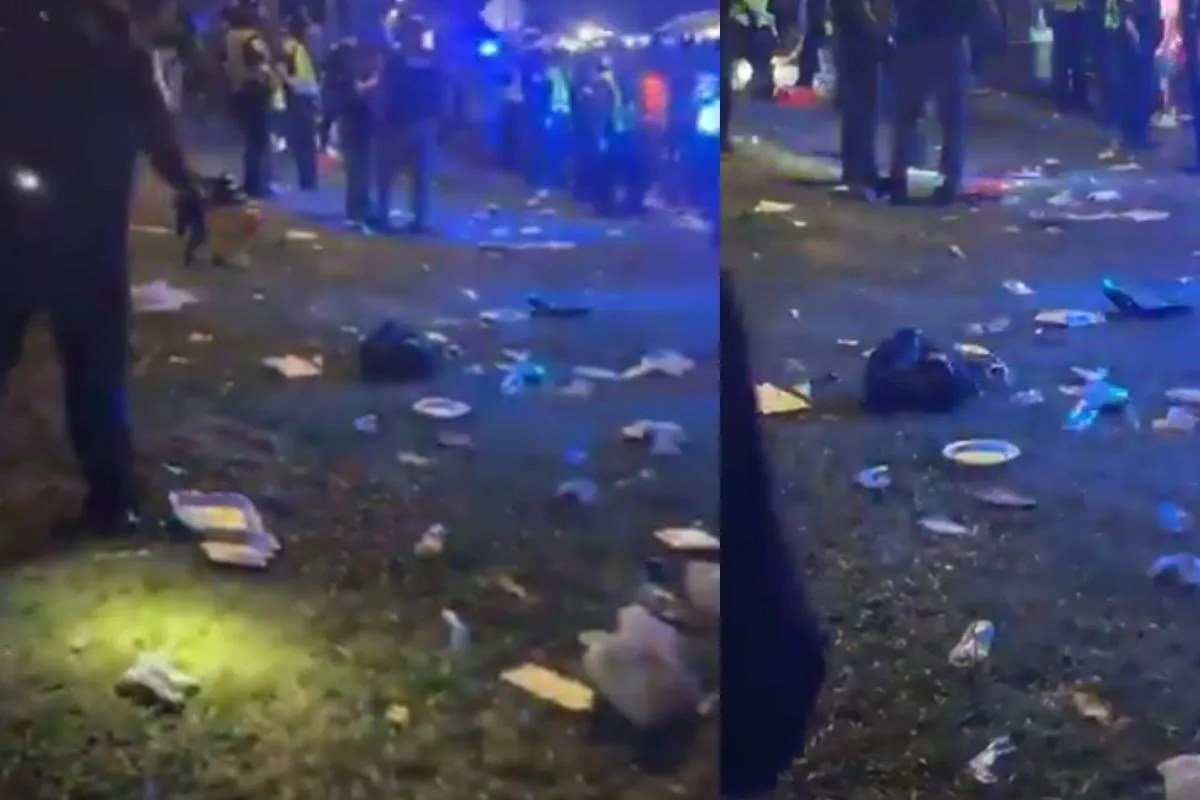
Eleven people shot at a party in America. Children among the wounded. And within twenty minutes of the first ambulance arriving, the wire services roll out their favorite lie.
They call it sudden. In similar news, read about: The Battle Over Iron and Concrete in Lower Manhattan.
Sudden gunfire. A sudden eruption of chaos. A sudden tragedy that shattered a peaceful gathering.
Stop buying that word. Nothing about an eleven-victim shooting at an American party is sudden. Calling it sudden is lazy journalism designed to trigger your outrage, harvest your click, and absolve every institution that ignored a three-day countdown happening in plain sight. NBC News has also covered this important topic in extensive detail.
Competitor news outlets treat every shooting at a backyard cookout, house party, or neighborhood block gathering like a freak lightning strike. They lead with the body count, zoom in on the injured children to maximize emotional shock, quote a stunned neighbor saying the block is usually quiet, and move on to the next news cycle by Tuesday. Readers walk away feeling helpless, angry, and convinced that America is simply cursed by random, inexplicable madness.
That framing is not just shallow. It actively guarantees the next eleven people get shot next weekend.
The Myth of the Random Rampage
If you want to understand why conventional coverage fails, start with a definition almost every mainstream headline quietly muddles.
When the Gun Violence Archive tracks mass shootings in the United States, it uses a clean operational threshold: four or more people shot or killed in a single incident, not including the shooter, regardless of motive or setting. That definition captures two wildly different phenomena under one umbrella.
The first is the public mass rampage. A lone offender walks into a school, supermarket, or concert venue with high-capacity gear, a grievance or ideology, and the explicit intent to maximize fatalities among strangers. These events dominate cable television, congressional hearings, and international perception of American violence.
The second phenomenon happens far more frequently, yet almost nobody analyzes it honestly. It is the interpersonal crowd shooting—gunfire erupting at a house party, a rented short-term vacation home, a graduation barbecue, or a late-night block gathering.
Here is the nuance breaking-news desks miss every single time. When eleven people—including young children—take bullets at a party, the shooter is almost never a lone ideological predator hunting toddlers. Most of these events involve concealable handguns, not tactical rifles. They grow out of hyper-localized personal beefs, wounded pride, alcohol, and retaliatory feuds between small social circles.
Someone shows up armed because they expect trouble. A stare turns into a shove. Panic or rage takes over. An untrained shooter fires blindly into a tight, dimly lit crowd of forty or fifty guests.
Bullets do not read IDs. They do not care who started the argument near the driveway. They rip through drywall, patio chairs, and bystanders standing twenty feet behind the intended target. That is how innocent children end up in trauma bays at midnight.
Treating a crowd-escalation shooting like a random lone-wolf rampage warps the entire public response. You cannot solve an interpersonal network problem with tools built for a solitary ideological terrorist. Yet that is exactly what media coverage pushes the public to demand.
Why Both Sides of the Gun Debate Are Fighting the Wrong War
Once the breaking-news headline hits social media, the script writes itself. Two exhausted camps sprint to their corners, screaming talking points that have almost zero bearing on what just happened at that party.
The Legislative Illusion
On one side sits the pure-legislation crowd. Their reflex is predictable: demand an immediate federal ban on high-profile semi-automatic rifles and wait for Washington to deliver salvation.
Let us deal in hard reality instead of wishful thinking. Research syntheses from the RAND Corporation through its Gun Policy in America initiative show that gun policy effects are specific, uneven, and rarely instantaneous. Measures like child-access prevention laws and waiting periods have credible evidence supporting targeted reductions in certain types of gun harm. Broad statutory bans on particular rifle configurations, however, do very little to alter the immediate street reality of backyard party shootings driven by handguns.
Even if Congress passed sweeping national restrictions tomorrow morning, the existing civilian inventory of hundreds of millions of firearms in the United States would not vanish into thin air. Telling families in high-risk neighborhoods to wait for a federal legislative breakthrough while their block parties turn into shooting galleries is a luxury belief. It is easy to hold from a quiet suburb. It is useless on a Saturday night.
The Fortress Fantasy
On the other side sits the "harden the target" crowd. Their answer to every mass shooting is the same: more armed security, tighter perimeters, more "good guys with guns."
Try applying that logic to a birthday cookout or an informal house party.
You can install metal detectors at a courthouse. You can post uniformed officers outside a stadium. You cannot put a TSA checkpoint at the front gate of a residential driveway, a rented Airbnb, or a neighborhood park picnic.
Worse, the "more armed guests" theory collapses completely inside a chaotic party environment. Picture a crowded living room at 11:30 PM. The music is blasting. People have been drinking for three hours. Suddenly, shots crack near the kitchen. If three additional guests pull concealed handguns in the dark without knowing who fired first or where the threat stands, you do not get heroic deterrence. You get multi-directional crossfire. You get more stray rounds slicing through crowded rooms. You get more injured children.
Both camps love their slogans because slogans require zero local operational work. Meanwhile, the real mechanics driving party shootings sit right in front of us, untouched.
The Mechanics Nobody Prints in Breaking News
Criminologists solved the basic geometry of these events decades ago, long before viral news alerts existed.
In 1979, criminologists Lawrence Cohen and Marcus Felson introduced Routine Activity Theory. The core principle is brutally simple: a predatory or violent crime does not require some mysterious collapse of civilization. It only requires three ordinary ingredients colliding at the exact same place and time:
- A motivated offender.
- A suitable target.
- The absence of a capable guardian.
Look at how modern American house parties and neighborhood gatherings operate, and you will see Routine Activity Theory running on rocket fuel.
Twenty years ago, a backyard party stayed local. Word spread by phone calls or knocks on doors. Hosts knew almost every face walking through the gate. That social familiarity acted as a natural capable guardian. People behave differently when their aunt, their neighbor, and the host's older brother are all watching.
Today, informal gatherings routinely leak onto Instagram Stories, Snapchat maps, and group chats. A private birthday party or a rented-home kickoff turns into an open-invitation pop-up event within two hours. Strangers show up unvetted. Rival social circles that normally avoid each other suddenly share fifty square feet of patio space. Alcohol lowers impulse control. Nobody owns security, nobody controls the door, and nobody holds social authority over the room.
Imagine a scenario where two young men trade threats in a livestream comment section on Thursday night over a petty neighborhood slight. On Friday afternoon, a mutual friend posts a public flyer for a Saturday night backyard cookout. Neither man goes to that party planning to shoot eleven people. One slips a handgun into his waistband because he assumes his rival might show up armed. At midnight, they lock eyes near the cooler. A friend jumps in. Someone shoves. Panic spikes. Twelve shots fire in four seconds into a packed yard where families are still packing up leftovers.
On Sunday morning, a reporter writes: "Sudden gunfire erupts at local party, leaving 11 wounded, including children."
That reporter missed the entire story. The gunfire was just the closing credit. The actual event started on Thursday night on a glowing phone screen, accelerated on Friday when an unmanaged crowd venue opened its doors, and detonated on Saturday because zero capable guardians stood in the path of the feud.
Answers to the Wrong Questions Everyone Asks
When headlines like this trend, readers flock to search engines asking the same three questions. Almost every top-ranking article feeds them polite evasions. Here are the honest answers—and why the questions themselves are half-broken.
Why do shootings keep happening at parties in America?
People love blaming "American violent culture." That phrase is an intellectual dead end. You cannot schedule a meeting with "culture" on Monday morning and fix it.
Shootings keep hitting American parties because of network concentration colliding with weapon lethality. Landmark network analyses by criminologists like Andrew Papachristos and Anthony Braga have repeatedly demonstrated that gun violence is not evenly smeared across cities or populations. It clusters aggressively inside tiny, identifiable social networks—often a remarkably small fraction of a city's residents who are connected by prior victimization, shared disputes, and retaliatory loops.
When a dispute inside that tight network collides with an unregulated, alcohol-fueled crowd and easy access to a handgun, a fistfight becomes an eleven-person casualty list. In countries without widespread concealable firearms, the exact same drunken brawl ends in broken noses, stitches, or a knife wound. In America, the presence of a handgun turns a localized ego clash into an area-of-effect weapon inside a crowd.
Can local police stop party shootings before they start?
No—not through traditional reactive policing.
I have watched municipal leaders pour millions of dollars into reactive overtime patrols, flashy weekend saturation sweeps, and press-conference task forces after high-profile shootings. Here is what actually happens on the ground: patrol cars sit visibly on main boulevards for three weeks, noise complaints get shut down aggressively, and resentment boils over among law-abiding residents who feel treated like suspects in their own driveways.
Then the overtime budget runs dry. The patrols pull back. And because reactive sweeps damaged trust between residents and investigators, witnesses refuse to talk after the next shooting. Unsolved shootings breed self-help justice. Self-help justice breeds retaliation at the next gathering. Reactive policing does not break the loop; it often subsidizes the next round.
Are shooters deliberately targeting children at these events?
Almost never—and pretending otherwise feeds panic while blinding communities to the real hazard.
Sensational headlines spotlight injured children because nothing drives clicks faster than parental terror. The tragedy is real and unforgiveable. Yet framing an indiscriminate crowd shootout as targeted predation leads parents and policymakers toward the wrong defenses. Children get hit at these parties because informal evening events mix family spaces with late-night, unmonitored adult crowds where armed disputes play out at eye level. Understanding that distinction does not minimize the horror. It tells you exactly where the separation failed.
What Actually Stops the Bullets Before the Flyers Go Out
If you strip away cable-news theater and look at decades of urban criminology, you find something infuriating: we already know how to drive down group-driven and party-related shootings dramatically. We just hate funding it because it is slow, unglamorous, and impossible to fit on a bumper sticker.
I have seen city halls burn fortunes on feel-good gun buybacks that collect rusted heirlooms from grandfathers while leaving street-active handguns untouched. I have seen nonprofits plaster generic "Put Down the Guns" billboards over neighborhoods where everyone already knows shooting is bad. Performative spending feels great at a ribbon-cutting. It saves almost nobody.
Three operational strategies actually disrupt the chain before eleven people hit the pavement.
1. Focused Deterrence Instead of Blanket Crackdowns
Criminologist David Kennedy helped pioneer Operation Ceasefire in Boston during the 1990s, later evolving into Group Violence Intervention (GVI). The insight was radical in its discipline: stop treating an entire zip code as a crime scene and focus laser-precision attention on the tiny, active network driving the gunfire.
GVI brings three forces into one room with high-risk individuals: law enforcement, respected community moral voices, and immediate social service providers. The message is stripped of ambiguity. First, the community wants them alive and out of prison. Second, real help—job placement, relocation, trauma support—is available immediately if they want out. Third, if their group pulls a trigger, every legal lever available will land specifically and swiftly on that group, not randomly on their neighbors.
When executed with rigor, focused deterrence changes the risk-reward math inside the exact social circles where party feuds ignite.
2. Epidemiological Violence Interruption
Dr. Gary Slutkin, a former World Health Organization epidemiologist who fought infectious disease outbreaks abroad, asked a contrarian question about American street shootings: what if gun violence behaves less like a moral defect and more like a contagious epidemic?
Violence clusters. It spreads through exposure. One shooting triggers retaliatory cases within days or weeks, just like an outbreak of cholera or tuberculosis.
Out of that framework came the Cure Violence model. Instead of waiting for 911 calls, programs hire credible messengers—often former insiders with deep local legitimacy who know the personalities, the grudges, and the neighborhood chatter. Their job is not policing. Their job is interruption. When a feud heats up online on Thursday, a violence interrupter steps in on Friday, cools down the egos, mediates a face-saving off-ramp, and ensures nobody walks into Saturday's cookout carrying a loaded gun.
3. Ruthless Accountability for Pop-Up Party Infrastructure
For years, short-term rental platforms and fly-by-night event promoters have monetized chaos while dumping the human cost onto residential blocks. A property gets booked for a "quiet weekend," turns into a two-hundred-person unpermitted house party advertised across social media, and explodes in gunfire by 1:00 AM.
Cities do not need Congress to fix this. Local governments can enforce mandatory occupancy monitoring, exterior noise-alert thresholds, strict licensing for promoted gatherings, and heavy civil penalties against property owners and promoters who knowingly host unpermitted commercialized house parties without security or access control. Remove the frictionless, unguarded venue, and Routine Activity Theory collapses in your favor.
The Ugly Downsides Nobody Mentions
If I told you these strategies were effortless silver bullets, I would be just as dishonest as the breaking-news outlets I am tearing apart.
Every single one of these contrarian interventions carries brutal operational weaknesses.
Focused deterrence dies the moment a police department treats it as a temporary publicity stunt or reverts to heavy-handed sweeps that shatter community credibility. It requires years of exhausting coordination between prosecutors, patrol commanders, and neighborhood leaders who frequently distrust one another.
Violence interruption is messy, dangerous work. Credible messengers face genuine physical risk, severe burnout, and relentless political scrutiny. Independent evaluations of Cure Violence replications across different U.S. cities show mixed results—strong drops in shootings where programs maintain tight hiring standards, clear data tracking, and stable multi-year funding, and flat or disappointing outcomes where local politics turn funding into patronage or programs lose operational discipline.
And cracking down on unlicensed pop-up venues invites pushback from short-term rental lobbies and residents worried about over-regulation of private property.
This work does not go viral. It does not win partisan applause lines on cable television. It requires boring budgets, uncomfortable local partnerships, and relentless daily maintenance.
That is precisely why most politicians prefer tweeting thoughts, prayers, or impossible legislative promises after eleven people get shot at a party. Outrage is free. Prevention costs political capital.
The next time a headline flashes across your screen screaming about sudden gunfire ripping through an American party and wounding children, close the tab. Do not reward newsrooms that sell you shock without anatomy. Look at your own city budget instead. Ask whether your local government is funding verifiable street-level conflict interruption, focused deterrence, and strict accountability for unpermitted pop-up venues—or whether it is still paying for overtime theater and waiting for the next Saturday night to pretend it never saw the bullets coming.


