The media loves the phrase "freak accident." It absolves everyone of responsibility. It turns a predictable, preventable tragedy into an act of God.
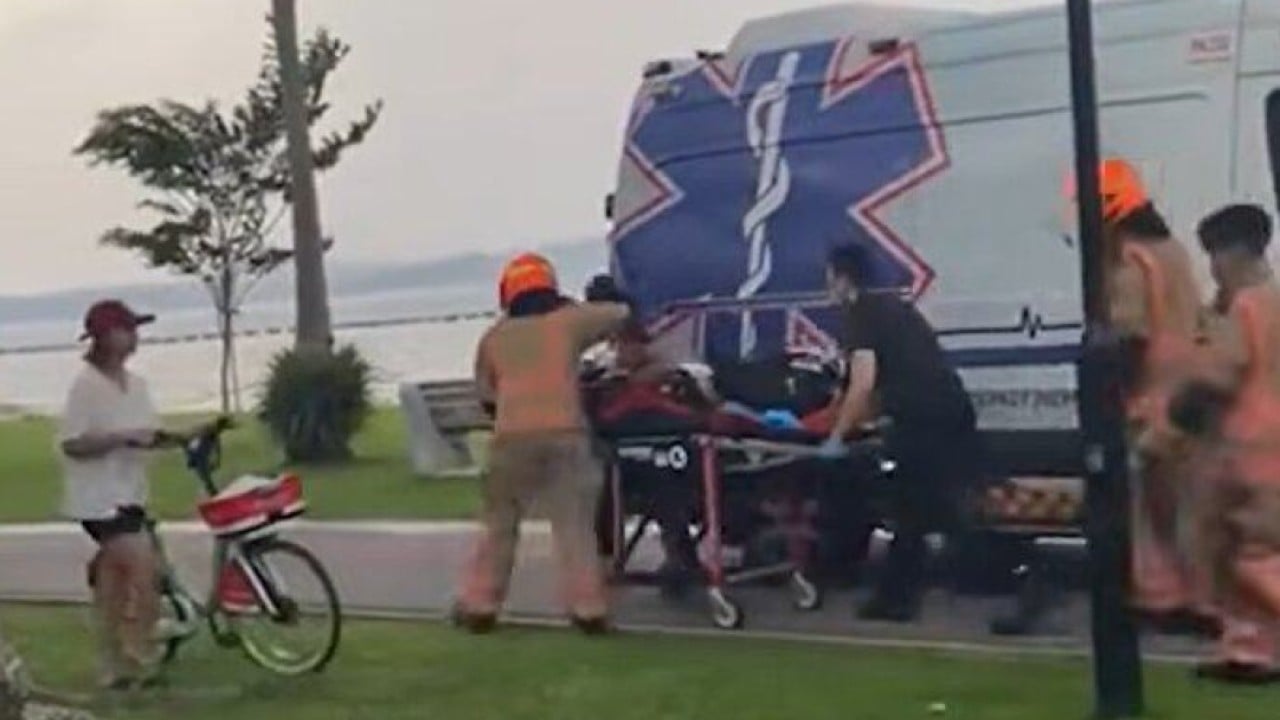
When a 24-year-old is struck down under a seemingly clear sky in Singapore, the press runs the same tired narrative. They paint a picture of a blameless victim, an unpredictable sky, and a cruel twist of fate. They are wrong. It was not a freak accident. It was a textbook manifestation of a phenomenon that meteorologists have understood for decades, yet the public routinely ignores because looking at a blue sky feels safer than respecting atmospheric physics.
We are taught from childhood that rain means danger and sunshine means safety. This childish binary is killing people. The lazy consensus states that if it is not raining on your head, you are safe from the storm. The reality is far more terrifying, and far more controllable.
The Myth of the Blue Sky
There is no such thing as lightning striking from a truly clear sky out of nowhere. Every single lightning strike requires a parent thunderstorm. The illusion of the "clear day strike" exists because human beings have pathetic spatial awareness when it comes to the upper atmosphere.
What the public calls a "clear day" is often just the edge of a highly organized, severe convective system sitting ten to fifteen miles away. You look up, see blue sky directly overhead, and assume you are safe. You fail to see the massive cumulonimbus anvil stretching out horizontally high above your field of vision.
This is where the "bolt from the blue" originates.
These are not standard negative lightning strikes. Standard strikes travel from the negatively charged base of the cloud straight down to the positively charged ground directly beneath the storm. Those are localized. Those are easy to avoid because you can see the rain shaft.
The strikes that kill people on "clear days" are positive lightning strikes. They originate in the highly positive upper regions of the storm's anvil. Instead of dropping straight down, the step leaders propagate horizontally through clear air, traveling massive distances before suddenly banking vertically and striking the ground.
- Distance: Positive lightning can travel 10 to 25 miles away from the rain core.
- Power: These strikes carry a peak current of up to 300,000 amperes. That is nearly ten times the energy of a standard negative strike.
- Duration: The continuing current lasts longer, meaning they do not just shock; they vaporize and ignite.
When you are struck by a bolt from the blue, you are not being hit by a random anomaly. You are being hit by the long-range artillery of a storm that you thought was someone else's problem.
Why Your Weather App Is Actively Endangering You
People rely on smartphone apps to tell them when to seek shelter. This reliance is a systemic failure.
Most consumer weather apps rely on delayed radar sweeps or generalized regional forecasts. By the time your app sends a push notification warning you of lightning in the area, the charge grid above your head has already stabilized into a lethal configuration.
Worse, people look at the radar map, see the green and red rain blobs a few miles away, and think, “The storm is still over the next town. We have time.”
You do not have time. The electric field $E$ between the upper cloud layers and the ground does not care about your municipal boundaries. If you can hear thunder, you are already inside the storm's footprint. It does not matter if the sun is shining so bright you need sunglasses. Sound travels roughly one mile every five seconds. If you hear a rumble twenty seconds after a flash, that storm is a mere four miles away. Given that positive lightning easily covers fifteen miles horizontally, you are standing directly in the kill zone.
I have spent years analyzing workplace safety protocols in high-risk tropical environments. The biggest hurdle is never the gear; it is the cognitive dissonance of the workers. They will stand in an open field, hearing distant rumbles, refusing to stop work because "it isn't raining yet." Rain is a comfort metric, not a safety metric.
Dismantling the Flawed Premises of Public Safety
Let us address the questions people ask when these tragedies happen, and dismantle the flawed premises behind them.
"Can lightning strike when there are no clouds?"
No. It cannot. This question reveals a fundamental misunderstanding of charge separation. Lightning requires the collision of ice crystals and graupel within a convective cloud to generate the massive electrical potential necessary to break down the dielectric strength of air.
If you get hit, there is a cloud. It just happens to be miles away, or so high up that it appears as a thin, harmless haze rather than a dark, threatening wall.
"Isn't it safe if I am surrounded by tall buildings?"
This is the urban complacency trap. Cities like Singapore are packed with skyscrapers and lightning rods designed to divert strikes. People assume this creates a perfect Faraday cage across the entire urban geography.
It does not. Lightning does not always choose the tallest object; it chooses the path of least resistance at the final microsecond of its descent. As the downward stepped leader approaches the ground, it induces upward streamers from objects on the surface. A tall building a block away will protect its immediate vicinity, but it cannot prevent a high-energy positive strike from finding a human being standing in an open plaza, a park, or on a beach. The urban landscape is full of shadow zones where protection drops to zero.
The Cost of Complacency
The hard truth is that the 24-year-old in Singapore, and the hundreds of others killed globally in identical scenarios every year, are victims of a collective cultural failure to respect basic meteorology.
We have built a society that demands absolute predictability. We want our apps to give us a countdown timer for danger. Nature does not operate on a subscription model.
If you want to survive the realities of modern climate volatility, you have to throw out the traditional visual cues.
- Ditch the rain metric: If you wait for the first drop of rain to seek shelter, you have already gambled with your life and lost the odds.
- The 30-30 Rule is outdated but a bare minimum: If you see lightning, count the seconds. If it is under 30 seconds, go inside. Stay inside for 30 minutes after the last rumble. But honestly? Even 30 seconds is too risky when dealing with horizontal propagation. If you hear it at all, clear the area.
- Substantial shelter only: A canvas tent, a picnic shed, or a tree canopy are not shelters. They are lightning attractors and shrapnel factories. You need a fully enclosed metal vehicle or a grounded building with plumbing and wiring to channel the current away from your body.
Stop looking at the sky directly above your head to judge the weather. Look at the horizon. Listen to the atmosphere. The sun can be shining directly into your eyes while a fatal charge is streaming toward your chest. Stop calling these events freak accidents to make yourself feel better about your own ignorance. Take accountability for your safety, or become the next statistical anomaly the media writes off as unavoidable.