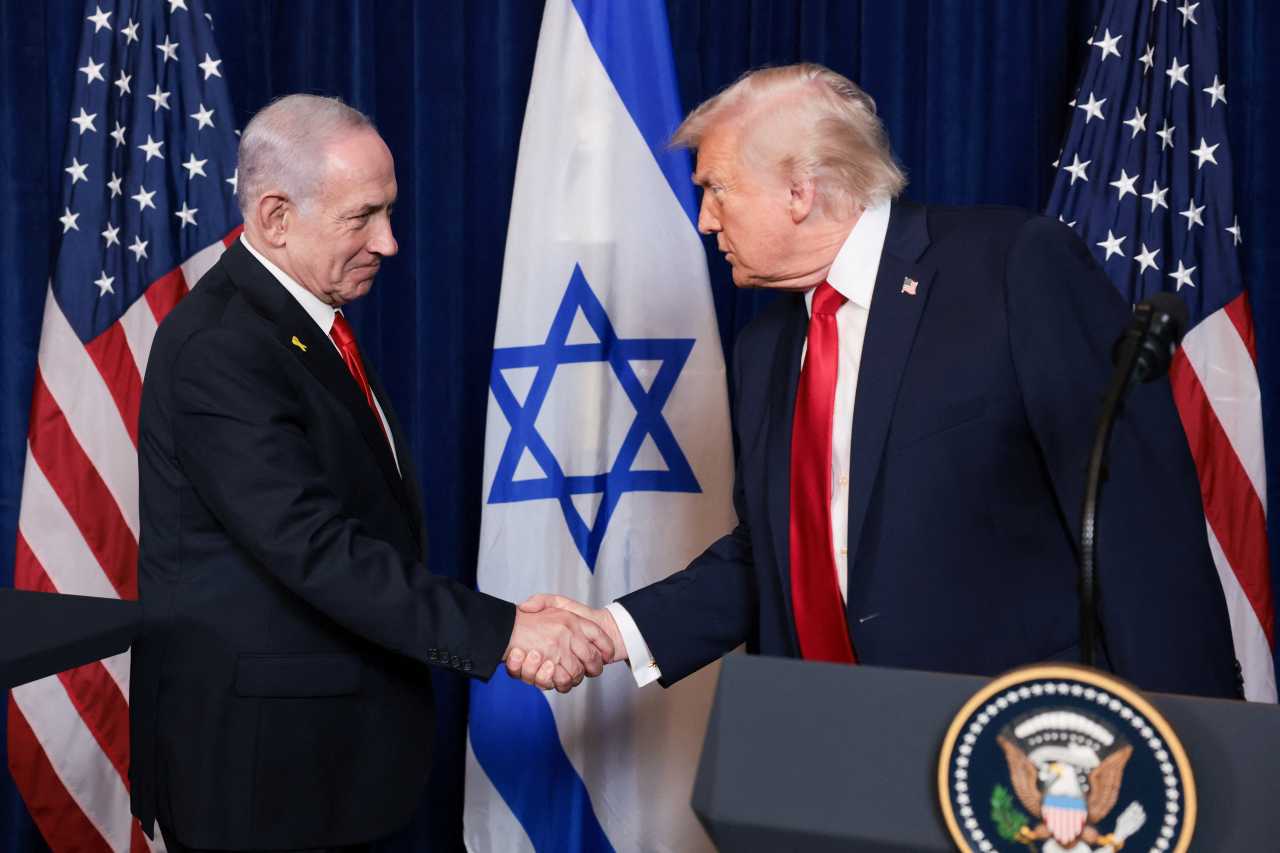
Political commentators love a good lovers' quarrel. When reports surfaced detailing the supposed friction between Donald Trump and Benjamin Netanyahu, the mainstream media salivated. They painted a picture of a shattered alliance, parsing every public statement, delayed phone call, and subtle snub as evidence of a permanent geopolitical rift.
It is a comforting narrative for people who view international relations through the lens of a reality television show. It is also entirely wrong.
The lazy consensus ignores how power actually operates. What pundits mistake for a personal fallout is a masterclass in strategic theater. This is not a breakdown of diplomacy. It is calculated political maneuvering designed to serve the domestic survival of both men. The institutional, structural alignment between a Trump-led Washington and a Netanyahu-led Jerusalem remains untouched by personal irritation.
To understand the reality of this relationship, you have to stop reading the gossip columns disguised as foreign policy analysis.
The Myth of Personal Loyalty in Statecraft
Pundits operate under the naive assumption that international alliances are built on friendship. They point to Trump’s irritation over Netanyahu congratulating Joe Biden on his 2020 election victory as the moment the relationship died. They highlight subsequent cold statements and public side-eyes as proof of an irreparable divide.
This ignores the first rule of realpolitik: nations do not have permanent friends, only permanent interests.
During my years analyzing Middle Eastern policy and working alongside the institutional architects of these administrations, I watched billions of dollars in military aid, intelligence sharing, and diplomatic cover move flawlessly regardless of whether the leaders liked each other. The bureaucracy of the U.S.–Israel alliance is insulated from personal tantrums.
Imagine a scenario where two CEOs publicly bash each other to appeal to their respective board members, while their companies quietly finalize a massive merger behind closed doors. That is exactly what is happening here. Trump and Netanyahu are political survivors first. Every public statement they make is directed at a specific voting bloc, not each other.
Why Both Leaders Benefit from Public Tensions
The apparent distance between Trump and Netanyahu is not an accident; it is a tactical asset for both leaders.
For Netanyahu, being seen as entirely subservient to Washington is a liability at home. His right-wing coalition demands defiance. By occasionally showing friction with a U.S. leader—even one as historically supportive as Trump—Netanyahu signals to his base that he puts Israeli sovereignty above American approval. He gets to play the role of the uncompromising defender of the nation.
For Trump, maintaining a slight, unpredictable distance serves his "America First" posture. It allows him to signal to his supporters that his backing of foreign allies is not a blank check. It reinforces his image as a master negotiator who cannot be taken for granted by anyone, including traditional partners.
The friction is the point. It is a mutually beneficial performance that strengthens their respective domestic positions without altering the underlying geopolitical reality.
The Unbroken Structural Alliance
While the media focuses on the theater, the mechanics of the relationship tell a completely different story. Look at the hard data, not the headlines.
The foundational policy shifts of the first Trump administration—the relocation of the U.S. Embassy to Jerusalem, the recognition of sovereignty over the Golan Heights, and the brokering of the Abraham Accords—permanently altered the architecture of the region. These were not temporary executive orders; they were structural transformations.
The Abraham Accords normalized relations between Israel and several Arab nations, fundamentally shifting the regional balance of power. This framework remains the baseline for regional policy. No amount of rhetorical sparring alters the fact that both leaders are locked into this specific geopolitical trajectory.
Furthermore, the defense integration between the two nations has only deepened. Joint military exercises, missile defense funding, and intelligence co-management continue without interruption. The institutional apparatus does not care about personal grudges.
Dismantling the Flawed Premises of Political Punditry
If you look at the queries dominating search engines and panel discussions, you realize the public is asking the entirely wrong questions.
Question: Will the tension between Trump and Netanyahu weaken the U.S.–Israel alliance?
The Brutal Truth: No. The alliance is anchored by deep state structures, evangelical voting blocks in the United States, and shared intelligence priorities targeting regional adversaries. To think a delayed phone call will derail a multi-billion-dollar defense apparatus is a fundamental misunderstanding of power.
Question: Can Netanyahu trust Trump if he returns to office?
The Brutal Truth: Netanyahu does not trust Trump, nor should he. He trusts Trump’s incentives. Trump’s political core is deeply aligned with a heavily pro-Israel domestic base. Netanyahu does not need a friend in the White House; he needs an executive whose political survival depends on supporting Israeli policy. He already has that.
The downside to acknowledging this contrarian reality is that it strips away the drama. It requires admitting that international politics is often dry, transactional, and insulated from the personality-driven narratives that dominate the evening news. It forces us to accept that politicians lie to their audiences far more than they pivot their policies.
Stop analyzing foreign policy as if it were an emotional drama. The public tension is a smokescreen. The structural alliance is ironclad, and the theater will continue as long as it wins votes.
Ignore the rhetoric. Watch the signatures on the policy documents. Everything else is just noise designed to keep you clicking.