The air in the province of Limón often tastes like salt and burning diesel.
It hangs heavy over the docks, wrapping around the corrugated iron roofs of houses where people live with their doors bolted long before sunset. For years, the name whispered across these humid alleys was not that of a politician, nor a police chief. It was a nickname born from smoke and shadow.
El Diablo.
To the outside world, distant headlines reduced him to a statistic. A high-value target. The most wanted drug trafficker in Costa Rica. But statistics do not capture the sound of shutters slamming shut when a motorcycle slows down too much on an unpaved road. They do not measure the heavy, suffocating silence that settles over a neighborhood when everyone knows who holds the real power, and everyone knows to look away.
Panama was where the chase finally stopped.
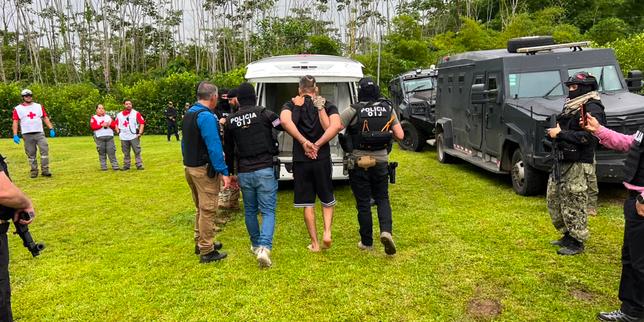
Not in a cinematic shootout beneath flashing neon lights, but in a quiet, coordinated sweep that felt almost anticlimactic for a man who had cast such a massive, terrifying silhouette over Central America's Caribbean coast. Law enforcement agencies closed the net. Handcuffs clicked. The ghost was real, and he bled just like anyone else.
Yet, standing here now, looking at the empty streets where his shadow used to stretch, a bitter truth lingers in the salt air.
An arrest is not an eradication.
Consider what happens next: the vacuum.
When a apex predator is pulled from an ecosystem, the environment does not suddenly become peaceful. It becomes volatile. Lesser players scramble for the crown. Old alliances fracture into bloody territorial disputes. The machinery of illegal narcotics transport does not grind to a halt because one man lost his freedom; it simply recalibrates, seeking out new veins through the porous borders of ports that handle thousands of steel shipping containers every single day.
Costa Rica has long prided itself on being an island of peace in a turbulent region. A green sanctuary of eco-tourism, coffee, and Pura Vida. That national identity made the rise of figures like El Diablo all the more jarring. It was a rude awakening. It forced a comfortable nation to look in the mirror and realize that the lucrative cocaine corridors stretching from South America to North America and Europe do not just bypass paradise. They carve right through it.
The docks of Limón are the epicenter of this brutal geometry.
Imagine standing at the edge of the harbor at midnight. Massive cranes stand like prehistoric skeletons against a starless sky. Millions of tons of legitimate cargo move through these gates—pineapples, bananas, electronics. Hidden among them, packaged in waterproof bricks stamped with corporate logos of cartels, are fortunes that could buy small nations.
El Diablo understood this geometry better than anyone. He was not merely a street thug with a weapon. He was a logistics master, an invisible architect who wove a network of corruption, intimidation, and maritime smuggling that operated in plain sight. He exploited the cracks in the system. Where there was poverty, he offered cash. Where there was institutional weakness, he offered bribes that were impossible to refuse.
And when bribes failed, fear did the job.
I remember talking to a local shopkeeper whose name must remain unsaid for obvious reasons. His hands shook as he wiped down a counter scarred by decades of humidity. He did not talk about drug kilograms or international cartel routes. He talked about the afternoon a black SUV parked outside his shop for three hours. No words were spoken. None were needed. That is the real tax of organized crime. It is paid in autonomy. It is paid in the slow erosion of community trust.
When the news broke that the fugitive was finally in custody, the shopkeeper did not cheer. He simply looked down the street, his eyes narrowing against the glare of the midday sun.
"They caught the devil," he muttered. "Now let's see who crawls out of hell to take his place."
That is the heavy burden resting on the shoulders of law enforcement today. The operation that dismantled his inner circle was hailed as a historic victory, and rightfully so. Intelligence sharing between Costa Rican authorities and international partners proved that cooperation can pierce even the most heavily fortified criminal enterprises. Months of surveillance, wiretaps, and asset tracking culminated in a synchronized raid that shattered an empire built on violence and cocaine distribution.
But the architecture of crime survives its architects.
The money laundering fronts remain operational until systematically unpicked. The corrupted officials do not magically turn honest overnight. The young men on street corners, recruited because alternative economic options are vanishingly rare, are still looking for a way out of systemic hardship.
To truly understand why the capture of El Diablo is only a single chapter in a much longer book, one must look at the soil from which he grew. Organized crime does not take root in a vacuum. It thrives wherever the state is absent, wherever infrastructure is weak, and wherever economic desperation strips away the luxury of long-term choices.
Fixing a leaky roof requires more than catching the rain in a bucket.
Costa Rica stands at a profound crossroads. The arrest of its most wanted man offers a rare, precious window of opportunity. It is a moment to fortify democratic institutions, to cleanse ports with cutting-edge non-intrusive inspection technology, to invest heavily in the coastal communities that have been treated as collateral damage for too long, and to break the cycle that supplies cartels with an endless stream of desperate labor.
The sirens have faded. The extradition proceedings have run their course. The man who terrorized a coast is locked behind heavy steel doors where he can no longer dictate the rhythm of life in Limón.
Out on the water, the container ships continue to arrive, moving silently across the dark horizon, carrying the weight of a global appetite that never sleeps.
The sun dips below the Caribbean, painting the water in shades of bruised purple and gold.
A motorcycle rumbles down the coastal road. The shutters stay closed.