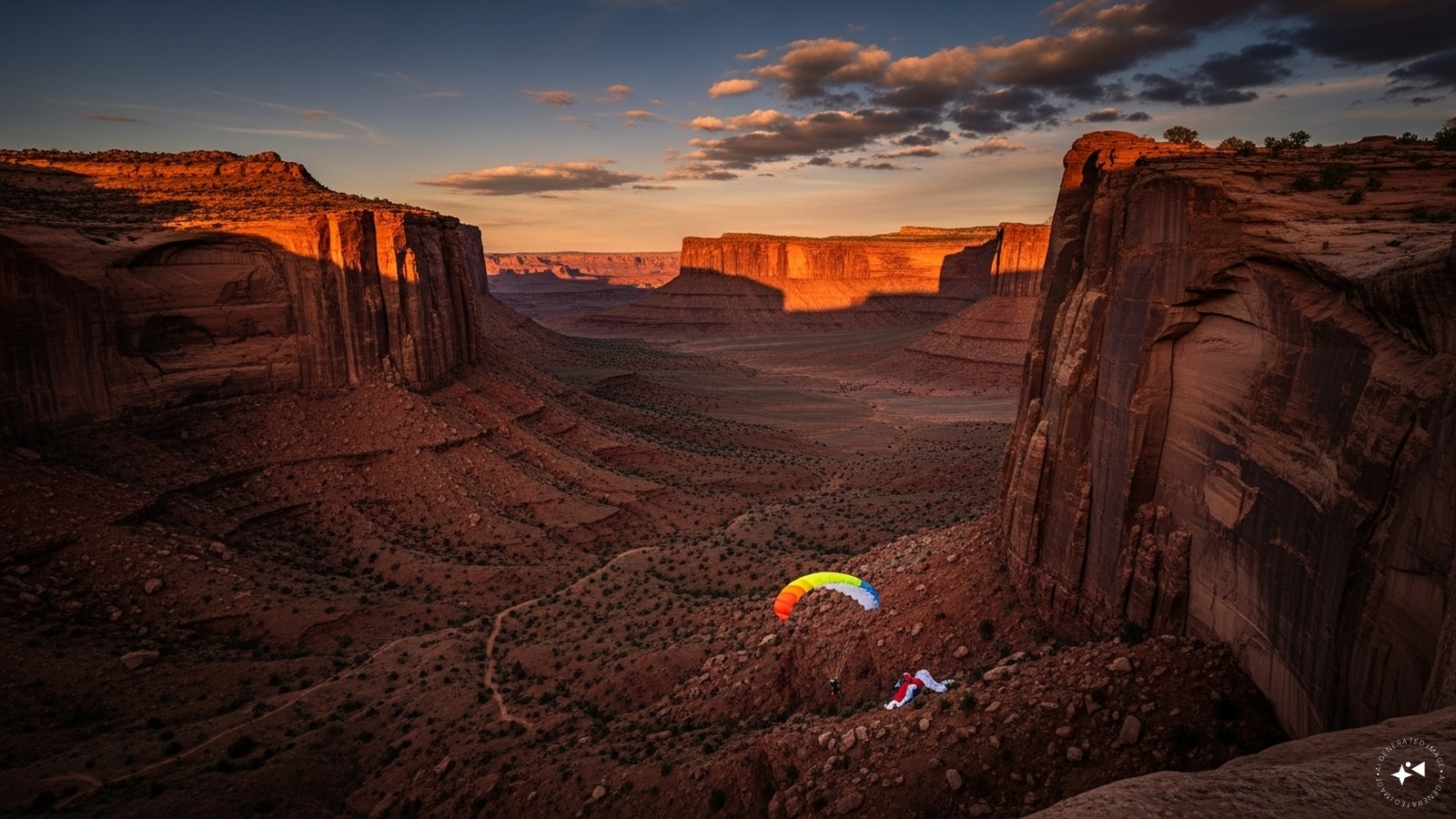
Two experienced jumpers went regular BASE jumping in the red rock canyons of Utah and never returned. The deaths of world-class aerialist Amber Forte and her partner Espen Fadnes in a tandem wing-suit accident near Moab exposed a stark reality. Extreme sports progression has outpaced the human margin for error. This tragedy did not involve reckless amateurs. These were elite, highly disciplined athletes operating at the absolute pinnacle of their discipline. When the best in the world fail to survive a standard jump, the problem is no longer about individual judgment. It points to a systemic crisis in the sport itself.
The incident occurred in a region known globally for its sheer cliffs and unforgiving terrain. Moab draws hundreds of jumpers every year. It offers some of the most accessible exit points in North America. Yet that very accessibility masks the compounding risks of low-altitude aviation.
The Physics of Failure at Three Hundred Feet
BASE jumping relies on a razor-thin timeline. Unlike skydiving, where a participant jumps from an aircraft at ten thousand feet, a BASE jumper operates with no reserve parachute. There is simply no time for a backup system to deploy.
When a jumper leaves a cliff face, gravity accelerates the body at thirty-two feet per second squared. Within three seconds, the jumper travels nearly one hundred feet vertically. If the parachute opens with the wrong orientation—a phenomenon known as an off-heading opening—the canopy can fly directly back into the rock wall.
Tandem jumps multiply these risks exponentially. The physics change completely.
- Weight Distribution: The center of gravity shifts forward and down, altering how the tandem pair cuts through the air before deployment.
- Aerodynamic Drag: A second body creates turbulent airflow behind the primary jumper, which can delay the clean inflation of the parachute canopy.
- Deployment Delay: A fraction of a second spent stabilizing the extra mass translates directly into lost altitude.
In a sport measured in frames of video, a delay of half a second means the difference between a clean canopy ride and a fatal impact. The gear used in these jumps is highly specialized. Manufacturers design the containers and canopies to open instantly upon pilot chute release. But mechanical perfection cannot overcome a lack of altitude.
The Commercial Pressure on Elite Athletes
The modern extreme sports economy demands constant escalation. Sponsors no longer fund athletes simply to exist. They require content, visibility, and spectacles that push past previous boundaries.
Forte had achieved mainstream recognition, notably performing alongside Madonna during a Super Bowl halftime show. This level of crossover success brings intense pressure. To maintain sponsorships and funding, athletes must continuously feed the media machine with more daring feats, tighter lines, and novel jumping formats.
This commercial drive creates a psychological trap. Aerialists spend thousands of hours refining their skills until the unnatural feels completely routine. They normalize the deviance of survival. Over time, the proximity to death loses its sharpness. The brain treats a three-hundred-foot cliff not as a mortal threat, but as an office.
This normalization often leads to the adoption of tandem wing-suit flights—an experimental discipline with almost no standardized training protocol. No regulatory body oversees BASE jumping infrastructure. There are no certified tandem pilot licenses like those found in civilian aviation or commercial skydiving. The community polices itself. While this freedom is central to the ethos of the sport, it removes the bureaucratic guardrails that save lives in other high-risk industries.
The Mirage of Total Control
The elite jumping community often points to meticulous preparation as the ultimate safety net. Athletes study wind patterns, use laser rangefinders to calculate exact trajectories, and use advanced GPS logging to analyze their flight angles. They believe that data can eliminate chance.
This is a dangerous illusion. Micro-climates inside desert canyons defy predictable modeling. A thermal updraft pushing against a cliff face can drop to zero in seconds. A sudden tailwind can stall a wing-suit or push a deploying canopy offline.
"The wind in the canyons does not blow straight. It rolls over the rim like water, creating rotors and pockets of dead air that no instrument can predict."
When an athlete flies at high speeds mere meters from jagged limestone, they assume the air is stable. It rarely is. The margin for survival shrinks to zero.
Consider the mechanics of a wing-suit flight. The fabric wings generate lift based on forward airspeed. If that speed drops even slightly due to a sudden shift in wind direction, the suit stalls. The pilot drops like a stone until they can regain forward momentum. At high altitudes, a stall is an inconvenience. Near a canyon floor, it is fatal.
The Local Cost of Global Adrenaline
The consequences of these accidents extend far beyond the immediate community of jumpers. Small tourist towns bear the practical burden of the sport.
Local search and rescue teams, often comprised entirely of volunteers, must navigate treacherous terrain to recover bodies. These operations carry high financial costs and put the lives of rescue personnel at risk. High-angle technical rescues require teams to suspend themselves from the same crumbling desert towers that claimed the jumpers.
- Resource Strain: A single recovery operation can tie up emergency services for an entire county, leaving rural areas without medical coverage for hours.
- Psychological Toll: First responders in small communities repeatedly witness catastrophic trauma, leading to high burnout rates.
- Public Lands Debate: Frequent fatalities trigger calls for blanket bans on public lands, threatening the access rights of traditional recreationists like climbers and hikers.
The Bureau of Land Management manages the terrain around Moab. For decades, the agency has maintained a policy of minimal intervention regarding extreme sports. They treat the activity as a matter of personal responsibility. However, as the body count rises, the political pressure to close these areas increases.
The Flaw in the Progression Model
The trajectory of action sports suggests that what is radical today becomes standard tomorrow. In snowboarding or skateboarding, this progression results in more spins or higher aerials over foam pits and snow landings. In low-altitude aviation, the progression curve moves directly toward rock faces.
The sport has reached a point where the equipment cannot evolve fast enough to protect the user from the laws of motion. Parachute nylon cannot open faster without tearing apart from the opening shock. Wing-suits cannot generate more lift without becoming too large for a human body to control physically.
The tragedy in Utah demonstrates that human reflexes have met their match against gravity. The industry can no longer hide behind the narrative that accidents only happen to the untrained or the reckless. The system itself rewards proximity to danger, and the environment eventually collects the debt.
Safety initiatives within the community currently focus on better mentorship and stricter self-regulation. Experienced jumpers urge newcomers to slow down their progression. They advise completing hundreds of skydives before ever stepping onto an exit point. But these recommendations fail to address the core issue. The veterans themselves are the ones dying.
The data shows that experience does not act as armor. It often acts as a catalyst for taking more calculated risks that eventually turn uncalculated. When the baseline activity requires flawless execution in an unpredictable environment, survival becomes a statistical improbability over a long enough timeline. The sport must confront the reality that some disciplines offer no sustainable path forward.


