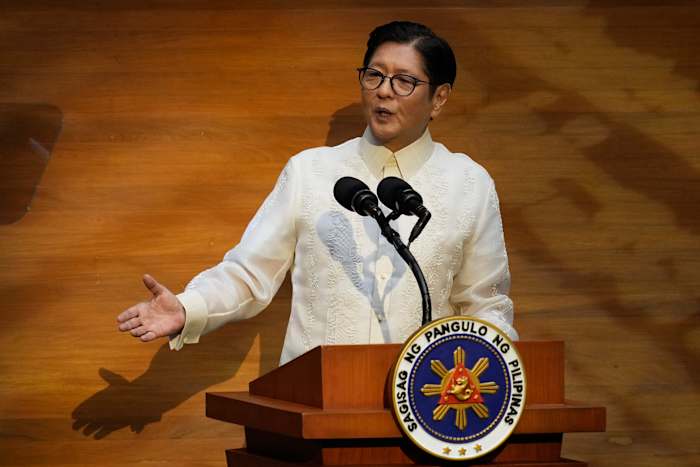
When a president uses his biggest national platform to declare that citizens "do not yield," nobody has to guess who he is talking to. Philippine President Ferdinand Marcos Jr delivered a sharp, calculated message during his state of the nation address, taking direct aim at Beijing's aggressive footprint in the South China Sea without ever needing to drop a formal name.
If you have been watching geopolitical tensions in Southeast Asia simmer over the past few years, this latest speech marks a critical turning point. Manila isn't backing down from the 2016 international arbitration ruling that completely invalidated China's sweeping territorial claims. Instead, Marcos is doubling down, turning international maritime law into a shield for national sovereignty.
The Spark Behind the Speech
Why the sudden escalation in tone? The context matters immensely here. Just days before the address, Manila summoned Chinese Ambassador Jing Quan over a deplorable incident. State-backed media outlet China Daily published an AI-generated video and cartoon explicitly depicting Filipinos as monkeys. The racist imagery was tied directly to Beijing's ongoing rejection of the 2016 tribunal award.
The Philippine government condemned the media stunt as dehumanizing. When the core dignity of a population gets dragged into state media propaganda, diplomacy starts wearing thin. Marcos addressed this head-on in his speech, noting that the collective humanity of Filipinos had been questioned lately.
"Filipinos are a noble and a great race," Marcos told Congress, drawing loud applause from lawmakers. "We are not greedy. We are not racists. We are not liars."
By tying the defense of maritime boundaries directly to national dignity, the administration has successfully galvanized public support. People are tired of being bullied in their own backyard.
Upholding the 2016 Arbitration Ruling
The cornerstone of Manila's current foreign policy remains the 2016 Hague ruling, which ruled Beijing's historic nine-dash line claims legally baseless under the United Nations Convention on the Law of the Sea (UNCLOS). China has spent years dismissing the verdict as a sham, refusing to participate in the proceedings.
Marcos made it crystal clear that his administration views the ruling as a final, binding benchmark. He vowed to use every available peaceful and legal mechanism to defend the nation's maritime entitlements against any domestic or foreign interference.
Confrontations in these strategic shipping lanes have grown increasingly volatile. Between aggressive Chinese coast guard maneuvers, water cannon incidents targeting supply ships, and crowded fishing fleets, the South China Sea remains one of the most dangerous flashpoints on earth. Marcos is signaling to international allies—particularly the United States and regional partners—that the Philippines will stand its ground.
Domestic Housecleaning and Nuclear Shifts
Foreign policy wasn't the only heavy hitter in the address. Marcos used the speech to target domestic corruption, dropping a bombshell regarding high-level political accountability. He announced that special anti-graft prosecutors are preparing to file criminal charges against former House Speaker Martin Romualdez.
Romualdez happens to be the president's cousin and a powerful political ally. By moving forward with corruption investigations tied to massive flood control scandals, Marcos is trying to project institutional integrity. Nearly 25 billion pesos, equivalent to roughly $410 million, in cash and frozen properties have already been recovered by the government.
"This is painful to me, but we have to do the right thing," Marcos stated. "I'm not a president for my family. I'm not a president for my friend."
On the energy front, the administration is facing economic pressures from global fuel price spikes linked to ongoing conflicts in the Middle East. To secure long-term stability, Marcos threw weight behind a controversial proposal: reviving nuclear energy production in the Philippines. While the country's sole historic nuclear plant in Bataan was shelved decades ago due to deep safety and corruption worries, the administration insists any future push will prioritize strict safety protocols and public transparency.
The stakes for the Marcos administration have never been higher. Balancing economic ties with a dominant neighbor while fiercely protecting maritime borders requires an impossibly tight tightrope walk. Monday's address proved that Manila is done whispering.


