Fifteen minutes.
That is less time than it takes to brew a proper pot of coffee, scroll through your morning notifications, or sit in traffic waiting for a broken stoplight to cycle through its red. For most of us, fifteen minutes is pure friction—the dead air between the things we actually care about.
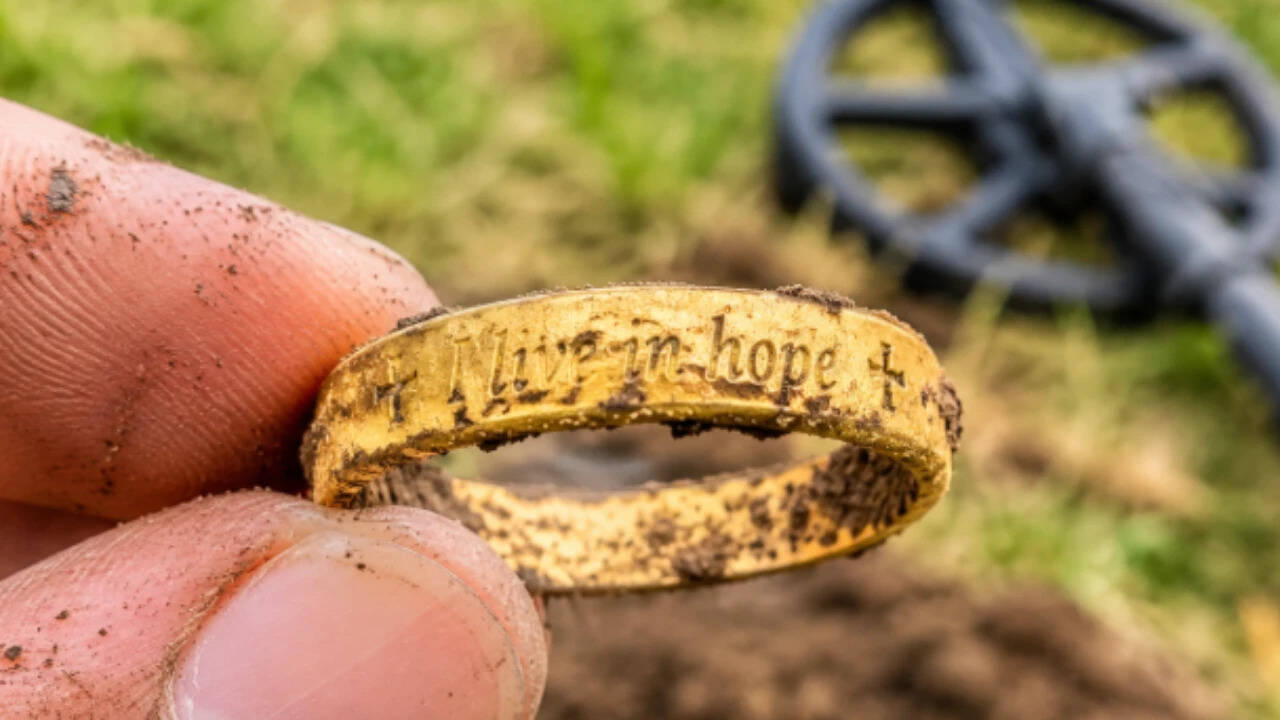
Yet, on a damp, unremarkable afternoon in a plowed field, fifteen minutes was all it took for a man holding a piece of plastic and copper wiring to reach down into the dirt and pull up a piece of the seventeenth century.
If you read the standard news reports about this kind of discovery, they read like a police blotter. A hobbyist goes out with a metal detector. The machine beeps. He digs a hole. He finds a centuries-old gold ring. The artifact is handed over to local authorities for valuation. End of story. You nod, maybe feel a brief flicker of envy over the potential auction price, and move on to the next headline.
That dry recitation misses the entire point. It strips away the electricity of what actually happens when modern metal meets ancient gold. When you look past the headline and understand the mechanics of how something like this survives—and what it takes to find it—you realize this isn't a story about getting rich quick. It is a story about patience, invisible history, and the thin layer of topsoil separating our frantic modern lives from the people who walked these exact paths centuries ago.
The Myth of Beginner’s Luck
When news breaks that someone found a medieval or post-medieval gold ring within fifteen minutes of turning on their machine, the immediate reaction from the outside world is always the same. Luck. Pure, blind, lottery-ticket luck.
Ask anyone who has spent real hours swinging a search coil in the freezing rain, and they will laugh at that word.
I remember my first few outings with a detector years ago. You buy the gear thinking you are Indiana Jones, and within twenty minutes, your lower back is screaming, your boots weigh ten pounds each from caked clay, and your pouch is full of rusted nails, crushed aluminum cans, and mysterious shards of lead. You dig forty holes to find forty pieces of trash. The machine screams at you with high-pitched tones that promise silver, only for you to unearth a flattened bottle cap from 1994.
To understand what happened during that fifteen-minute miracle, you have to understand what the machine is actually doing. A metal detector isn't a magic wand that points at treasure. It is an electromagnetic interrogation tool. It sends a magnetic field into the earth; when that field hits a conductive object, the object generates its own weak magnetic field, which the coil picks up and translates into audio frequencies and target identification numbers.
Here is the catch. Gold is a terrible conductor compared to silver or copper. In the electromagnetic spectrum of a detector, a centuries-old gold ring does not sound like a glorious symphony. It sounds almost identical to a modern aluminum pull-tab from a soda can, or a tiny piece of crumpled foil from a chocolate wrapper.
Most amateurs ignore those signals. They discriminate them out of their settings because they get tired of digging up modern garbage.
The man who pulled that gold ring out of the earth after fifteen minutes didn't just get lucky. He had to make a deliberate, disciplined choice to trust a faint, ambiguous tone that ninety percent of casual walkers would have dismissed as junk. He knelt in the mud, pushed his shovel into the soil, and took a gamble on a whisper.
What Survives Beneath the Plow
Think about the journey of that ring before the shovel broke the crust.
Imagine a hypothetical scenario—a merchant, a landowner, or a bride walking across a muddy track four hundred years ago. Hands swell in the summer heat and shrink in the winter cold. A ring slips off a finger during harvest, or during a hurried ride on horseback, or while mending a fence. It hits the dirt. In less than a season, grass grows over it. Within a decade, worms and falling leaves bury it two inches deep.
Then comes the miracle of survival.
Iron rusts away into orange dust. Silver tarnishes black and becomes brittle in acidic soil. Bronze corrodes into green disease. Wood rots, leather dissolves, and bone turns to chalk.
Gold refuses to die.
Because gold is chemically inert, it does not react with oxygen, water, or the harsh acids of fertilizer and decaying organic matter. A gold ring dropped during the reign of Elizabeth I or James I does not age. When the mud is washed away under a kitchen tap four centuries later, the metal gleams with the exact same warm, buttery luster it had the day a goldsmith hammered it into shape by candlelight.
Every time a tractor plows that field in the spring, the steel blades churn the top eight to ten inches of earth, flipping soil like pages in a book. Most historical artifacts get shattered by the blades or pushed too deep for hobbyist machines to reach. For a ring to be found in fifteen minutes, the plow had to lift it back toward the surface just enough for an electromagnetic field to graze its edge, without crushing its delicate band.
You aren't just looking at a piece of jewelry when you see photos of these finds. You are looking at a statistical impossibility that survived centuries of agriculture, weather, and chemical erosion, waiting for one person to walk the exact right line at the exact right pace.
The Quiet Obsession of the Search
Why do people do this? Why spend thousands of dollars on equipment and hundreds of hours wandering empty fields in the wind?
From the outside, metal detecting looks like the ultimate solitary eccentricity. You see a figure in waterproof trousers sweeping a stick back and forth over dirt, wearing oversized headphones, completely cut off from the world.
Yet, if you talk to the people who do it, you discover it is one of the few remaining antidotes to modern digital exhaustion.
In our daily lives, everything is curated, algorithmic, and predictable. We know what is at the end of every click. When you step onto a freshly harvested field with a detector, the algorithm vanishes. You are forced into a state of hyper-present mindfulness. You have to listen to the subtle pitch changes in your headphones, read the topography of the land to guess where old footpaths or cottages used to stand, and pay attention to the texture of the soil.
There is a profound psychological shift that happens when you realize the ground beneath your feet isn't just dirt—it is a vertical archive.
Consider what happens next when a signal hits. Your heart rate spikes. You cut a neat plug of earth, flip it over, and wave your pinpointer—a small handheld probe—over the clod. When the probe buzzes, you gently crumble the dirt with your bare fingers. You never scrape with metal; you use skin against soil so you don't scratch whatever is hiding inside.
And then, through the dark brown clay, you see a curve of yellow that doesn't belong to nature.
Nothing in the natural world is that color. Not a stone, not a root, not a beetle shell. That unmistakable, heavy glint of high-karat gold stops time. For a few seconds, you are the only person on earth who knows this object exists. You are the first human being to touch it since the person who lost it realized their finger was bare and felt that sickening drop in their stomach centuries ago.
The Invisible Rules of Treasure
Once the adrenaline fades, reality sets in—and this is where the romantic fantasy of finding treasure collides with the complex legal and ethical machinery of the real world.
A common misconception is that if you dig up a priceless gold ring, you simply put it in your pocket, drive to a pawn shop or an auction house, and buy a new car. In regions with rich archaeological histories, particularly across the United Kingdom and Europe where these dramatic fifteen-minute discoveries frequently happen, the law treats ancient artifacts very differently.
Under frameworks like the Treasure Act in England and Wales, any object containing at least ten percent precious metal that is more than three hundred years old is legally classified as "Treasure."
The moment you pull that ring from the mud, you do not own it. You are its temporary custodian.
Finders are legally required to report the discovery to a local Finds Liaison Officer within fourteen days. Failing to do so isn't just frowned upon; it is a criminal offense that can result in heavy fines or prison time, alongside permanent banishment from the detecting community.
Here is how the process actually works, and why it protects history rather than punishing the finder:
- The Archaeological Record: Experts examine the ring, record the exact GPS coordinates of the hole, and study the surrounding soil context. A ring found alone tells one story; a ring found near scattered pottery shards might reveal a lost medieval settlement.
- The Coroner’s Inquest: An official inquest formally declares whether the item meets the legal criteria of treasure.
- Museum Acquisition: National or local museums are given the first right to purchase the artifact so it can be preserved and displayed to the public rather than locked away in a private vault.
- Independent Valuation: A committee of experts determines the fair market value of the ring. That payout is then split—typically fifty-fifty—between the person who found it and the landowner who granted permission to search the field.
This system transforms a selfish gamble into a civic partnership. The landowner gets rewarded for stewarding the land, the museum gets a piece of local heritage, the public gets to see it behind glass, and the detectorist receives both financial reward and the ultimate validation: their name printed on a museum placard next to a four-hundred-year-old masterpiece.
Why These Stories Grip Us
We live in an era where almost everything we buy is designed to be obsolete within thirty-six months. Our phones slow down, our clothes fray, our cars rust, and our digital photos sit on servers we don't own, vulnerable to a single corrupted drive or forgotten password.
We are surrounded by disposable things.
Perhaps that is why a story about a man finding a gold ring in fifteen minutes cuts through the noise so effortlessly. It taps into a deep, quiet hunger for permanence.
To hold a piece of gold shaped by human hands four centuries ago—a ring that perhaps bore a secret romantic inscription, or a family crest, or a religious prayer—is to confront the reality that our time here is brief, yet the things we make with care can outlast empires.
That detectorist walked into a field expecting nothing more than fresh air and a bit of exercise. Fifteen minutes later, he bridged a four-hundred-year gap with a simple pair of muddy hands.
The next time you walk across an old park, a farm track, or a quiet stretch of woods, look down at your boots. You are walking over a floor of forgotten lives. Everything that has ever been dropped, lost, or buried is still down there in the dark, completely unchanged, waiting for someone patient enough to listen for the whisper.


