Water remembers what concrete tries to forget.
For ten thousand years, the ancient wetland in Ohio has breathed in the spring rains and exhaled slow, filtered clarity into the watershed. It is a sponge of peat, sedge, and black willow roots, holding back floods and giving refuge to things that fly quietly in the dark. But ecosystems do not have a voice at zoning board meetings. They do not hire lawyers. They rely entirely on boundaries.
Right now, those boundaries are shifting.
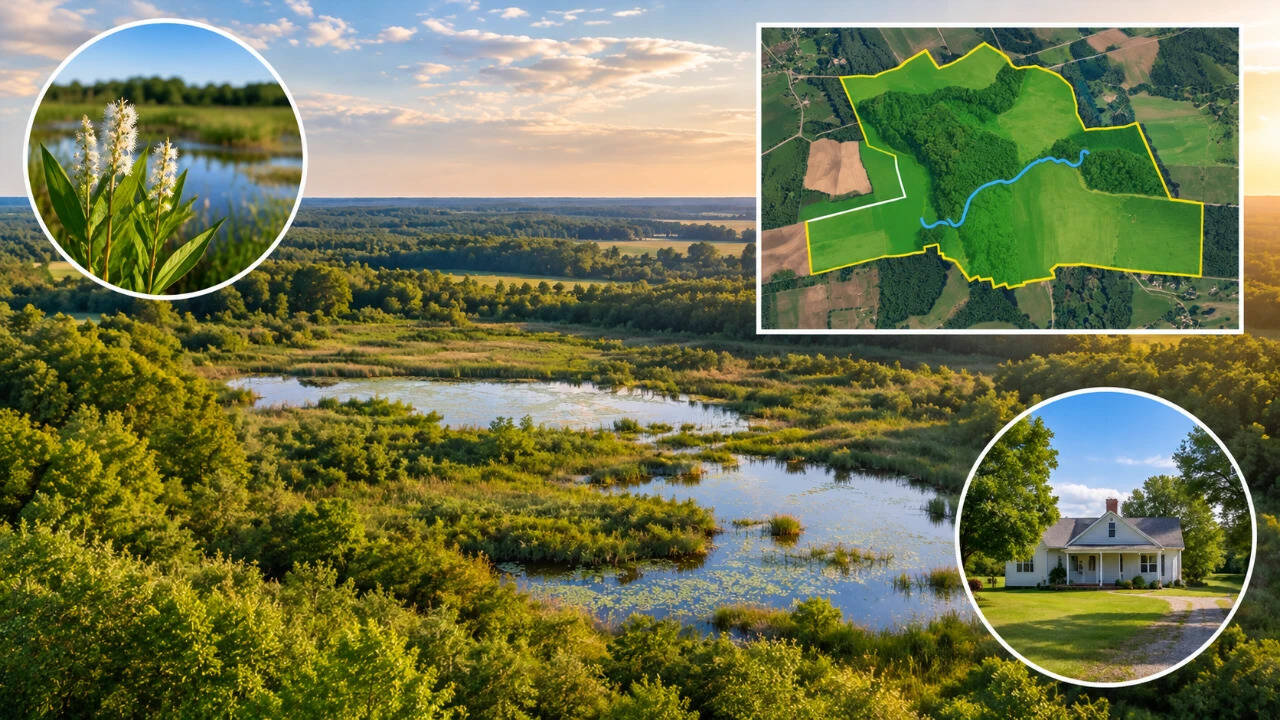
The state is moving to secure 118 acres of land surrounding this rare wetland, a strategic expansion designed to stitch together a fragmented sanctuary. If the plans hold, the protected zone will swell to 450 acres. That total includes a single family’s house and three surrounding acres—a tiny enclave wrapped entirely by public stewardship.
Quiet changes are rarely simple.
Imagine standing on that porch. Generations of footsteps have worn down the wooden floorboards. The kitchen window looks out over water-logged soils where wood ducks paddle through duckweed in the fading light. This family didn't buy a piece of real estate; they inherited a living map. Every autumn brings the high-pitched calls of migrating waterfowl, and every spring brings the heavy, fertile smell of mud thawing under a gray sky.
Now, the map is being redrawn.
State conservation efforts often look clinical on paper—bullet points, acreage goals, funding allocations. Yet every square foot marked for preservation carries a human story. To expand a wetland is to crowd the edges of private lives. It forces a collision between public ecological necessity and private domestic history.
Wetlands are nature’s kidneys. They trap phosphorus, nitrogen, and sediment, keeping municipal water clean before it ever reaches a treatment plant. When a state targets 118 new acres, it is not just buying dirt. It is buying safety. Every acre of restored marshland absorbs millions of gallons of stormwater, acting as a natural speed bump against the sudden, violent flooding that plagues modern Midwestern towns.
Consider what happens when rain hits asphalt instead of earth. It races. It tears through ditches, swells creeks, and tears at riverbanks. But when rain hits a wetland, it slows down. It sinks. It lingers.
The expansion of this preserve is an acknowledgment that we are running out of sponges.
Yet, as the state closes in on the remaining parcels, the human element remains front and center. A house stands within the footprint of the planned expansion. Three acres of private lawn, flower beds, and rooflines encircled by a rising tide of state-owned conservation. It is an unusual geometry. Most buyouts involve clearing the land, tearing down foundations, and letting nature wipe the slate clean. Here, a unique arrangement or a lingering negotiation sits at the heart of the project, highlighting the friction between human habitation and ecological restoration.
What does it feel like to watch your backyard turn into a wildlife refuge?
It means trading the hum of lawnmowers for the chorus of spring peepers. It means accepting that your property line is no longer just a fence, but a membrane dividing human civilization from a restored wilderness. It is an uneasy coexistence, but it is also a profound partnership.
We often talk about conservation as if it happens somewhere else, in distant national parks or untamed mountain ranges. We forget that the most critical battles for the environment are happening in our backyards, right on the fringes of suburbs and agricultural fields. They happen quietly, one parcel at a time, through state grants, reluctant compromises, and the slow, grinding machinery of public land acquisition.
The 450-acre preserve will soon stand as a monument to what can be saved when people decide that water is more valuable than development. But the true measure of the project won't just be found in the numbers on a surveyor's map or the census of nesting herons.
It will be found in the stillness of the morning, when the fog rises off the marsh, wrapping around an old chimney, blurring the line between what we built and what was always here.



