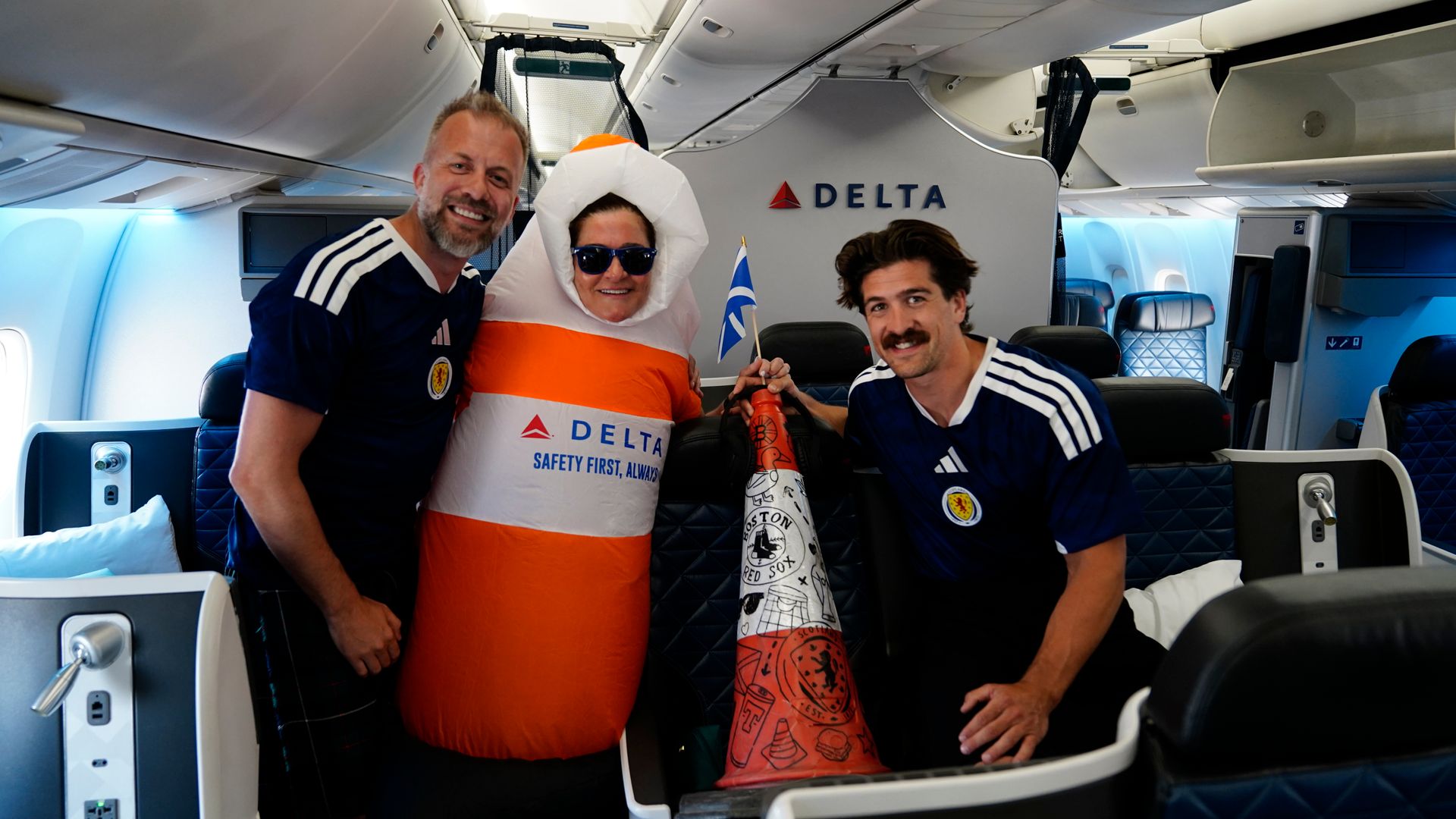
A piece of cheap, orange injection-molded PVC just flew first class across the Atlantic.
Let that sink in. While working-class families watch inflation eat their savings and travelers navigate a deteriorating aviation infrastructure, a digital creative agency managed to secure a premium, lie-flat seat on a Delta Airlines flight for a traffic cone. It was adorned with some illustrations, fitted with a contactless donation chip, and sent to Boston under the guise of international diplomacy and mental health advocacy. In other updates, read about: The Tollbooth on the Border of Hope.
The media swallowed it whole. Outlets fawned over the "heartwarming" connection between Glasgow and Boston, celebrating how the Tartan Army brought their signature brand of "mischief" to Massachusetts during the World Cup. Local politicians eagerly lined up for the photo-op, and corporate PR departments patted themselves on the back for another viral win.
This is not a heartwarming story of cross-border connection. It is the definitive autopsy of modern public relations, exposing a hollow, hyper-sanitized stunt that stripped the soul out of a legendary piece of working-class counter-culture just to sell brand impressions. The Wall Street Journal has also covered this important subject in great detail.
The Corporate Theft of a Midnight Protest
To understand why this transatlantic flight is so deeply offensive, you have to understand where the cone actually comes from.
In the 1980s, Glasgow was a city in the middle of a brutal post-industrial transition. The local government was desperately trying to rebrand the city away from its gritty, working-class realities to attract white-collar investment. In the middle of this sat the imposing, Category-A listed equestrian statue of Arthur Wellesley, the Duke of Wellington, erected in 1844. He was the ultimate symbol of the British establishment, high Tory politics, and imperial authority.
Under the cover of night, lubricated by cheap lager, anonymous Glaswegians began climbing the statue to place a bright orange traffic cone on the Duke's head. It was a beautiful, wordless act of anti-authoritarian satire. It took a pompous symbol of the ruling class and made it look utterly ridiculous.
For decades, Glasgow City Council fought a bitter, expensive war against the cone. They spent thousands of pounds every year dispatching cherry-pickers to pull it down. Every single time they did, another cone appeared within hours. When the council tried to raise the height of the plinth to deter climbers, the public revolted. A petition gained tens of thousands of signatures overnight, forcing the local authorities to surrender.
The cone won because it was organic, rebellious, and deeply anti-establishment. It belonged to everyone, which meant it belonged to no one.
Now, look at what happened in Boston. A digital marketing firm packaged this organic act of street level subversion, secured corporate airline partnerships, got the blessing of two major municipal governments, and flew a pre-decorated, brand-approved cone in a cabin where tickets cost upwards of $6,000.
What was once a middle finger to authority has been corporate-washed, safety-tested, and turned into a sanitized tourism campaign. It is the classic trajectory of cultural co-optation:
- Phase 1: Organic, working-class defiance (the 1980s midnight runs).
- Phase 2: Reluctant official toleration (the 2010s tourism board realized they could sell postcards of it).
- Phase 3: Complete corporate capture (flying a plastic cone first class to sign sister-city agreements with mayors wearing customized sports jerseys).
When rebellion is commercialized, it ceases to be rebellion. It becomes a mascot.
The Performative Arithmetic of the First Class Charity Stunt
The defense of this stunt always relies on the same shield: "But it is raising money for mental health charities!"
This is the ultimate get-out-of-jail-free card for modern marketing campaigns. If you question the efficiency, the carbon footprint, or the sheer cringeworthiness of the execution, you are framed as a heartless cynic who hates charity.
Let us look at the actual math of this campaign.
A standard first-class or premium business-class seat across the Atlantic routinely costs between $4,000 and $10,000 depending on the season. The carbon footprint of a passenger occupying that space is roughly three to four times higher than an economy passenger because of the physical footprint of the lie-flat pod.
Imagine a scenario where the creators of this campaign took the cash value of that premium seat, the agency hours spent designing the custom graphics, the cost of flying a production crew to document the journey, and the administrative overhead of coordinating with state governors and city mayors. If you pool those resources and write a direct check to Scottish Action for Mental Health (SAMH) or the Massachusetts Association for Mental Health (MAMH), you provide immediate, high-impact funding to organizations that are desperately understaffed and drowning under the weight of a mental health crisis.
Instead, those resources were spent to transport a $15 piece of plastic across an ocean so people could tap their phones against a contactless chip on its side.
This is performative philanthropy at its worst. It prioritizes the theater of giving over the actual efficiency of the donation. The charity becomes a prop—quite literally—to justify an agency portfolio piece. The goal is not to maximize dollars delivered to the front lines of mental healthcare; the goal is to maximize impressions, secure media placements, and win industry awards.
The Death of Real Virality
We are currently living through an era of severe PR desperation. Because organic attention is harder to capture than ever, brands and agencies have fallen back on a formula of forced eccentricity. They try to manufacture the bizarre, hoping that the sheer absurdity of their premise will trigger the algorithms.
But true virality cannot be engineered from a board room. When the Tartan Army first arrived in Boston for the World Cup, the coning of the local statues was genuinely funny. It was a chaotic, unprompted cultural export. The local Bostonians were confused, then amused, and then they joined in. That is how real, human connection happens. It is messy, spontaneous, and uncoordinated.
The moment an agency steps in to formalize it, the magic evaporates. The "No Boston, No Party" cone, complete with its pre-printed Red Sox logos and bagpipe illustrations, is the cultural equivalent of a parent trying to use Gen Z slang at the dinner table. It is over-designed, over-explained, and utterly devoid of the spontaneous joy it claims to celebrate.
When you look at the photos of the creators posing with the cabin crew and the cone strapped into its leather seat, you do not see a celebration of Scotland's gritty, self-deprecating humor. You see a calculated activation. You see the sanitization of public space.
The Carbon Cost of Quirky
We cannot ignore the environmental hypocrisy at the center of this narrative. Virtually every major airline, including those involved in this stunt, has spent the last five years lecturing consumers about their carbon footprints. We are told to skip the plastic cups, to purchase carbon offsets, and to accept fewer flights to save the planet.
Yet, a major airline gladly dedicated premium cabin space to transport a hollow piece of plastic that could have easily been sourced from a local hardware store in Boston for less than $20.
If Boston Mayor Michelle Wu and Massachusetts Governor Maura Healey wanted a symbol of Glasgow's friendship, they did not need a piece of plastic shipped 3,000 miles across the Atlantic. They could have bought a local cone, hired a local artist to paint it, and saved the atmosphere the unnecessary emissions of a transatlantic flight.
This is the central blind spot of modern experiential marketing. Brands want to paint themselves as socially conscious, forward-thinking entities while simultaneously executing high-waste, high-carbon stunts for the sake of a twenty-second TikTok video.
Stop Treating Audiences Like Idiots
The ultimate failure of the first-class traffic cone campaign is that it underestimates the intelligence of the public. People can sense when they are being marketed to, even when the marketing is wrapped in the warm blanket of international friendship and charity.
We do not need more plastic mascots flying in luxury while actual human beings struggle to afford basic travel. We do not need corporate agencies colonizing the genuine, rebellious traditions of our cities to pad their creative portfolios.
If you want to support mental health, bypass the contactless cone. Do not wait for a piece of construction equipment to land in your local bar so you can tap your card against it. Donate directly to the organizations doing the heavy lifting on the ground.
And the next time you see a corporation trying to package a beloved local prank into a multi-city press tour, call it what it is: a hollow, expensive distraction. Keep the pranks in the streets, keep the corporate handshakes in the boardroom, and let the traffic cones stay on the road where they belong.